
Key Takeaways
- AI tools can be evaluated by where they sit in a firm's advice workflow, and how they connect to adjacent functions, rather than by feature checklists alone.
- One common reason AI tools underperform expectations is an integration gap; tools that require manual data re-entry between systems often get shelved.
- Key evaluation factors include accuracy, integration with existing CRM and custodial platforms, data security, privacy, human oversight, auditability, and how well a tool fits into existing workflows.
- Enterprise firms and independent RIAs often emphasize different priorities and resource considerations. Enterprise firms may focus more heavily on centralized governance and visibility, while independent RIAs may prioritize speed, configurability, and ease of administration, while still maintaining meaningful compliance and governance obligations.
- Mapping a firm's current workflow before adopting an AI tool can help identify where AI-assisted extraction, software automation, and governed client-ready output may have the most practical impact.
The volume of AI tools for financial advisors has grown substantially, with platforms promising to streamline everything from meeting notes to portfolio analysis. Yet, most evaluation content organizes these tools by vendor name or generic category, offering little insight into how they fit into an advisory firm's actual operations. This approach often leads firms to adopt technology that looks impressive in a demo but creates new friction in practice.
The critical question is not which AI tool has the longest feature list, but which tools address the specific workflow stages where advisors spend the most preparation time. More importantly, do these tools connect to each other, or do they create new data silos that require manual workarounds?
This article provides a different way to assess the landscape of AI tools for financial advisors . We will map the major AI tool categories to the core advice workflow from data intake and portfolio analytics to proposal creation and governance. We will also examine the practical integration and adoption factors that determine whether a tool compounds advisor capacity or just adds complexity to a firm's tech stack .
Why Workflow Position Matters More Than Feature Checklists
Most AI tool evaluations compare features side by side, but a tool's value is determined by where it sits in an advisor's workflow and how it handles the handoffs to upstream and downstream systems. Features only matter relative to their operational context. A tool that performs a single task exceptionally well but requires manual data export and re-entry to connect to the next step can disrupt an advisor's productivity more than it helps.
Consider an illustrative example of a mid-size RIA evaluating three AI tools: one for meeting-note summarization, one for portfolio risk scoring, and one for client-facing report generation. Each performs well in isolation. Within six months, however, only the meeting-note tool might see regular use, because it is the only one that connects directly to the firm's CRM and requires no manual data handling. The other two, despite their sophisticated features, require advisors to export data from one system, reformat it, and upload it into the AI tool before any analysis can begin. The feature set was never the problem; the workflow fit was.
This pattern is common across advisory firms. The real measure of an AI tool's effectiveness is whether it reduces the number of manual handoffs between the stages of preparing advice. A tool that uses AI to extract portfolio data from statements and then feeds that data directly into analytics and proposal workflows can multiply time savings across multiple steps. In contrast, a series of disconnected point solutions for note-taking, data extraction, analytics, and reporting can leave advisors spending their time managing data between applications rather than engaging with clients.
Read more: Automation in Wealth Management: Why Half-Automated Workflows Can Create More Risk Than Manual Ones
Where AI Tools Sit Across the Advice Workflow
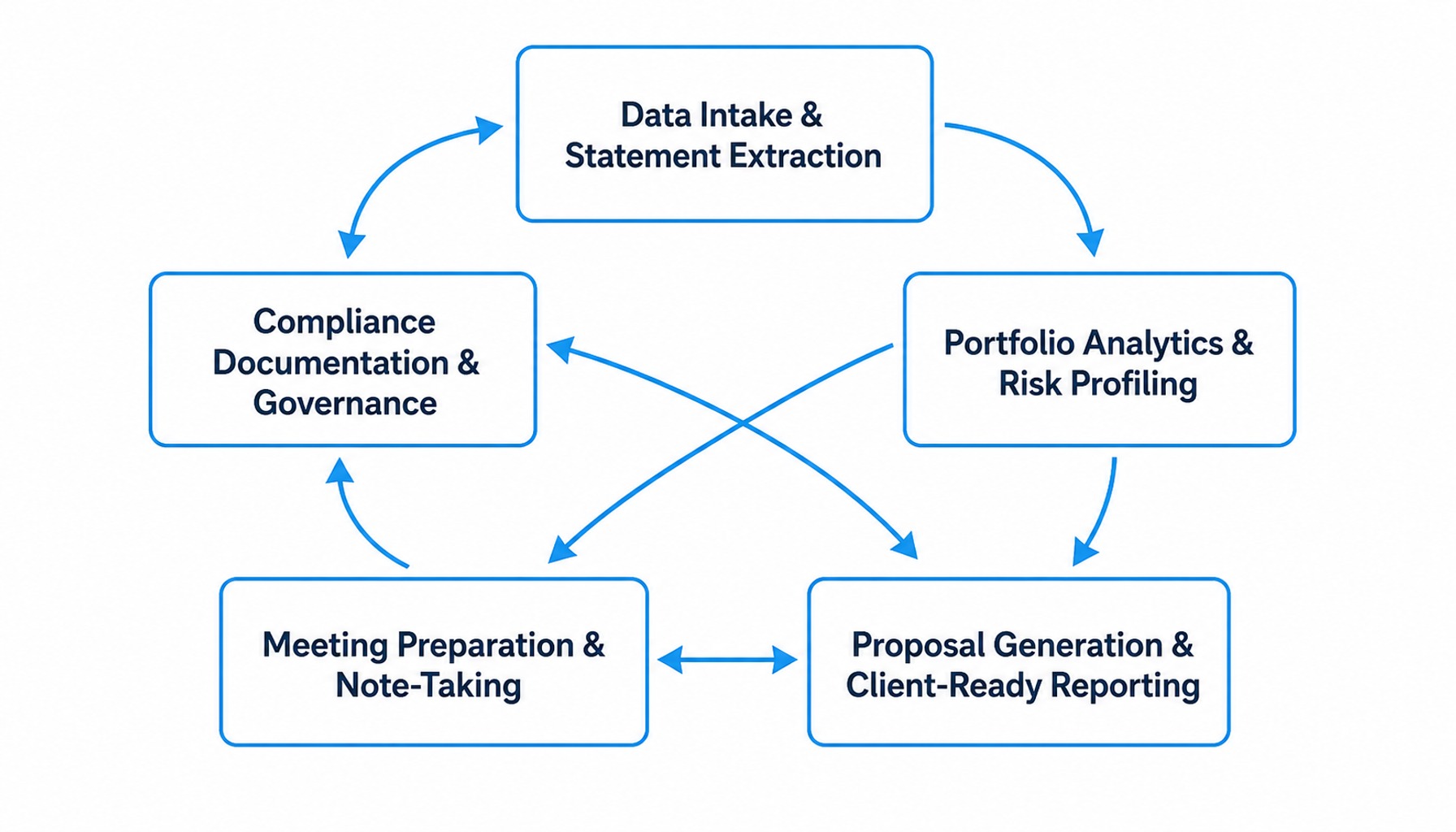
The advice workflow from the moment a prospect's data enters the firm to the moment a recommendation is communicated involves several connected functions, not just a rigid linear sequence. Data intake, analytics, proposal creation, meeting preparation, and governance often inform one another throughout the process. Compliance and governance considerations can apply across the workflow, and meeting preparation can happen before, during, and after analytical work depending on the engagement.
Data Intake and Statement Extraction
The workflow begins with data. This function involves converting prospect or client investment statements from PDFs, paper documents, or custodial feeds into structured, analyzable portfolio information. AI-assisted Optical Character Recognition (OCR) and document ingestion tools aim to reduce the manual data entry that historically consumed hours of preparation time, particularly when dealing with complex or held-away assets .
Platforms in this category, such as VRGL's statement extraction capability or other dedicated extraction solutions, use AI to identify and capture holdings and standard statement information. The key evaluation question is not just about extraction accuracy, but what happens next: does the tool normalize data across different custodial formats and connect directly to downstream analytics, or does it simply output a spreadsheet that still requires manual formatting and upload into another system?
Portfolio Analytics and Risk Profiling
Once data is structured, analysis becomes possible. This function involves evaluating a portfolio's characteristics across dimensions like risk, diversification, fees, taxes, and performance relative to a proposed model. Not every capability in this category is necessarily AI-based. In many cases, the AI component may sit upstream in data capture, while the analytics themselves are produced through established software, calculation engines, and portfolio comparison workflows.
Tools in this category include VRGL, which provides five-pillar analytics across performance, risk, diversification, taxes, and fees, as well as risk-tolerance platforms, data aggregation systems, and broader reporting solutions. While these tools can accelerate analysis, the advisor retains full responsibility for interpreting the results and forming a recommendation. The critical evaluation question here is whether the analytics tool produces outputs that can be used directly in client-facing materials, or if it requires a separate, manual step to translate raw analysis into clear communication.
Proposal Generation and Client-Ready Reporting
The gap between analysis and client communication is where many firms lose significant time and introduce inconsistency. This function involves transforming analytical outputs into branded proposals, reports, and presentations. Manually rebuilding charts and tables in PowerPoint or Word is not only inefficient but also prone to error.
Proposal management tools address this gap by connecting analytics to governed, client-ready templates. These capabilities are not inherently AI-driven in every platform. In VRGL's case, AI is used in statement extraction, which then feeds broader portfolio analytics and proposal generation capabilities. The distinction between an AI tool that assists with data capture and software that supports governed client-ready output is operationally significant. The key evaluation question becomes: can the proposal workflow support firm-level branding, disclosures, and presentation standards while still allowing for advisor-level customization?
Meeting Preparation and Note-Taking
AI-assisted meeting preparation and note-taking tools address a real time burden for advisors, but they do not always sit at the end of the workflow. Depending on the use case, meeting prep can happen before portfolio analysis, alongside proposal review, or after a client conversation as part of follow-up and documentation. Using natural language processing (NLP), AI-assisted meeting tools can transcribe meetings, summarize conversations, and extract action items. This information can then be integrated into the firm's CRM to maintain a clear record of client interactions.
The primary value of these tools depends on their integration. The key evaluation question is whether the tool connects with the firm's CRM and downstream task-management workflow, or if it produces standalone documents that require manual copying and pasting. Firms may also want to evaluate accuracy, data privacy, security, human review, and auditability before using AI transcription with client conversations.
Compliance Documentation and Governance
Some tools support firmwide governance functions rather than a single advisor task, and these considerations can apply throughout the workflow rather than at only one endpoint. These platforms can help support documentation consistency, audit trails, and workflow standardization. A more relevant example is centrally configured templates that include approved branding, disclosures, and presentation structure, helping firms support consistency and documentation across teams.
Platforms like VRGL support governance through configurable templates, approved disclosures, and centrally managed presentation content. While software can contribute to a more structured and auditable process, the firm's compliance obligations remain its own responsibility. The essential evaluation question for tools in this category is: does the platform support the firm's own governance framework, or does it impose a rigid model that may not align with the firm's specific interpretations, review processes, and operational needs?
What Separates Tools That Get Used From Tools That Get Shelved
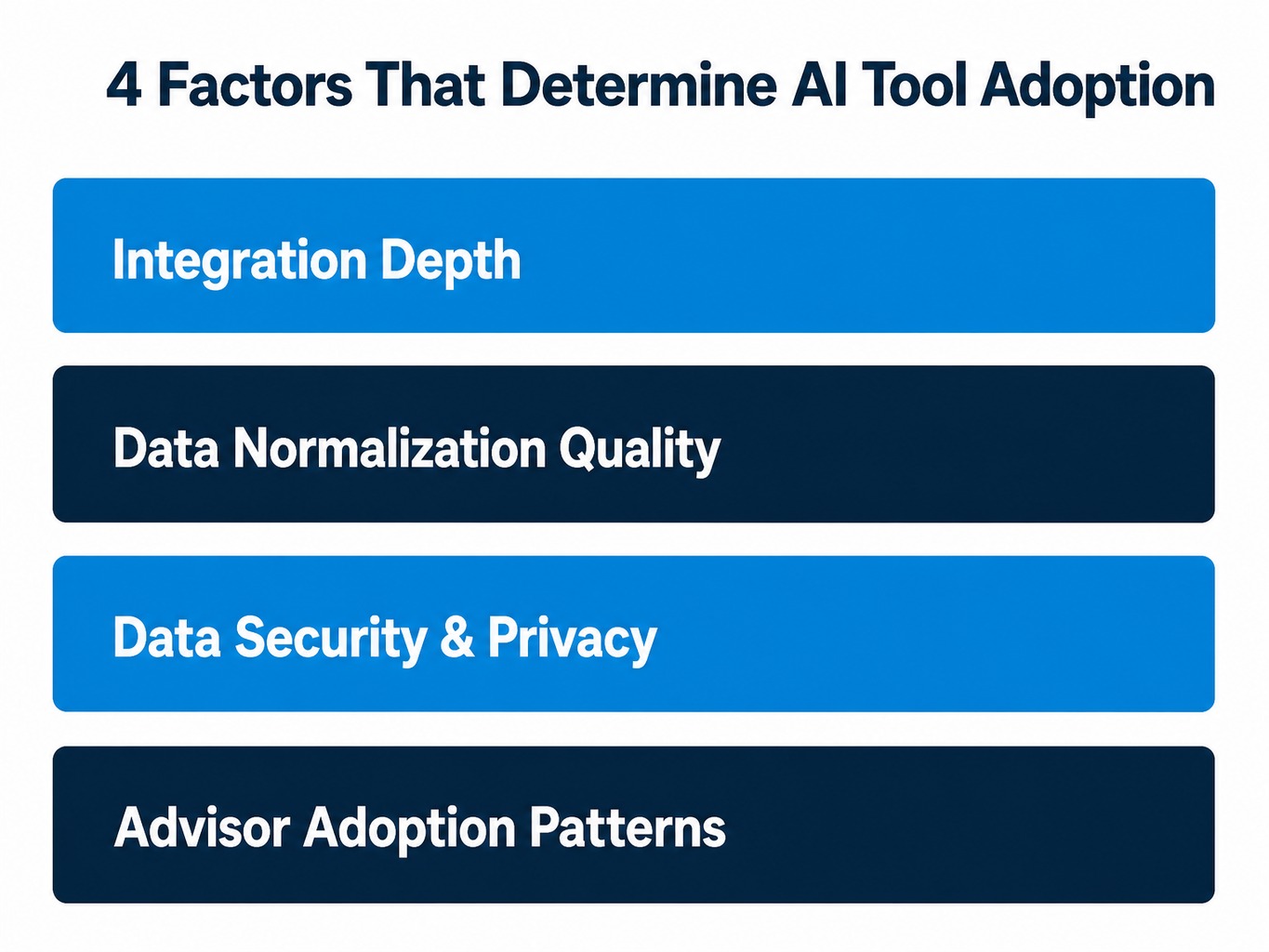
A common reason AI tools underperform expectations is not a feature gap but an adoption and integration gap. A tool can work perfectly in a demonstration but fail in practice if it does not fit into the firm's existing technology stack, data flows, and advisor habits. Several factors often determine whether a tool builds capacity or gets abandoned.
First is integration depth . Does the tool connect to the firm's core systems, including custodial platforms, CRM, and portfolio management software (e.g., Black Diamond Wealth Platform, Orion)? A standalone application that requires advisors to manage separate logins and manually move data between systems creates friction that can easily outweigh its benefits.
Second is data normalization quality and accuracy . AI tools that ingest financial data are only as useful as their ability to normalize holdings, account types, and other relevant information across different custodians. Inconsistencies at the data layer, for instance, misinterpreting a security type or misclassifying statement data, can propagate through downstream analytical output, eroding trust in the tool and forcing advisors to spend time on manual validation.
Third are data security, privacy, human oversight, and auditability . In regulated financial services, firms may need to evaluate how a tool handles client information, what controls exist around access and retention, whether outputs can be reviewed by a human before use, and whether the process leaves sufficient documentation to support internal governance.
Fourth are advisor adoption patterns and workflow fit . AI adoption challenges are frequently tied to workflow or data-format mismatches rather than advisor resistance alone. Tools that require advisors to fundamentally change their preparation habits often face more resistance than those that fit into existing meeting-prep or proposal workflows. A tool that requires an advisor to log into a separate platform, upload documents manually, and then copy outputs into another system adds friction points, even if the analysis itself is strong.
| Evaluation Area | What to Assess | Practical Questions |
|---|---|---|
| Workflow Fit | Where the tool sits in the firm's workflow and what happens before and after it | Does it reduce handoffs, or create another manual step? |
| Integration Depth | Connections to CRM, custodial platforms, portfolio systems, and reporting workflows | Will advisors need separate logins, exports, or manual uploads? |
| Accuracy and Data Quality | Reliability of extracted or processed information | How often will staff need to validate holdings, classifications, or calculations? |
| Security and Privacy | How the tool stores, processes, and protects client information | Does the firm have appropriate visibility into access, retention, and data handling? |
| Human Oversight | Ability for advisors or operations teams to review outputs before use | Does the workflow keep advisor judgment at the center? |
| Auditability | Documentation of outputs, edits, templates, and usage | Can the firm support internal review and documentation expectations? |
| Governance | Use of approved templates, disclosures, and standardized presentation elements | Can the firm support consistency without making the workflow overly rigid? |
How Enterprise Firms and Independent RIAs Evaluate AI Tools Differently
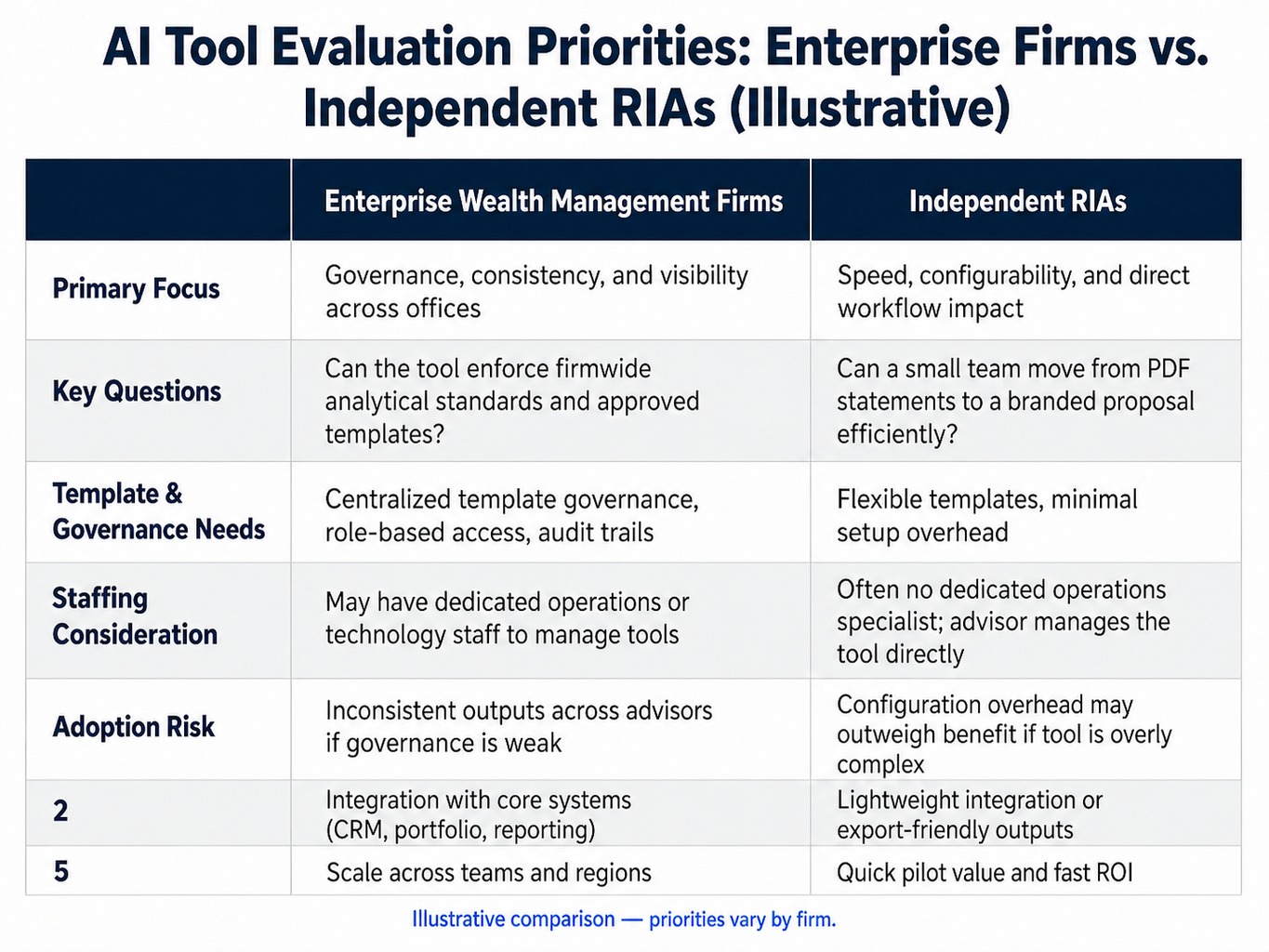
The evaluation criteria for AI tools differ meaningfully depending on firm structure. Most vendor roundups treat all advisory firms as interchangeable buyers, but the priorities and resource constraints of a large enterprise are often different from those of an independent RIA.
For enterprise wealth management firms with multiple advisors, teams, and offices, evaluation priorities often center on governance, consistency, visibility, and administrative control at scale. The key questions are strategic: can the tool support firmwide analytical standards? Can it deploy approved presentation templates and disclosure language across the organization? Can leadership gain visibility into preparation activity happening in different offices? For these firms, an AI analytics tool may be evaluated on its ability to produce consistent outputs across a broad advisor base with different investment approaches. Centralized template governance, role-based access controls, and detailed audit trails are often important considerations.
For independent RIAs , the primary priorities often focus on speed, configurability, and direct workflow impact relative to available staff and operational resources. The questions are more immediate: does the tool reduce preparation time for a small team without requiring dedicated technology or operations support to manage it? Can a single advisor move from a prospect's PDF statements to a branded proposal efficiently? Even so, independent firms still have meaningful compliance, documentation, and governance obligations. The difference is often less about whether those obligations exist and more about how much administrative infrastructure the firm has to manage them.
How VRGL Connects Multiple Workflow Stages Into a Configurable System of Work
Much of the friction in preparing for client and prospect meetings comes from the manual handoffs between disconnected systems. Data extracted in one tool is analyzed in another and formatted for presentation in a third. VRGL is a growth platform for wealth management firms designed to address this fragmentation. Within the platform, VRGL Core connects multiple workflow stages into a single, configurable system of work.
VRGL helps firms standardize how advice is prepared and presented by integrating:
-
Automated Statement Extraction: VRGL uses AI in its data intake capabilities to convert investment information from PDF statements and other sources into structured portfolio data. That data then feeds directly into the platform's broader analytical and proposal workflows, reducing manual re-entry and helping advisors move more efficiently into review and comparison.
-
Portfolio Analytics: The platform analyzes any portfolio across five core pillars: performance, risk, diversification, taxes, and fees. This provides advisors with an objective basis for comparing a current portfolio against a proposed model and communicating their value with clarity.
-
Proposal Generation and Governed Client-Ready Outputs: VRGL connects analysis to communication through proposal generation, branded reports, and configurable templates. Firms can use centrally configured templates that include approved branding, disclosures, and presentation standards, supporting consistency and documentation while preserving advisor flexibility.
By connecting statement extraction, objective portfolio analytics, and proposal management , VRGL can help firms reduce the workflow gaps that consume advisor capacity.
Conclusion
The landscape of AI tools for financial advisors is expanding, but the firms that extract the most value are not necessarily those that adopt the most tools. They are the ones that evaluate technology through the lens of their own operational workflow.
The central question should shift from "What features does this tool have?" to "Where does this tool sit in our advice-preparation process, and how does it connect to the steps before and after it?" By evaluating tools based on their workflow position, integration depth, data quality, and fit with the firm's unique structure, leaders can better identify which platforms will genuinely expand advisor capacity and which will only add complexity. As AI capabilities in wealth management continue to mature, the firms with the clearest view of their own workflows will be best positioned to make technology a sustainable advantage.
Frequently Asked Questions
How do AI tools for financial advisors differ from traditional portfolio management software?
Traditional portfolio management software typically focuses on trade execution, rebalancing, and performance reporting for existing client portfolios. AI tools often extend into adjacent workflow stages such as statement extraction from unstructured documents, meeting transcription, or summarization. Portfolio analytics, proposal generation, and governed templates are not inherently AI capabilities in every platform. In many cases, those functions are handled through traditional software automation, calculation engines, and reporting workflows, while AI is used more selectively in areas like document ingestion or language processing.
How can AI tools support portfolio analytics without providing recommendations?
AI can assist with data preparation tasks such as extracting and organizing information from statements or other documents, while traditional analytical engines perform the portfolio calculations themselves. Those tools can then present portfolio characteristics such as risk exposure, fee structure, diversification patterns, and performance attribution in structured formats. The tool surfaces objective data and patterns, and the advisor interprets those findings, applies professional judgment, and determines what, if anything, to recommend. This distinction is important for compliance: the tool supports the analytical workflow, but the advisor retains full fiduciary responsibility for the advice.
What role does natural language processing play in AI tools for financial advisors?
Natural language processing (NLP) enables several capabilities relevant to advisory workflows. These include extracting structured data from unstructured documents like client statements, transcribing and summarizing meeting conversations, and generating narrative text for proposals or reports. The practical value depends on both accuracy and integration; an NLP tool that accurately transcribes a meeting but does not connect to the firm's CRM or follow-up workflow creates an output that still requires manual handling.
How do AI note-taking tools for financial advisors handle data privacy?
Data privacy handling varies significantly across AI note-taking platforms. Key considerations for a firm include whether meeting audio or transcripts are used to train the vendor's models, where data is stored and processed, whether the tool meets the firm's data security and regulatory requirements, and whether the firm can control data retention policies. Firms may want to evaluate these factors with their compliance and technology teams before deploying any AI tool that processes client conversations.
Can a small RIA benefit from AI tools designed for larger firms?
Some AI tools designed for enterprise firms include governance, multi-advisor workflow management, and centralized template controls that a small RIA may not need, and the configuration overhead may outweigh the benefit. However, platforms that are configurable rather than rigid can often scale down as well as up. A small RIA evaluating an enterprise-capable tool should assess whether it can be deployed for a single advisor or small team without requiring dedicated operations support to manage it.
What can advisors consider before using general-purpose AI chatbots for client work?
General-purpose AI chatbots can assist with research and brainstorming, but they are not designed for regulated advisory workflows. Key considerations include the risk of inaccurate outputs (hallucinations), the absence of compliance controls or audit trails, data privacy risks when entering client information, and the lack of integration with custodial or portfolio management systems. Firms may find that purpose-built tools designed for advisory workflows offer more reliable outputs and stronger governance than general-purpose alternatives.
This content is for informational purposes only and should not be considered investment, legal, or compliance advice. VRGL does not provide financial, investment, tax, or legal advice, nor does it assume fiduciary responsibility. Firms must consult with their own legal and compliance professionals to ensure their practices and use of technology are compliant with all applicable regulations.