
Key Insights
- Partial automation, where individual tasks are automated but the handoffs between them are manual, can create overlooked operational gaps and additional risk by creating a false sense of coverage.
- Operational and compliance-related risk often concentrates in the gaps between automated steps, such as manual data re-entry into proposals or inconsistent use of disclosures.
- Firms should evaluate automation platforms based on "workflow coverage" (how many consecutive steps a tool handles) rather than isolated feature lists.
- Advisor adoption is a primary bottleneck for automation ROI. If a tool doesn't reduce an advisor's total preparation time from data intake to client-ready output, it may be used inconsistently or abandoned.
- Commonly underautomated workflow layers include proposal and report assembly and the governance functions that help control templates, versions, and approvals.
Consider a hypothetical, illustrative example: An advisory team extracts a prospect's multi-custodian statements using an automated tool. The data is clean and structured in minutes. The investment team runs the holdings through a sophisticated analytics engine, generating powerful comparisons on fees, risk, and allocation. The technology works perfectly in isolation.
Then, the workflow breaks down. The analytics output is exported as a PDF and emailed to the advisor. The advisor manually copies numbers into a PowerPoint template, reformats the charts to match the firm's brand, and pulls the latest compliance disclosures from a shared drive. The automation saved hours on data entry and analysis, but the final, client-facing deliverable is still assembled by hand.
This illustrates a challenge firms can encounter as they automate individual parts of the workflow. Individual tasks may be faster, but the overall process is not always more reliable. The hidden cost of this partial automation is not just inefficiency, it is the false confidence that a workflow is governed when, in reality, it is held together by memory, email, and individual effort.
This article will define what effective automation means today, identify the five workflow layers where partial automation can create overlooked risk, and explain why advisor adoption is often as important as technology selection in determining whether an automation investment compounds value or just shifts manual work from one step to another.
What Automation in Wealth Management Actually Means in 2026
Automation in wealth management is the use of technology to execute, coordinate, and govern the recurring operational tasks that support advisory workflows from data extraction and portfolio analysis to proposal generation, compliance documentation, and client reporting. While much industry content frames automation as a technology category (RPA, AI, robo-advisors), a more useful lens for advisory firms is workflow coverage: how many consecutive steps in a process can execute without manual intervention or data re-entry.
For practitioners, it is helpful to distinguish between three layers of automation:
- Task Automation: A single, discrete step runs without human input. An example is using a tool to extract holdings from a PDF statement.
- Workflow Automation: Multiple, dependent steps execute in sequence with data flowing between them. This would involve extracting statement data and having it flow directly into an analytics engine without manual export or import.
- Governance Automation: The firm can add controls that support consistent execution, use approved data and templates, and create a traceable record of how output was produced.
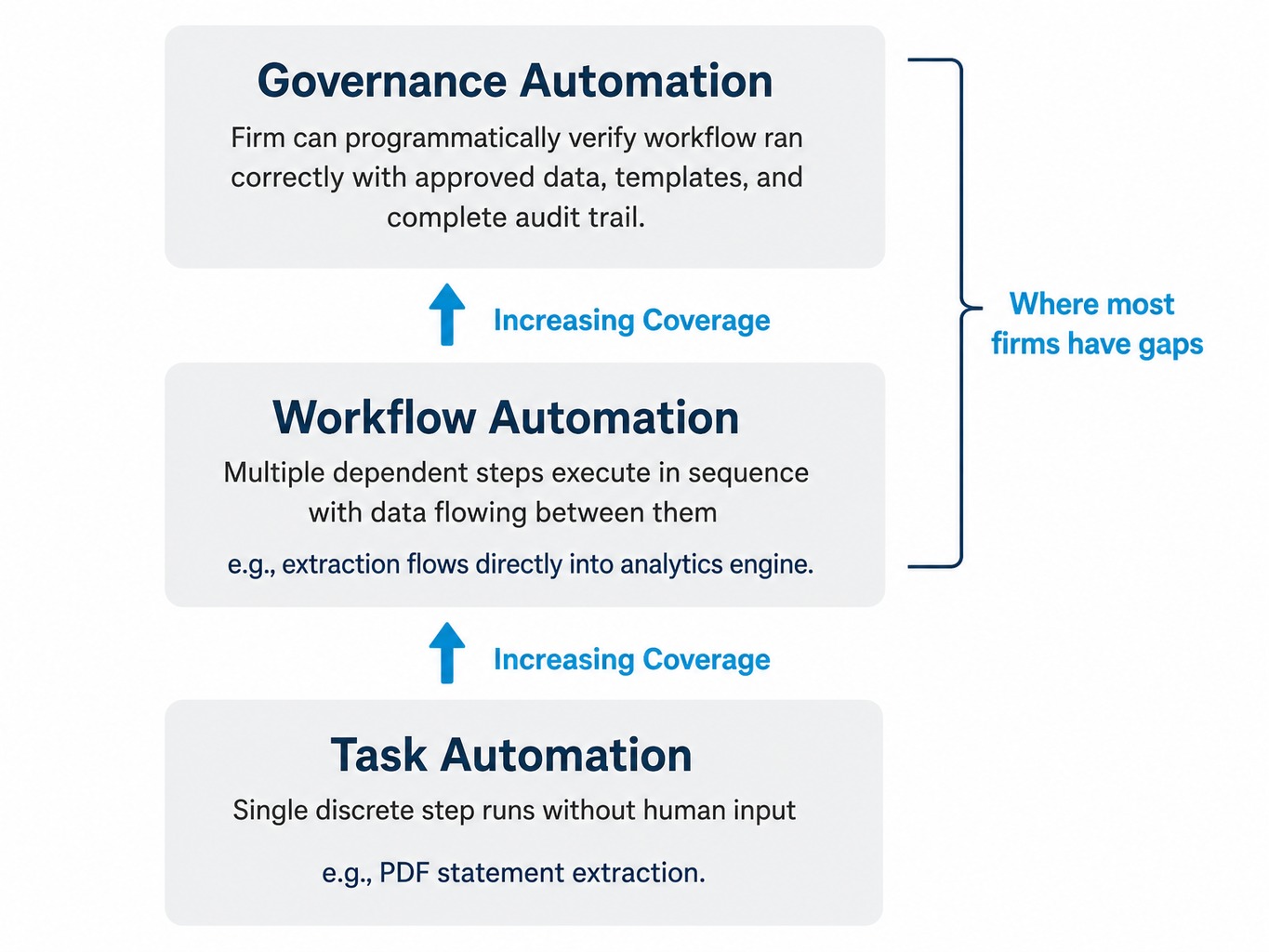
Many firms automate tasks but leave workflow and governance layers more manual.
Many wealth management firms have achieved the first layer. They may have a collection of tools from providers like Orion, Tamarac, Addepar, and Black Diamond that automate specific tasks well. However, the connective tissue between these tools is often the advisor's inbox, creating a fragmented process where the second and third layers, workflow and governance, may remain more manual. This gap is often where operational risk concentrates.
The Hidden Cost of Half-Automated Workflows
Firms that automate individual tasks but leave the handoffs between them manual may create overlooked operational gaps that are harder to spot and manage. A completely manual process, for all its inefficiency, often involves visible human attention at every step. A half-automated workflow can create an illusion of coverage, where the automated steps generate clean records while the manual gaps between them are less documented or less visible to operations teams.
The challenge is not that an automated step will fail, it is that a manual step between two automated steps may be skipped, handled inconsistently, or executed differently by various advisors. Imagine an investment team running analytics in one system, an advisor building a proposal in another, and a review happening via email. Each automated component may function correctly, but the integrity of the end-to-end process can still depend on informal handoffs.
Read more: Operational Visibility for Wealth Management Growth | VRGL
Where Operational Risk Concentrates
In a half-automated advisory workflow, operational risk often concentrates at three specific points:
- Data Re-entry: An advisor manually transcribes numbers from an analytics output into a proposal template, introducing the potential for error.
- Version Control Gaps: An advisor uses an outdated model portfolio or fee schedule because the proposal tool is not connected to the firm's central model library, and the update was communicated in a missed email.
- Output Inconsistency: Two advisors present the same analytics in different formats because the presentation layer is not standardized, creating a disjointed client experience and making firm-wide performance attribution more difficult.
Consider this scenario: Advisor A extracts a prospect's holdings, runs analytics, and builds a proposal using last quarter's model allocations. Advisor B, at the same firm and with a similar prospect, produces a materially different recommendation. The discrepancy may trace back to an ungoverned manual step between analysis and presentation, rather than a difference in professional judgment. The risk was not necessarily in the automated tools, but in the gap between them.
Where Compliance Exposure Grows
Compliance-related risk in a half-automated workflow can be harder to detect when documentation is uneven across the process. Automated steps often produce accessible records, while manual steps may not, leaving firms with a partial view of how a final deliverable was assembled.
For example, a firm may automate its risk tolerance questionnaire and portfolio analytics but still require advisors to manually attach the correct disclosures to each proposal. In that scenario, the firm may have strong documentation for some parts of the workflow but less consistency and traceability around the final assembly step if that step is handled manually and outside the main system of record.
The challenge is not what was automated, but what was assumed to be covered by the manual process that followed. Firms may want to evaluate whether their current workflow creates consistent documentation and traceability from data intake through the final client deliverable, not just for the automated segments.
5 Workflow Layers Where Automation Matters Most for Advisory Firms
Many discussions about automation organize use cases by department (compliance, operations, client service). A more practical approach for advisory firms is to look at the workflow sequence, as this is where gaps and manual handoffs actually occur.
- Data Extraction and Structuring: This is the process of converting statements, custodial feeds, and client documents into usable, structured data. It is one of the most commonly automated layers today, with platforms like VRGL's Statement Extraction designed to handle multi-custodian complexity.
- Analysis and Insight Generation: This involves running portfolio analytics, risk assessments, fee comparisons, and tax impact calculations. Tools from Addepar, Tamarac, and Orion have provided robust capabilities here for years.
- Proposal and Report Assembly: This is the critical step of turning analytical outputs into client-ready, branded, and compliant deliverables.
- Review, Approval, and Governance: This layer helps firms support consistency, verify materials against internal standards, and maintain clearer records around what goes to the client.
- Ongoing Engagement and Retention: This involves maintaining consistent, valuable communication between formal reviews, often through automated client newsletters or market updates.
While many firms have tooling for layers 1 and 2, significant operational friction and risk often reside in layers 3 and 4.
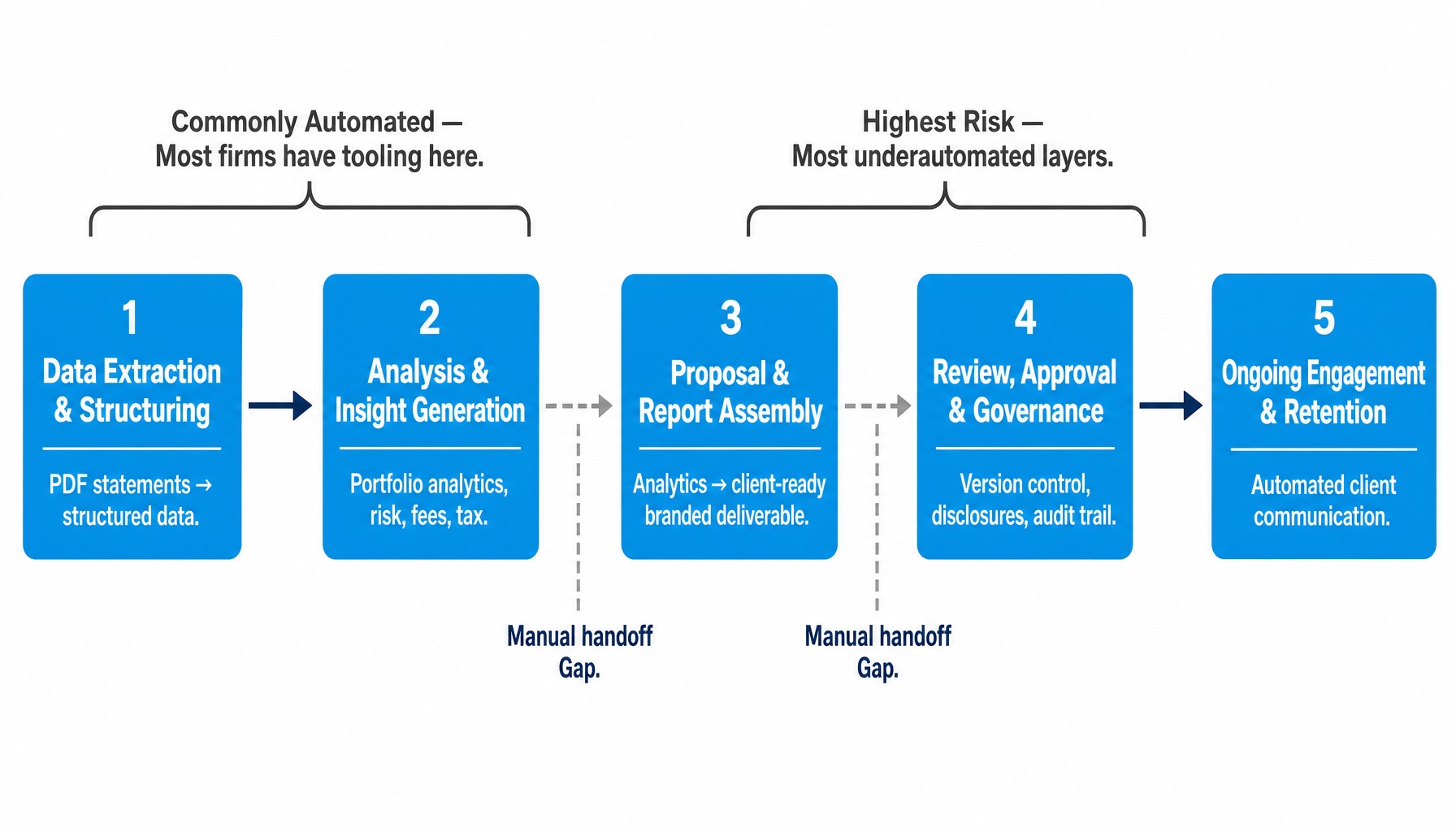
Automation in wealth management often breaks down at proposal assembly and governance
layers.
Proposal and Report Assembly: A Commonly Underautomated Step
Proposal and report assembly is a workflow step where many firms still rely on intensive manual effort. Advisors and their teams spend hours copying analytics outputs into slide decks, formatting tables, manually attaching disclosures, and adjusting branding. This is not only inefficient, it can also introduce avoidable inconsistency.
This step often has high client-facing visibility, meaning inconsistency here is more likely to be noticed by prospects and clients. The gap between what a powerful analytics engine produces and what the client actually sees is often wide. Automating upstream analysis without automating the final presentation layer means advisors may still spend significant preparation time on low-value formatting tasks rather than on high-value advising.
Read more: How to Create Winning Proposals: 3 Tips for Advisors | VRGL
Review, Approval, and Governance: An Often-Overlooked Layer
Governance automation encompassing version control, template controls, approval workflows, and audit trails is a layer many firms do not automate at all. It is also an important layer for enterprise firms with multiple advisors, teams, or offices seeking to deliver a more consistent client experience.
Without it, firms may have a harder time supporting consistency around current models, approved proposal templates, or fee schedules across teams. A firm with 40 advisors where each person builds proposals independently has 40 potential points of inconsistency. Governance automation is not about restricting an advisor's professional judgment, it is about helping the firm support its own governance processes and consistency standards without relying on manual oversight of every single client deliverable.
Why Advisor Adoption Is Often the Bigger Automation Bottleneck
One reason automation initiatives can fall short is inconsistent advisor adoption. In some cases, a new tool may automate one task but still add manual steps elsewhere in the advisor's workflow.
Consider a hypothetical example: a firm purchases an analytics platform that produces excellent portfolio comparisons. The advisor, however, must still export the output, reformat it for their preferred presentation style, manually add context and commentary, and then send it through a separate review process. The tool automated the analysis but added three manual steps to the advisor's day. Over time, the advisor may revert to their old, fully manual process because it feels faster and more direct.
Sustained advisor adoption is closely tied to three conditions:
- The tool must reduce the total preparation time, not just one step within the process.
- The output must be client-ready and on-brand without requiring significant additional formatting.
- The advisor must retain enough flexibility to apply their own judgment, commentary, and style.
When any of these conditions aren’t met, adoption often declines. This is why firms evaluating automation vendors should assess end-to-end workflow coverage, how many consecutive steps the tool handles, rather than getting lost in feature lists for individual capabilities.
How to Evaluate Automation Investments by Workflow Coverage, Not Feature Count
Most technology evaluation frameworks devolve into feature checklists: does the tool handle rebalancing, reporting, or compliance monitoring? This approach can miss an important ROI question: how many consecutive workflow steps does the platform handle without requiring the advisor or operations team to intervene manually? Workflow coverage is not the only factor that shapes ROI, but it is a useful way to evaluate how much manual work still sits between the tool's output and the final client deliverable.
A more effective evaluation can be performed using a simple four-question framework:
- From what input to what output does this tool operate? Map the exact starting point (e.g., a PDF statement) to the exact ending point (e.g., a client-ready proposal with disclosures). Be precise.
- How many manual steps exist between the tool's output and the final client-facing deliverable? Identify the remaining handoffs, such as exporting, reformatting, or attaching files, and evaluate whether they introduce friction, inconsistency, or additional review burden. A common failure mode is evaluating a tool on its analytics quality without testing how easily the output flows into a branded, client-ready proposal.
- Can the firm support consistency around the output without reviewing every deliverable individually? Look for capabilities like template controls, version management, permissions, and audit trails where relevant.
- Does the tool preserve advisor flexibility on judgment and presentation while standardizing the underlying data and workflow? An effective approach can provide a consistent chassis of data and governance while allowing advisors to customize the commentary and narrative.
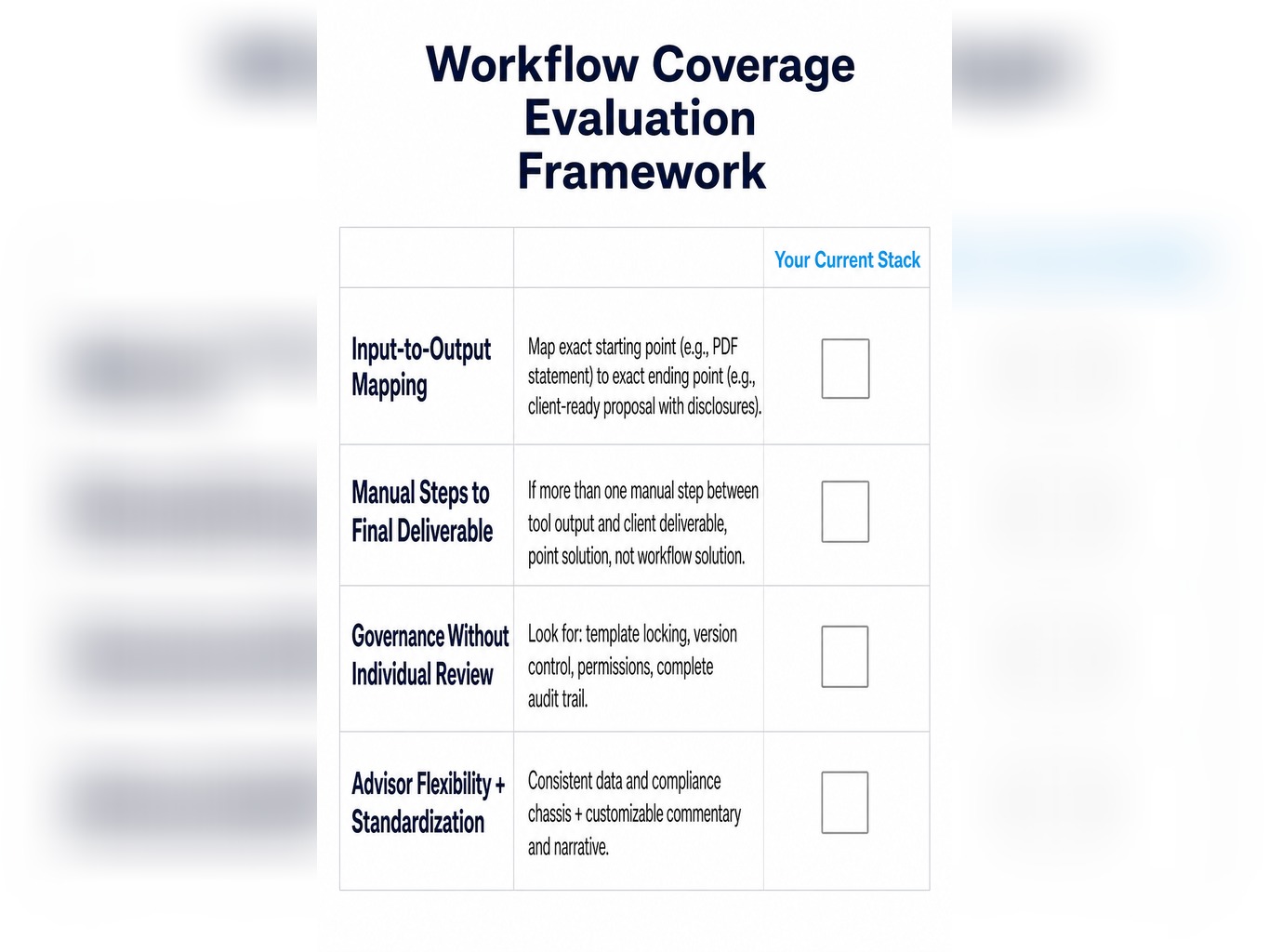
Evaluate automation investments by workflow coverage, not feature checklists.
How VRGL Approaches the Workflow Coverage Problem
The central argument of this article is that automation of isolated tasks, without connecting the workflow between them, can leave important operational gaps unresolved. One useful evaluation question is how many consecutive steps a platform supports from data intake to client-ready output. VRGL was designed as a system of work to address this challenge.
VRGL's architecture is built to reduce the manual middle layer between analytics and the client deliverable. The platform connects automated statement extraction, institutional-grade analytics, and the assembly of white-labeled proposals and reports into a more continuous workflow. This allows an advisor to move from a prospect's raw statements to a client-ready presentation with less need to export data or reformat charts manually.
For enterprise firms, VRGL offers capabilities such as controlled proposal workflows with locked templates, version control, governance and permission controls, and audit trails that can help firms support greater consistency in the proposal and report assembly layer. The platform is designed to standardize the data and design layers of a firm's advisory process while preserving the advisor's flexibility to apply their own judgment and commentary.
See how VRGL connects the workflow from statements to client-ready presentations
The Real Challenge Is Connecting the Dots
The real automation challenge in wealth management is not whether firms have automated enough individual tasks, many have. The challenge is whether the workflow between those tasks is governed, consistent, and reliable enough for the firm to scale without multiplying manual oversight and operational risk.
Firms that continue to evaluate automation based on feature checklists may continue to accumulate a stack of disconnected point solutions, compounding the manual workarounds needed to bridge them. In contrast, firms that shift their focus to workflow coverage can build a more resilient operational engine, which can help free up advisor capacity and support more consistent execution. The ROI of automation is strongly shaped by what happens between the automated steps, not just within them.
Frequently Asked Questions
What is the difference between a TAMP and in-house automation for portfolio management?
A TAMP (turnkey asset management platform) outsources investment management, model construction, and trading to a third party. In-house automation keeps those decisions with the firm but uses technology to execute them more efficiently. The choice depends on whether a firm views investment management as a core differentiator or an operational function it prefers to delegate.
How can smaller advisory firms afford wealth management automation without enterprise budgets?
Smaller firms can prioritize automation at the highest-friction points in their workflow typically statement extraction and proposal assembly rather than attempting to automate every process at once. Modular platforms that allow firms to start with core capabilities and add functionality as they grow can help manage costs while still reducing manual preparation time where it matters most.
What data security considerations should firms evaluate when adopting automation platforms?
Firms should assess how a platform handles data at rest and in transit, whether client data is used to train AI models, where data is stored, and what access controls and audit logging are available. Vendor SOC 2 compliance, encryption standards, and data retention policies are common evaluation criteria, but firms should always conduct their own due diligence.
How should firms measure the ROI of automation beyond time savings?
Time savings is visible but can be misleading. Firms may also want to consider output consistency, error rates in client materials, completeness of documentation, and advisor adoption rates alongside time saved. In practice, a tool's overall value often depends not just on efficiency gains, but on whether teams actually use it consistently and whether it fits the broader workflow.