

Key Insights
- Held-away assets are not just a missed AUM opportunity; they are a data-completeness failure that makes every risk assessment, diversification score, and proposal analytically wrong from the start.
- Most aggregation feeds provide balance-level data, which is insufficient for analysis. Advisors need position-level data (holdings, shares, cost basis) to identify concentration risk and model accurate recommendations.
- Discovery is a human process. Asking the right questions during onboarding like "Are there any retirement plans from previous employers?" is more effective than generic inquiries about "other accounts."
- The primary operational bottleneck for most firms is not discovering held-away assets but turning unstructured PDF statements into analyzable, position-level data at scale.
- Firms that build a standardized process for held-away data capture, moving beyond manual data entry, can create more credible proposals and deliver more accurate advice.
An advisor sits down with a promising prospect. They upload three custodial statements, run a risk and diversification analysis, and generate a proposal, confident the picture is complete. The analytics are sharp, the proposed allocation is optimized, and the value proposition is clear. Two meetings later, the client casually mentions a $400,000 401(k) at a former employer and a spouse's $250,000 brokerage account managed elsewhere.
Suddenly, the advisor's entire analysis – the risk score, the asset allocation, the tax exposure is revealed to have been built on roughly 60% of the household's actual investable assets.
This scenario is the daily reality in wealth management. Held-away assets are not primarily a missed AUM opportunity; they are a data-completeness failure that renders every downstream analytical output unreliable. Your firm's core value proposition, grounded in objective, data-driven analysis, is undermined from the start.
This guide will define held-away assets, quantify what this partial data actually costs your practice, explain why position-level data is non-negotiable, and walk through a reliable discovery process. Most importantly, we will address the operational bottleneck most firms underestimate: turning unstructured statements into analyzable intelligence.
What Held-Away Assets Are (and What They Are Not)
Held-away assets are financial accounts or investments that a client owns but that sit outside the direct custody and management of their primary financial advisor. The terms held-away assets and held-away accounts are used interchangeably in practice. Technically, the account is the container and the assets are the holdings within it, but the distinction rarely matters operationally.
Common examples include:
- Old 401(k)s and 403(b)s from previous employers
- Spouse's outside brokerage accounts or retirement plans
- Legacy annuities and variable life insurance policies
- 529 college savings plans for children or grandchildren
- Health Savings Accounts (HSAs)
- Inherited IRAs or other beneficiary accounts
- Restricted Stock Units (RSUs) and Employee Stock Purchase Plans (ESPPs)
- Crypto wallets and other digital asset holdings
- Real estate syndications and other private alternative investments
- Deferred compensation plans
The defining characteristic of these accounts is not that they are unimportant; it is that they are invisible to an advisor's standard analytics unless a deliberate process exists to surface and extract the data.
What Partial Data Actually Costs an Advisor
When held-away assets are missing from an advisor's analytics, the outputs are not just incomplete; they are directionally wrong. This isn't a minor rounding error; it's a fundamental misrepresentation of the client's financial reality, which quietly sabotages the credibility of your advice.
Consider a household with $1.2 million visible to you and a $600,000 held-away 401(k) heavily allocated to a target-date fund with 40% fixed income. This single data gap, representing one-third of the household's portfolio, introduces at least three critical analytical failures:
-
Risk Score Distortion: Your analysis of the visible $1.2M portfolio might show a moderate-aggressive risk profile. Based on this, you might recommend increasing equity exposure to align with the client's stated goals. However, the household's actual allocation, including the conservative 401(k), is closer to moderate-conservative. Your recommendation, based on partial data, accidentally pushes the client further from their true risk posture.
-
Diversification Blind Spots: The visible portfolio shows no exposure to international small-cap stocks, so you propose adding a position to improve diversification. Unseen by your tools, the 401(k)'s target-date fund already holds an 8% allocation to that very asset class. The household is now unknowingly overweight in a niche category, increasing concentration risk where you intended to reduce it.
-
Proposals Built on False Premises: You present a current-vs-proposed comparison showing a 15% improvement in the portfolio's diversification score. The analysis looks compelling. But the "current" portfolio baseline was wrong, excluding a third of the household's assets. The proposal's credibility collapses the moment the client mentions the 401(k), forcing you to backtrack and re-run the numbers.
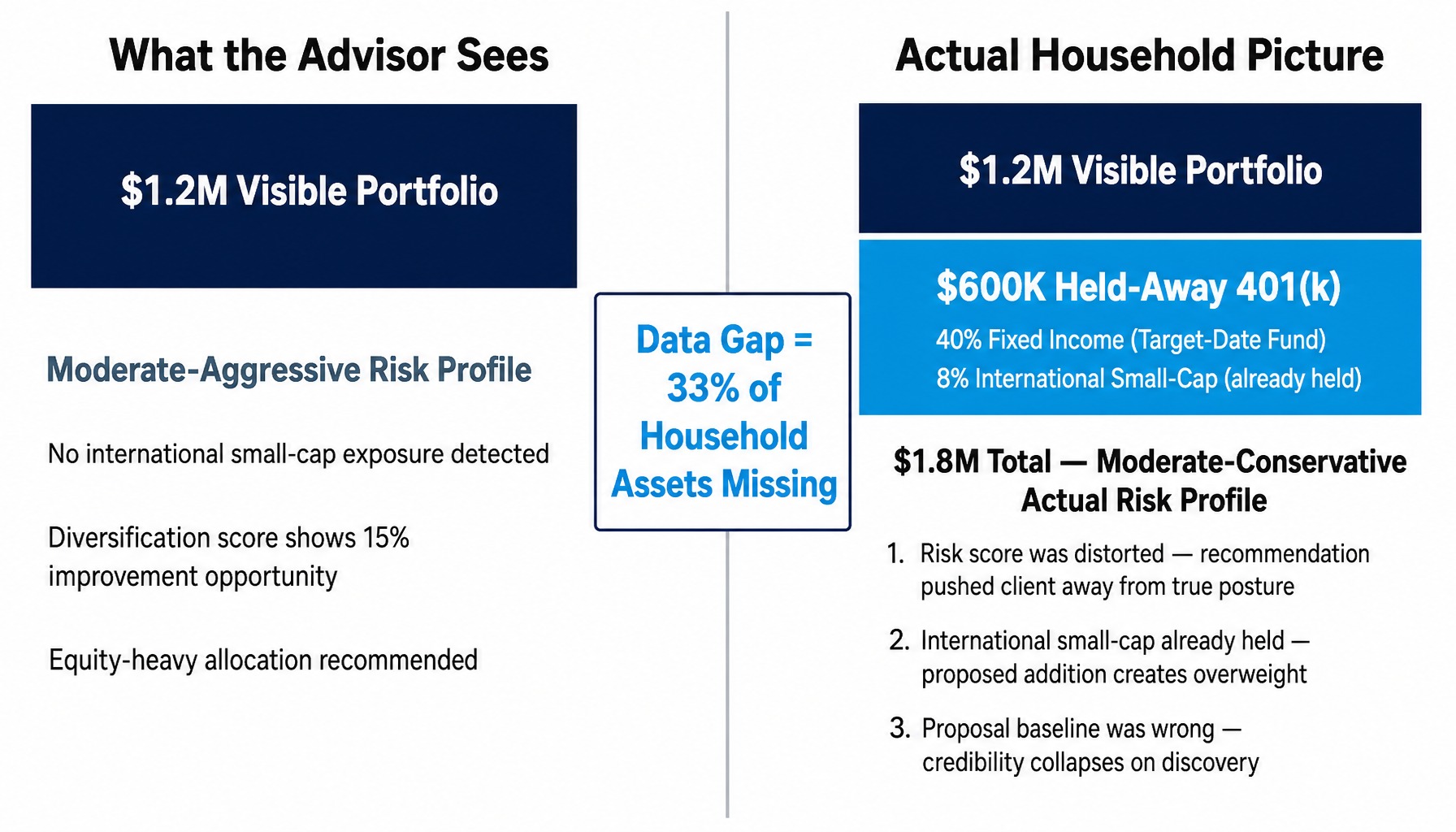
One missing held away account made every analytical output directionally wrong.
With over $10 trillion sitting in 401(k) and other defined contribution plans alone, these are not edge cases. The cost is not just missed AUM. It is that the advisor's core value proposition – objective, data-driven analysis is undermined by the data gap itself.
Read more: How to Create Winning Proposals: 3 Tips for Advisors
Why Position-Level Data Matters More Than Balance-Level
Most aggregation feeds deliver balance-level data for held-away accounts – a single dollar figure updated daily or weekly. That is enough for a net-worth report. It is not enough for portfolio analysis.
The distinction is critical. Balance-level data tells you a client has $600,000 in a Fidelity 401(k). Position-level data tells you that $600,000 is split across a target-date fund (60%), a concentrated company stock position (25%), and a stable value fund (15%).
Without position-level detail like the individual holdings, share counts, and cost basis, an advisor cannot perform meaningful quantitative portfolio analysis. You cannot run an accurate risk assessment, identify sector concentration, evaluate fee drag from underlying funds, or model tax-loss harvesting opportunities.
The practical consequence is that an advisor who aggregates a held-away account at the balance level and assigns it a generic allocation assumption is introducing modeled noise into what should be an observed data set. This is guesswork, not analysis.
In the data aggregation waterfall, different methods yield different levels of fidelity. Direct custodial API feeds offer the best quality but are rarely available for held-away accounts. Screen-scraping aggregators like Plaid or Yodlee offer variable position-level coverage but suffer from breakage and stale data flags. The highest-fidelity source for position-level data on held-away accounts has historically been the most labor-intensive: manual statement extraction. The key takeaway is that the quality of held-away data matters as much as its presence, and most aggregation shortcuts sacrifice the detail that makes the data analytically useful.
How to Actually Discover Held-Away Accounts
No aggregation tool or data feed will surface a held-away account that the advisor does not know exists. Discovery is a human process first and a technology process second. A reliable workflow replaces guesswork with a structured, repeatable methodology.
Step 1: Ask directly during onboarding and ask the right question.
The common failure: advisors ask, "Do you have any other accounts?" Clients often say no, because they don't
mentally categorize an old 401(k) or a 529 plan as an active "account." A better question prompts recall: "To get a
complete picture, could we review any retirement plans from previous employers, accounts your spouse manages
separately, or investments you haven't touched in a few years?"
Outcome: Surfaces accounts the client has
mentally filed away.
Step 2: Use a structured household balance sheet template.
Instead of relying on open-ended memory, provide a simple form that lists common account categories with checkboxes:
employer retirement plans, inherited accounts, annuities, education savings, HSAs, stock compensation, real estate,
and crypto. And let's be honest, clients often don't remember every account without a prompt. This simple checklist
acts as that prompt.
Outcome: Triggers recall by category, ensuring a more complete inventory of outside assets.
Step 3: Request statements, not credentials.
Asking a prospect for their login credentials to an aggregation service creates immediate friction and security
concerns. A lower-friction approach is to ask for PDF statements. Clients are far more willing to email a quarterly
statement than to share a password, especially early in a relationship.
Outcome: You receive high-fidelity,
position-level data without triggering the client's security alarms or violating custodian terms of service.
Step 4: Set a recurring cadence for review.
A household's financial picture is not static. Clients change jobs, inherit accounts, exercise stock options, and
start new ventures. The held-away asset picture you capture at onboarding will be obsolete in a year. Build a
semi-annual check-in question into your review process to keep the data current.
Outcome: The consolidated
financial picture remains accurate over time, preventing new blind spots from forming.
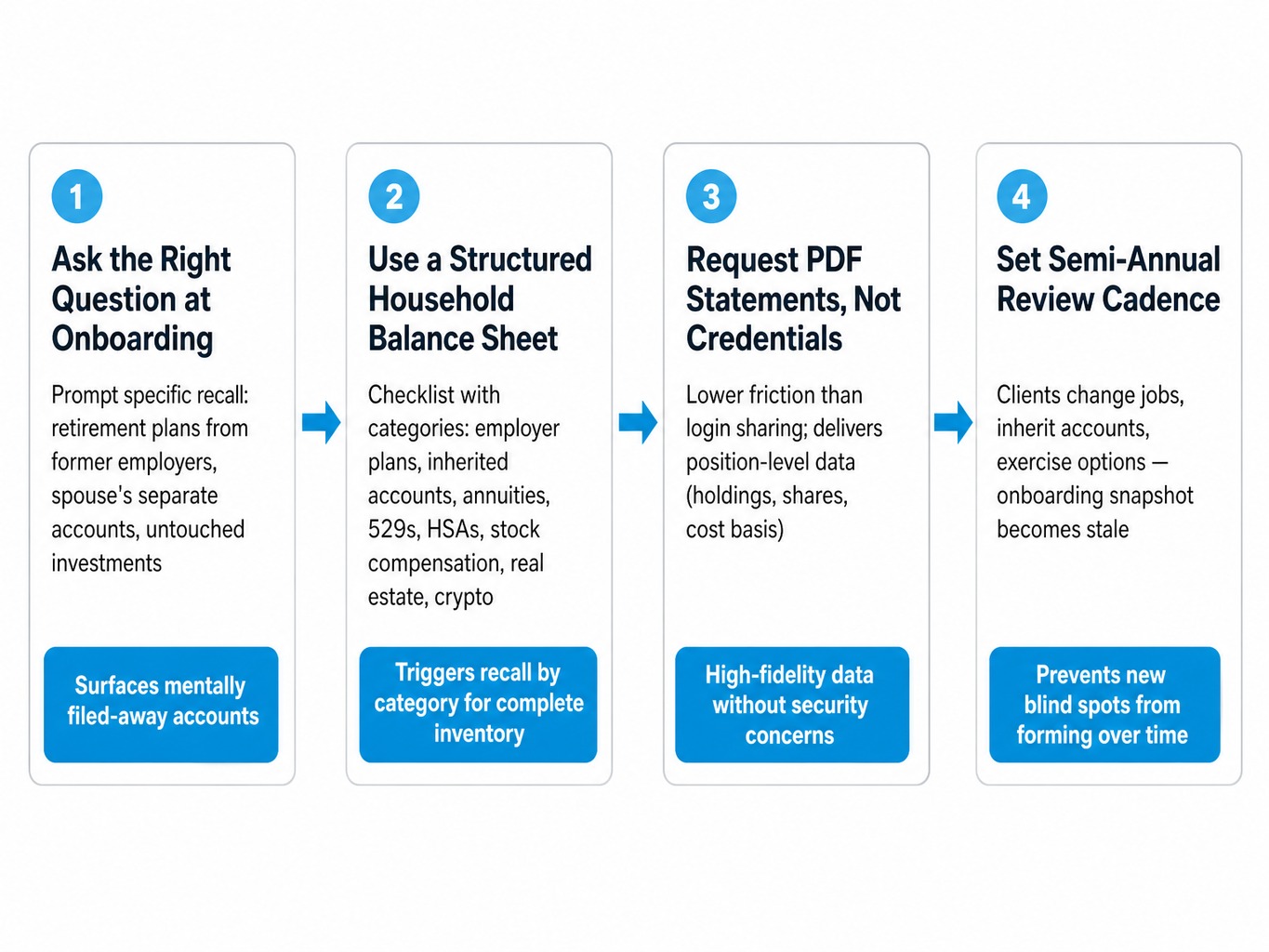
A repeatable process for managing held away assets starts with the right questions.
Read more: Here's how to draw new clients into the fold more quickly
The Statement Extraction Problem Most Firms Underestimate
The industry conversation about held-away assets assumes the hard part is getting the client to share the data. In practice, the harder part for most firms is turning what the client shares into something analytically usable.
Here is the operational reality: a prospect emails you a 12-page Fidelity NetBenefits 401(k) statement and a 6-page Prudential annuity statement. Neither is in a format your portfolio management system can ingest. They are formatted documents with proprietary layouts, footnotes, and varying terminology.
For most advisory firms, this triggers a manual, unscalable workflow. An advisor or an operations team member re-keys the data like ticker symbols, share counts, cost basis into a spreadsheet or analytics tool. This manual process is:
- Slow: Advisors commonly report spending 30-60 minutes per statement for a complex account.
- Error-Prone: Transposed digits, missed positions, and incorrect cost basis entries are common, corrupting the very analysis you're trying to improve.
- Unscalable: Multiply that time by 50 prospects a quarter, and the operational drag becomes a significant hidden cost. This manual process is the silent, unbilled time that kills advisor capacity.
Most firms have built their analytics stack around clean custodial data feeds and treat held-away data as an exception to be handled manually. But if 30-50% of a typical household's investable assets are held away, the exception is actually the norm. The true bottleneck is not discovery; it is the firm's institutional capability to extract structured, position-level data from unstructured statement documents at scale. Firms seeking operational visibility into their growth pipeline must address this gap.
Closing the Data Gap with Automated Statement Extraction
The operational tension is clear: held-away assets create analytical blind spots, position-level data is required to resolve them, and the bottleneck is extracting that data from unstructured PDF statements. This is precisely the problem VRGL was built to solve.
VRGL's automated statement aggregation capability is purpose-built to extract position-level data from PDF statements across hundreds of custodians and account types. It handles the non-standard formats common in employer retirement plans, annuities, and legacy brokerage accounts that break manual processes. An advisor receives a prospect's held-away statements, uploads them to the VRGL platform, and within minutes has clean, normalized data ready for analysis. In many cases, that includes position-level holdings data, although certain privately held holdings within retirement plans and annuities may have data limitations depending on how those assets are reported in the source statement.
This extracted data feeds directly into VRGL's analysis, which objectively assesses the entire household portfolio across performance, risk, diversification, taxes, and fees. The proposal you build is no longer based on a partial picture; it reflects the complete reality of the client's holdings. This is what it looks like when the statement extraction bottleneck is solved, freeing advisors to focus on analysis and advice, not data entry.
See how VRGL turns held-away statements into complete portfolio analytics.
From Blind Spot to Strategic Advantage
Held-away assets are not a secondary concern or a nice-to-have data point. They represent the difference between a portfolio review that reflects reality and one that is fundamentally flawed. An advisor's value proposition depends on analytical accuracy, and that accuracy depends on data completeness.
The firms that win in the coming years will be those that treat held-away data capture not as an artisanal afterthought but as a core operational capability. By building a standardized process to discover, extract, and analyze these assets, you create proposals that withstand scrutiny, deliver risk assessments that hold up, and earn the trust that converts prospects into lifelong clients. The blind spot becomes your source of strategic clarity.
Frequently Asked Questions
What is the difference between assets under management (AUM) and assets under advisement (AUA)?
Assets under management (AUM) are assets where the advisor has discretionary trading authority and typically charges an asset-based fee. Assets under advisement (AUA) refer to assets the advisor monitors and provides advice on but does not directly trade – a common model for held-away 401(k)s. Some firms charge a lower AUA fee or include this service as part of a flat financial planning fee, which must be clearly disclosed for compliance.
Are there compliance risks if an advisor knows about held-away assets but does not incorporate them into recommendations?
Yes. Under a fiduciary standard, an advisor who is aware of material outside holdings and ignores them in portfolio construction may face scrutiny if the resulting recommendation is unsuitable in the context of the client's full financial picture. This does not mean the advisor must manage every held-away account, but it does mean they should document awareness and explain how outside holdings were considered in the planning process.
How does CFPB Section 1033 affect held-away asset data access for advisors?
Section 1033 of the Dodd-Frank Act establishes consumer rights to share their financial data with authorized third parties through secure, standardized interfaces. For advisors, this may eventually reduce reliance on screen-scraping and credential-sharing by enabling API-based, consent-driven data access from more institutions. However, implementation timelines vary, and coverage for employer retirement plans and other complex held-away accounts remains a developing area as of 2025-2026.
Should advisors charge fees on held-away assets they advise on but do not trade?
There is no single correct model, but transparency is key. Some firms charge a reduced AUA fee (e.g., 25-50 basis points), others bundle advisement into a flat planning fee, and some advise on held-away assets at no charge to deepen the relationship. Whatever the model, it must be clearly disclosed in the firm's Form ADV and be defensible if a regulator asks why the fee is appropriate for the service provided.
Can a financial advisor directly manage a client's 401(k) held at their employer?
Generally, no, because advisors lack discretionary trading authority in most employer-sponsored plans. The two common workarounds are: (1) the advisor provides recommendations that the client executes themselves within the plan's investment menu, or (2) the plan offers a self-directed brokerage account (SDBA) option, which may allow an advisor limited management access. Both approaches have significant compliance implications and should be structured with legal counsel.