

Key Insights
- Most client attrition is a slow process of "silent disengagement," not a sudden event. Firms that only measure assets-out are missing the early behavioral warning signs.
- Communication failures are rarely personal; they are structural problems caused by high advisor-to-client ratios, fragmented preparation workflows, and compliance friction.
- The most common and costly form of attrition isn't full client departure but "wallet-share erosion," where clients direct new assets to competitors because they don't know what their current advisor can do.
- Effective communication isn't about frequency; it's about structure. Build a tiered cadence based on AUM and complexity, and define clear outreach protocols for critical life events.
- Technology is only as effective as the workflow behind it. A client portal or CRM only improves communication if it's built on a defined workflow that compresses preparation time and frees advisors to focus on clients.
A $4 million household, a client for seven years, transfers their assets. The exit survey cites a 'better fit' elsewhere. The advisor is blindsided. But the data tells a different story, one visible only in retrospect: eighteen months of declining engagement. Fewer returned calls. A skipped annual review. A spouse who never received a single direct communication. The relationship ended long before the assets moved.
This scenario is one of the most common and costly client communication issues in wealth management. The failure isn't what advisors say in meetings; it's a structural breakdown in how firms prepare for, deliver, and sustain communication across the entire client lifecycle.
The industry's default response "communicate more" misdiagnoses the problem. The real issue is fragmented workflows, inconsistent preparation, and the absence of a governed system for when, how, and what to communicate. This isn't a personal failing; it's a systems problem.
This article unpacks the structural causes behind communication breakdowns. We will diagnose the root causes, identify the attrition signals firms miss, build practical cadence frameworks, navigate compliance constraints, and assess where technology helps versus where it creates false confidence.
Five Structural Root Causes of Client Communication Breakdowns
Communication failures are rarely about advisor intent. Most advisors want to communicate well. The problem is that operational constraints make consistent, high-quality communication structurally difficult. According to J.D. Power, 28% of advisors lack sufficient time for client interactions due to back-office tasks, while a YCharts survey found 78% of clients say better communication would prevent them from switching advisors. This gap between intent and reality stems from five root causes.
-
Advisor-to-Client Ratio Pressure: When an advisor manages 150+ households, proactive outreach becomes mathematically impossible without systems. The default becomes reactive communication, responding only when clients call with a problem. This AUM-weighted service model isn't a choice; it's a consequence of capacity limits. High-value clients feel underserved, and the firm becomes vulnerable.
-
Fragmented Preparation Workflows: Consider an advisor who spends 90 minutes assembling a quarterly review: pulling notes from the CRM, exporting data from the portfolio accounting system, and manually building a PowerPoint. That preparation time for just ten clients consumes an entire workday. When analytics, proposals, and reporting live in disconnected systems, the time cost per interaction balloons, reducing the number of clients who get meaningful contact.
-
Compliance Pre-Approval Bottlenecks: With FINRA 2210 and SEC Marketing Rule oversight, many firms require every client-facing communication to pass through a compliance queue. When this process is slow, advisors default to saying less rather than navigating the bottleneck, especially for timely market commentary where speed is essential. Archiving and supervision requirements add another layer of friction.
-
No Governed Communication Standards: When each advisor sets their own cadence, content, and tone, the client experience varies wildly. This creates "orphaned accounts" and exposes the firm to compliance risk from inconsistent disclosures and messaging.
-
Rainmaker Dependency Risk: In firms where client relationships are concentrated in one or two senior partners, any succession event, extended leave, or capacity constraint creates a communication blackout for entire segments of the book. Without an institutionalized process, relationships are tied to a person, not the firm.
These causes compound. A firm with high advisor ratios, fragmented systems, and compliance friction isn't experiencing a communication problem. It's experiencing a structural capacity crisis.
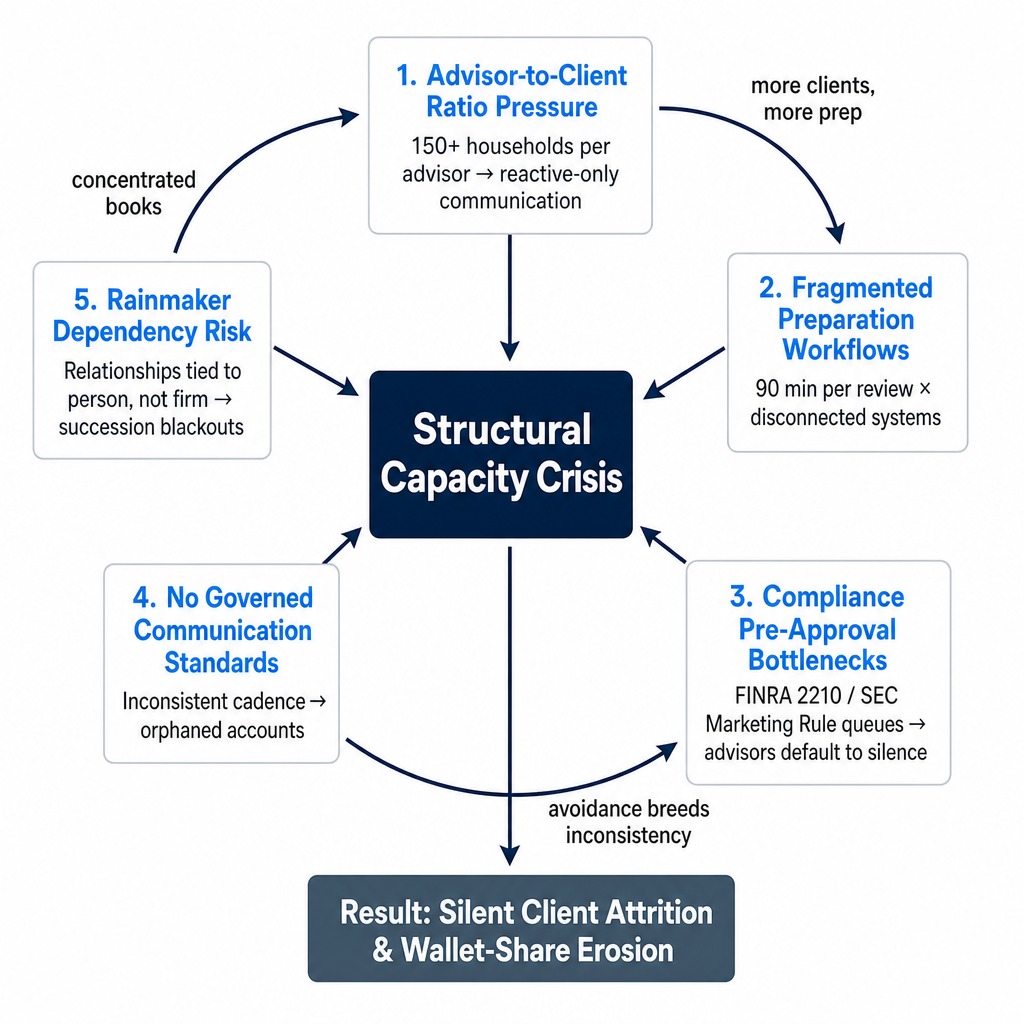
Communication failures compound - five structural causes create a capacity crisis.
Read more: Operational Visibility for Wealth Management Growth | VRGL
How Clients Leave Before They Leave: Detecting Silent Attrition
In wealth management, client attrition is not an event; it's a process that unfolds over 12 to 24 months. Communication failures are both the cause and the earliest detectable symptom. Most firms only measure attrition when assets transfer out, which means they are measuring the outcome, not the process. By the time a client calls to move their account, the relationship has been over for months.
This is a behavioral finance insight: clients experience 'relationship decay' through a predictable sequence. It starts with reduced responsiveness, progresses to skipped reviews, and ends with the quiet consolidation of assets elsewhere. According to the CFA Institute, a lack of responsiveness is a top reason clients leave. This isn't just about returning calls; it's about the client perceiving a decline in proactive engagement, which leads them to disengage in turn. Morningstar data showing 40% of investors took action without consulting their advisor is another symptom of this communication-driven disconnect.
The most dangerous blind spot is often with multi-generational households. An advisor might provide excellent service to a 72-year-old patriarch, but if their 45-year-old heirs have never had a direct conversation, there is no relationship to preserve when wealth is transferred.
Behavioral Signals That Predict Client Departure
Firms that track specific behavioral signals can intervene before a client relationship is lost. These indicators are individually ambiguous but collectively diagnostic. A "client at-risk scoring" model can formalize this monitoring.
- Declining Engagement: A noticeable drop in email open rates on portfolio reports or newsletters.
- Meeting Avoidance: Rescheduling or skipping annual or quarterly reviews two or more times consecutively.
- Reduced Responsiveness: A client who previously returned calls the same day now takes 48 hours or more.
- New Held-Away Accounts: Monitoring reveals new accounts opened at other custodians, signaling they are testing other relationships.
- Sudden Scrutiny: Questions about fee structures, performance benchmarks, or services that were never previously raised. This is often a sign the client is actively comparing your firm to a competitor.
Tracking these signals systematically moves a firm from being reactive to proactive, allowing advisors to address relationship decay before it becomes irreversible.
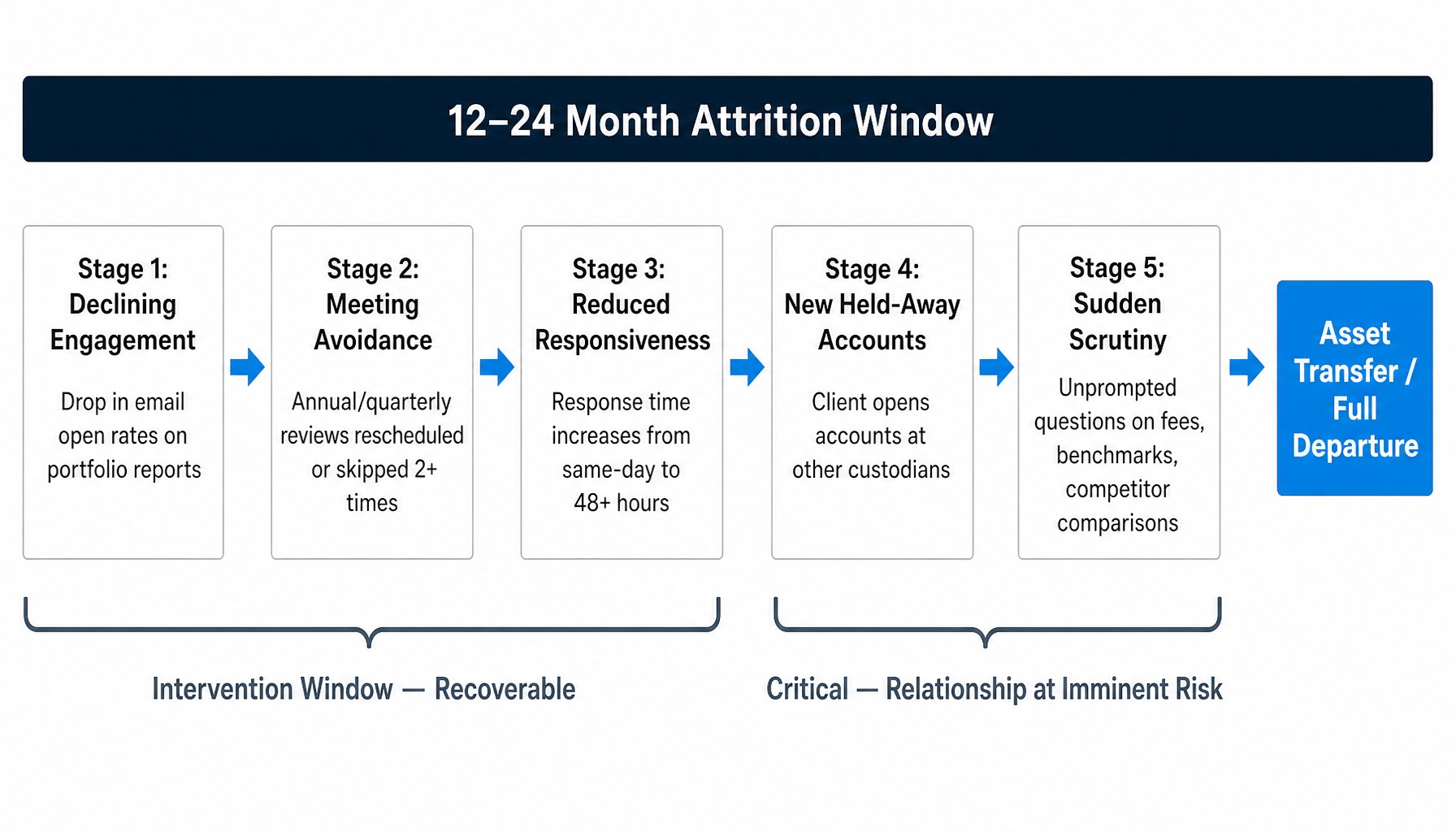
Silent attrition follows a predictable sequence - early signals are the intervention window.
Wallet-Share Erosion: The Attrition You Never Measure
Full client departure is the most visible form of attrition, but it's often the less costly one. The bigger, quieter problem is wallet-share erosion: when clients keep their existing accounts but direct new assets, liquidity events, or inheritances to a different advisor. This is invisible in standard AUM reporting because assets don't decline; they just stop growing.
Imagine a client who sells a business for $8 million. They keep their existing $2 million portfolio with you but place the $6 million of proceeds with a competitor. Why? Because you never discussed business succession planning or demonstrated the capability to manage a concentrated stock transition. The client didn't know what you could do because you never communicated it.
This is a direct failure of proactive communication. Wallet-share erosion happens when clients perceive their advisor's value is limited to managing their current portfolio. Communication isn't just about retention; it's about demonstrating the full breadth of your firm's capabilities to capture the total economic value of each relationship.
Read more: How to Create Winning Proposals: 3 Tips for Advisors | VRGL
Building a Communication Cadence That Scales Across Your Book
The solution to inconsistent wealth management client communication is not simply more communication; it's structured communication. Most firms default to one of two failing models: a uniform cadence where every client gets the same quarterly review, or no cadence at all, leaving it to advisor improvisation. The first model under-serves top clients and over-invests in smaller ones; the second creates orphaned accounts.
The answer is a tiered, trigger-based system that matches communication intensity to client value and life circumstances. This requires leadership to make an explicit decision on an AUM-weighted service model, rather than leaving it to individual discretion.
For example, a documented model might look like this:
- Tier 1 ($5M+): Monthly touches (proactive commentary, personal check-ins), quarterly in-depth reviews, and annual comprehensive planning sessions.
- Tier 2 ($1M-$5M): Quarterly reviews and semi-annual planning updates.
- Tier 3 (<$1M): Semi-annual reviews and automated monthly newsletters.
An advisor with 120 households can sustain this if their book segmentation is 15 households in Tier 1, 40 in Tier 2, and 65 in Tier 3.
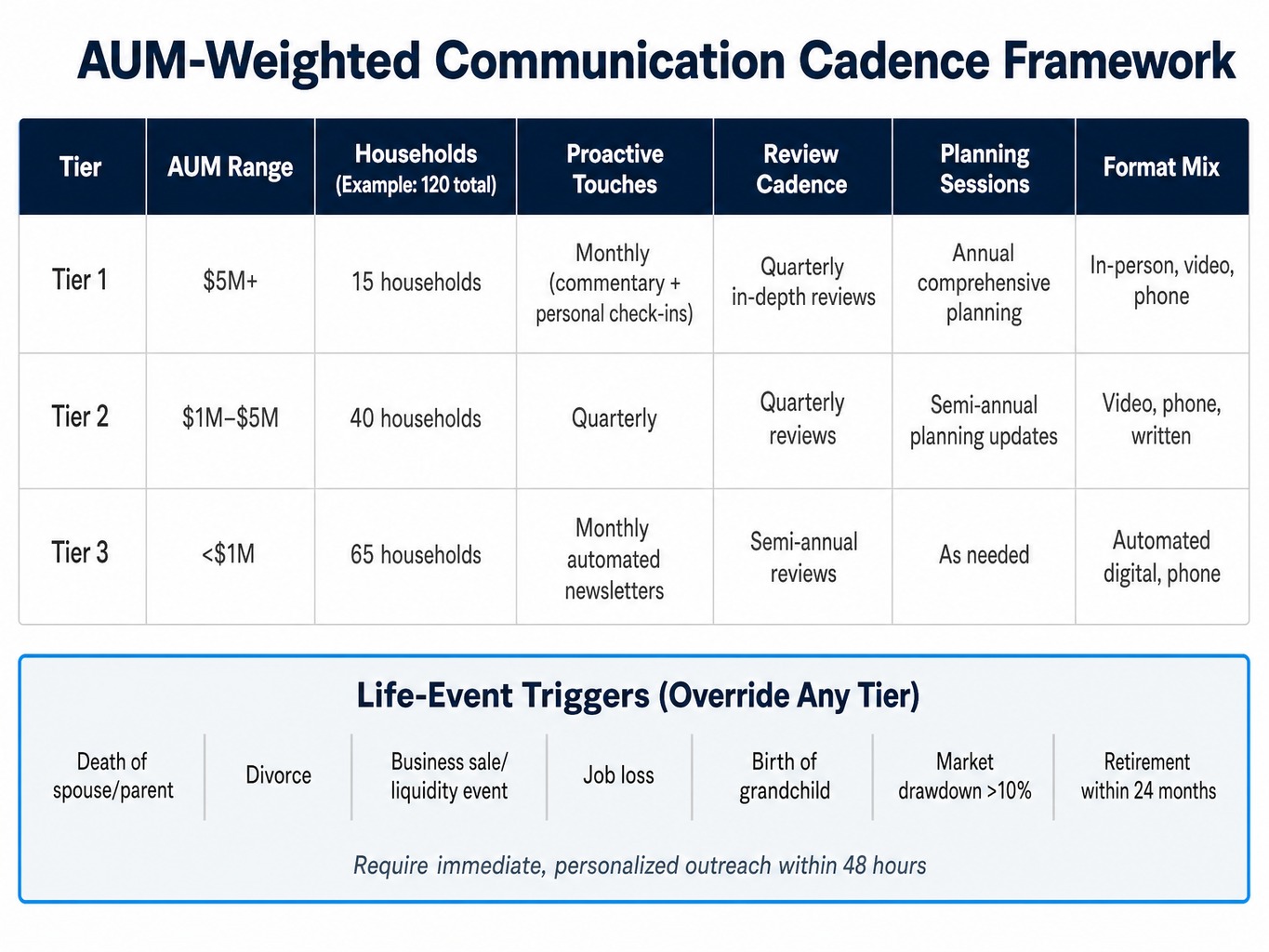
Structured cadence by AUM tier solves inconsistent wealth management client communication.
Designing Tiered Touches by AUM and Relationship Complexity
A tiered cadence framework must be documented and visible to the entire team, not just living in an advisor's head. The prerequisite is disciplined book segmentation by AUM, revenue, and relationship complexity. For each tier, specify the number of proactive touches per quarter, the format mix (in-person, video, phone, written), and the content type.
This is where a CRM like Wealthbox, Redtail, or Salesforce Financial Services Cloud becomes a true workflow engine. These tools can automate cadence tracking and trigger tasks for the next touchpoint, but only if the firm has defined the cadence first. Without a defined strategy, a CRM is just a digital rolodex.
Life-Event Triggers That Demand Immediate Outreach
Cadence alone is insufficient. The most relationship-defining communications are not scheduled; they are triggered by life events. These moments require immediate, personalized outreach.
Key triggers include:
- Death of a spouse or parent
- Divorce proceedings
- Business sale or major liquidity event
- Job loss or career transition
- Birth of a grandchild (prompting an estate plan review)
- Significant market drawdown (>10%)
- Approaching retirement within 24 months
The communication must be specific. After a market drawdown, a generic 'stay the course' email is worse than silence. The outreach should reference the client's specific portfolio impact, confirm alignment with their risk tolerance, and reinforce the plan's long-term assumptions. This is where firms that rely on manual tracking will fail; a well-configured CRM can create automated alerts for these triggers, ensuring no critical moment is missed.
Compliance as a Communication Design Constraint, Not Just a Checkbox
Many firms treat compliance as a communication bottleneck; something that slows down or prevents client outreach. A more effective approach is to treat it as a design constraint that shapes how communication is built from the start. A bottleneck creates avoidance; a design constraint creates structure.
The regulatory landscape is complex. For broker-dealers, FINRA Rule 2210 governs communications, requiring pre-use approval for retail communications and supervision of correspondence. RIAs face SEC Marketing Rule requirements around testimonials, endorsements, and performance advertising. Both must adhere to strict archiving and supervision requirements for all electronic communications, a task often managed by platforms like Smarsh or Global Relay.
Consider a firm that wants to send market commentary during a volatile week. If every piece requires a 48-hour compliance review, the message is irrelevant by the time it's approved. In contrast, a prepared firm has a library of pre-approved volatility templates with variable fields for portfolio-specific data. Advisors can send personalized, compliant commentary within hours.
This proactive approach like building compliant templates, automating disclosure insertion, and defining approved channels turns compliance from a gatekeeper into a guardrail. It doesn't have to kill speed, but it requires an upfront investment in a governed communication infrastructure. Platforms like Hearsay Systems can help manage this at scale for social media, but the underlying principle applies to all communication.
Where Technology Helps and Where It Creates False Confidence
Firms often treat technology adoption as a communication solution. It is not. It is communication infrastructure. It only enables better communication if the firm has defined what 'better' means. In three key areas, technology can create a false sense of confidence.
- The Portal Paradox: Firms invest heavily in client portals (via platforms like Orion, Advyzon, or eMoney),
expecting them to improve communication. However, an Avaloq survey found that 46% of wealth managers rarely
or never use their own portals. Worse, clients can interpret self-service access as a replacement for human
contact, not a supplement. If portal adoption isn't paired with a human-led engagement strategy, it can
reduce perceived communication quality.
- CRM as a Database vs. a Workflow: Most firms use their CRM as a contact database. A CRM that only tracks when
the last call happened is a record-keeping tool. A CRM configured as a communication system triggers the
next action based on the firm's tiered cadence and life-event rules. The difference is between passive
tracking and active workflow automation.
- Automated Communication Quality: Tools like Snappy Kraken and FMG Suite can automate newsletters and
marketing campaigns. While efficient for broad-based communication, generic automated content can actively
damage relationships with HNW and UHNW clients. These clients expect personalized, advisor-specific
insights, and content that feels mass-produced can signal a lack of personal attention. That is where a more
controlled approach matters. VRGL's Client Engagement Newsletter module is built to help firms stay
connected between meetings with recurring, relevant insights that still feel like the firm's own
communication. Instead of forcing a one-size-fits-all template, it supports firm-aligned branding, flexible
formats such as headlines, commentary, and summaries, and a configurable cadence that matches how the firm
wants to engage different client segments. The distinction is important: automation should increase
consistency and capacity, not make communication feel generic.
When Communication Fails Because Preparation Takes Too Long
The central tension is this: advisors spend so much time assembling portfolio data, building reports, and creating presentations across disconnected systems that they run out of capacity for the communication itself. The most impactful improvement most firms can make is not a new CRM or a better newsletter in isolation; it is compressing the preparation time behind every client interaction and extending that efficiency into more consistent client engagement.
When an advisor can move from statement intake to institutional-grade portfolio analysis to a client-ready, white-labeled presentation through a single repeatable workflow, the time recovered goes directly back into client-facing communication. That includes the ability to maintain timely touchpoints between meetings, not just prepare for the meetings themselves. For enterprise firms , VRGL provides an additional layer of governance. When every advisor's preparation follows a consistent, compliant process with centrally managed disclosures and presentation standards, the firm eliminates the inconsistency problem without dictating how individual advisors advise.
As a growth platform for wealth management firms, VRGL helps standardize the system of work behind advice and recover advisor capacity through faster preparation and more repeatable workflows. Rather than serving as the communication layer itself, it strengthens the operational layer that makes better communication possible. In that role, VRGL sits upstream of client engagement outcomes: when firms standardize how they prepare, analyze, and present advice, they create the operational foundation that supports client acquisition, engagement, retention, and long-term growth.
From Aspiration to Infrastructure
The most important belief shift for firm leaders is this: client communication issues in wealth management are not caused by advisors who don't care. They are caused by firms that haven't built the structural capacity for consistent, governed, and timely communication across their entire book.
The root causes are operational - ratio pressure, fragmented systems, and compliance friction. The consequences are invisible until they are irreversible - silent attrition and wallet-share erosion. The solutions, therefore, must be structural: tiered cadences, life-event triggers, compliance-as-design, and unified preparation workflows.
The firms that treat communication as a workflow design problem, not an advisor motivation problem, are better positioned to strengthen client relationships, support long-term growth, and build practices that survive transitions. The firms that keep telling their advisors to 'just communicate more' will keep losing clients they never knew were leaving.
Frequently Asked Questions
How often should a wealth manager communicate with clients during a market downturn?
During drawdowns exceeding 10%, proactive outreach should happen within 48 hours. This shouldn't be generic "stay the course" messaging but portfolio-specific context on impact and alignment with the client's risk tolerance and reinforcement of the client's long-term investment plan. For prolonged volatility, a second touch within 10 days is warranted for top-tier clients. Pre-approved templates allow for speed without sacrificing compliance.
How should advisors communicate fee changes to existing clients?
Fee changes require direct, individual communication - never buried in a report. Lead with the rationale before stating the new fee, and provide a comparison showing the cost change in dollars, not just basis points. Schedule this conversation at least 60 days before implementation and provide a written follow-up with the new fee schedule documented for compliance and trust.
What is the best way to engage next-generation heirs before a wealth transfer?
Request a joint meeting with the primary client and their adult children, framed around estate planning continuity. Establish direct communication with heirs, including their own risk tolerance assessment and at least one annual touchpoint independent of the primary client. Firms that wait until the transfer event to meet heirs lose the vast majority of inherited assets because no relationship exists.
How do encrypted messaging apps and texting affect advisor-client communication compliance?
SEC and FINRA have made it clear that off-channel communications via WhatsApp, Signal, or personal text must be captured and archived. Firms need a written policy defining approved channels, an archiving solution like Smarsh or Global Relay to capture these messages, and regular advisor attestations. Banning these channels is often impractical; the goal is to balance client preference with supervision requirements.
How do you measure whether client communication is actually effective?
Effective measurement combines leading and lagging indicators. Leading indicators include email open rates, meeting attendance, and advisor outreach response times. Lagging indicators include client retention rates, NPS scores, and wallet-share growth. The most diagnostic metric is often meeting cancellation frequency, as a rising trend is an early behavioral signal of disengagement.
What are the risks of inconsistent communication across a multi-advisor firm?
Inconsistency creates three compounding risks: compliance exposure from varying disclosures; client experience variance leading to dissatisfaction; and succession fragility, as there is no institutional standard to maintain when an advisor leaves. For enterprise firms, it also undermines brand integrity and makes M &A due diligence more difficult, as acquirers assess communication infrastructure as a proxy for relationship durability.