
Key Takeaways
- A Separately Managed Account (SMA) is typically a single-strategy managed account, while a Unified Managed Account (UMA) consolidates multiple strategies or investment types into a single account.
- The key structural difference is the UMA's overlay coordination layer, which can coordinate rebalancing, trading, and cash management across sleeves within one account. In multi-SMA structures, coordination can occur through the advisor, a centralized investment team, outsourced investment management, TAMPs, or other management infrastructure.
- Operational workflows for billing, reporting, and rebalancing differ significantly. UMAs may offer consolidated statements and billing, but program design, fee presentation, and governance vary by provider.
- The choice between UMA and SMA is not about which product is better. It is an operating model decision that reflects a firm's client needs, implementation preferences, custodial relationships, governance approach, and desired level of customization.
- Before choosing a structure, firms can benefit from analyzing a prospect's or client's existing portfolio to clearly communicate the rationale for any proposed changes, regardless of the implementation vehicle.
For advisory firms, the UMA vs SMA discussion is often framed as a simple product comparison. Most analyses present a checklist of features, treating the choice between a Unified Managed Account (UMA) and a collection of Separately Managed Accounts (SMAs) as a matter of preference. This view misses the point. The decision is less about product features and more about a firm's operating model.
The account structure a firm chooses fundamentally shapes how portfolios are rebalanced, how fees are billed, how transitions are managed, and how compliance oversight functions. The choice between a Unified Managed Account vs SMA structure often reveals more about a firm's operating model, client complexity, and governance philosophy than it does about the merits of one wrapper over another.
This article moves beyond feature lists to examine the structural and operational differences that matter most to advisory workflows. We will define each account type, analyze the workflow implications, and provide a framework for evaluating which structure aligns with your firm's model.
What SMAs and UMAs Actually Are
To understand the workflow implications, we first need clear, practitioner-focused definitions. Both structures can provide access to professionally managed investments, but they do so through different account architectures and operational models.
Separately Managed Account (SMA)
A Separately Managed Account (SMA) is a managed account overseen by a single investment manager according to a specific strategy. In many SMA programs, the client directly owns the individual securities held in the account. However, implementation details can vary by program and provider.
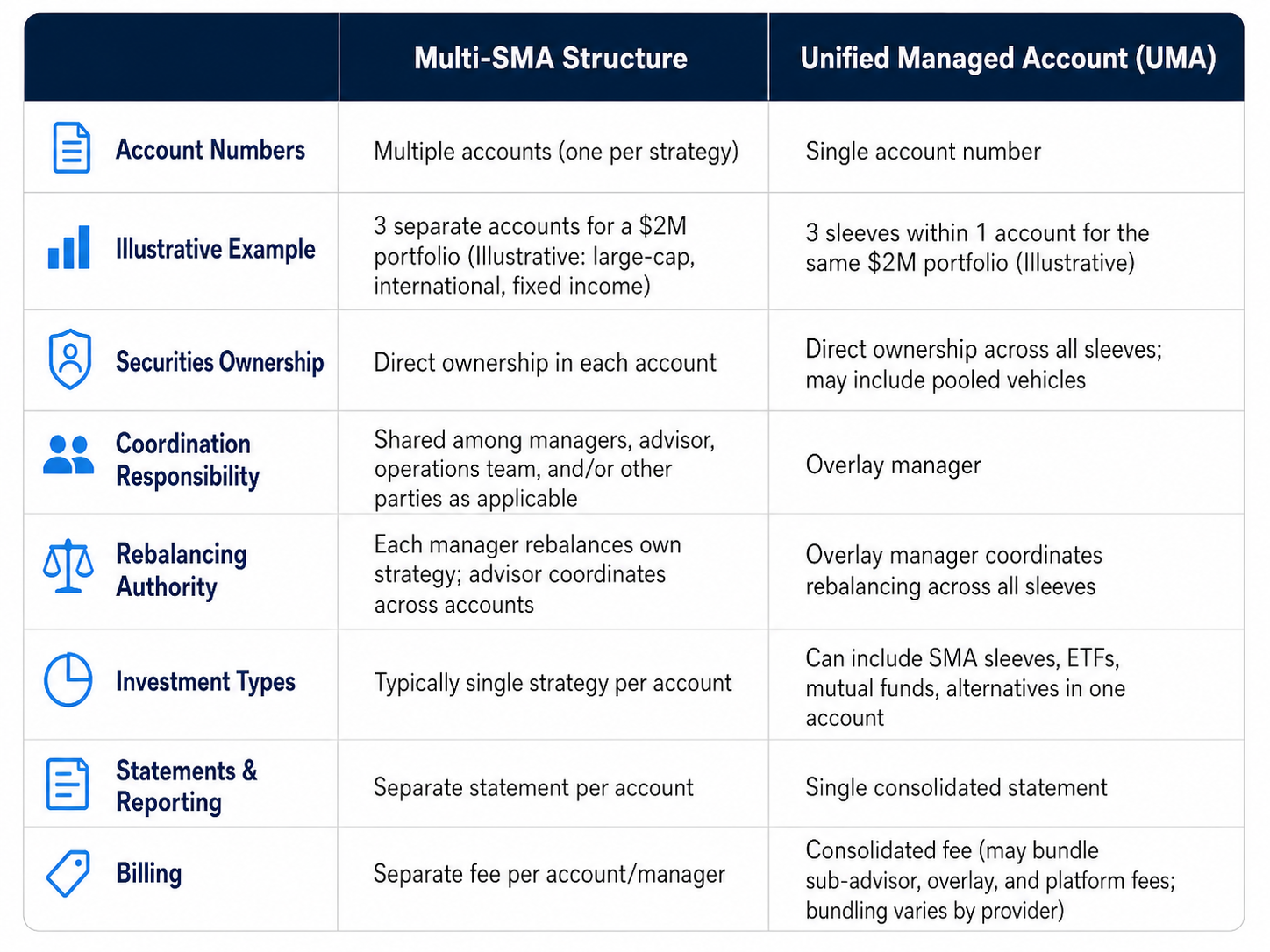
The key operational reality is that each SMA typically represents one strategy or asset class. For an illustrative client with a $2 million portfolio who needs exposure to large-cap domestic equity, international equity, and core fixed income, this approach may require opening three separate SMA accounts. Those accounts may have separate managers, or they may be administered through shared reporting, billing, or centralized management infrastructure, depending on the platform design. Coordination across these accounts for overall asset allocation, cash flows, or tax-sensitive transitions may be handled by the advisor, a centralized investment team, outsourced management support, or platform-based household coordination tools.
Unified Managed Account (UMA)
A Unified Managed Account (UMA) is a single brokerage account that consolidates multiple investment strategies, often called sleeves, under one account number. An overlay manager coordinates activity across the sleeves within that account.
For the same illustrative $2 million client, all three strategies, large-cap, international, and fixed income, could be held within a single UMA. Each strategy operates as a distinct sleeve, managed to its respective model, while an overlay manager may coordinate rebalancing, cash management, and other account-level activity across the full UMA. This overlay manager can be the advisory firm itself, in a rep-as-PM model, the platform sponsor, or a specialized third-party provider. UMAs can also incorporate ETFs, mutual funds, and other pooled vehicles alongside SMA-style sleeves, so direct ownership of individual securities is not a universal characteristic of every UMA. In addition, a UMA coordinates investments within a single account. Coordination across multiple accounts in a household is a separate capability that is often discussed as unified managed household, or UMH.
Structural Differences That Shape Advisory Workflows
The architectural differences between holding multiple SMAs and a single UMA create distinct operational realities. These differences influence how coordination happens and how much flexibility an advisor retains.
Account Ownership and Custody Mechanics
In SMA structures, clients often directly own the individual securities in each account. In UMA structures, the client owns the assets held in the account, but those assets can include individual securities, ETFs, mutual funds, and other pooled vehicles depending on the program. The critical structural difference lies in account consolidation. A multi-strategy portfolio built with SMAs results in multiple account numbers, potentially across multiple custodians, each generating its own statement and data files. An individual UMA consolidates those allocations into a single custodial account, even if the broader managed account program supports multiple custodians.
The practical implications for an advisory firm's operations team are significant. A UMA can provide a single, consolidated statement and a more unified data set for downstream reporting and billing. However, this simplicity can be deceptive in certain environments. For instance, multi-custodial UMA deployment is not simply a matter of replicating the same overlay logic at each custodian. Differences in trade-instruction formats, settlement conventions, and fractional-share handling can create custodian-specific operational exceptions that reduce some of the expected consistency.
How Overlay Coordination Changes the Workflow
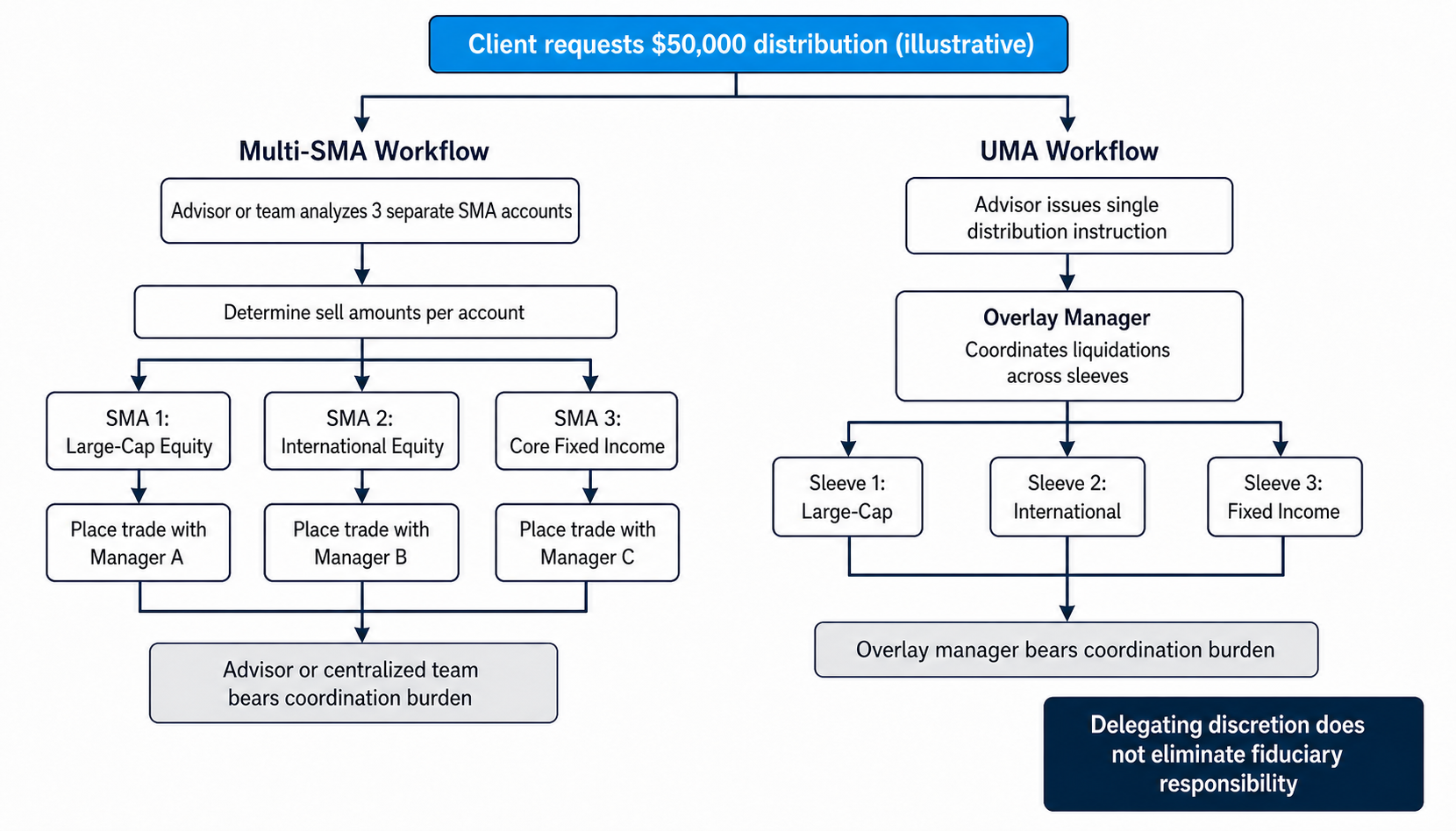
The defining feature of a UMA is the overlay manager, who is responsible for coordinating trades, rebalancing, and cash movements across all the sleeves within that account. In a multi-SMA structure, that coordination may sit with the advisor, a centralized investment team, outsourced investment management, a TAMP, or another management platform rather than falling exclusively on the advisor. Consider an illustrative scenario where a client needs to raise $50,000 for a distribution. In a multi-SMA setup, the firm may need to analyze three separate accounts and coordinate how liquidity is sourced across them. In a UMA, the advisor can issue a single instruction within the account structure, and the overlay manager may then coordinate liquidations across sleeves.
This centralized coordination can be a meaningful workflow benefit, but it also introduces an important governance consideration. One of the most consequential differences between a UMA and a collection of SMAs is where rebalancing discretion resides. Delegating discretionary authority to an overlay manager does not automatically transfer or eliminate the advisory firm's fiduciary obligations. Those responsibilities depend on the contractual arrangement, regulatory status, and respective roles of the advisory firm, platform sponsor, sub-advisors, and overlay provider. Firms can evaluate who holds that authority, the advisor, the platform sponsor, or a third-party overlay provider, and ensure their disclosures, agreements, and supervisory processes reflect the services and discretion actually being delivered.
Read more: Automation in Wealth Management: Why Half-Automated Workflows Can Create More Risk Than Manual Ones
Operational Considerations: Rebalancing, Billing, and Reporting
The high-level structural differences translate into day-to-day operational realities for advisory teams. How an account is rebalanced, billed, and reported influences whether a chosen structure reduces manual work or creates new complexity.
Rebalancing and Trading Workflows
In a portfolio of separate SMAs, each manager rebalances within their own strategy, but no single party is automatically responsible for correcting drift in the overall allocation across multiple accounts. Depending on the firm's model, that coordination may be handled by the advisor, the firm's investment team, outsourced management support, or a platform designed to centralize multi-account management.
A UMA can centralize more of this function within a single account. Depending on the program, the overlay manager may monitor the total account against its target allocation and may execute rebalancing trades across sleeves when drift exceeds predefined tolerance bands. The degree of automation, the trigger logic, and the delegated authority vary by provider and program design. UMA platforms may also support trading aggregation across accounts, but that is not unique to UMAs. SMA managers can also aggregate trades across client accounts, and aggregation does not in itself guarantee better execution.
Billing Transparency and Reporting Differences
For client communication, billing and reporting differences are paramount. A client with three SMAs may see fee details across multiple accounts or statements, although some firms and platforms consolidate parts of that experience through shared reporting or billing infrastructure. A UMA may present fees in a more consolidated format, but billing arrangements vary significantly by provider.
Some UMA programs bundle advisory, platform, sub-advisor, and overlay costs into a single charge, while others itemize some or all of those components or bill them separately. In addition, underlying fund expense ratios may represent additional costs when pooled vehicles are used, and those costs are not always directly billed as separate line items. While a UMA can simplify presentation, it does not remove the need for fee transparency. On the reporting side, a UMA's consolidated statement can be an advantage over aggregating multiple SMA statements. However, it is important to remember that this view only covers assets within that UMA account. Held-Away Assets and other accounts outside the UMA still require separate aggregation to create a complete household picture.
When the Decision Reflects Firm Operating Model, Not Product Preference
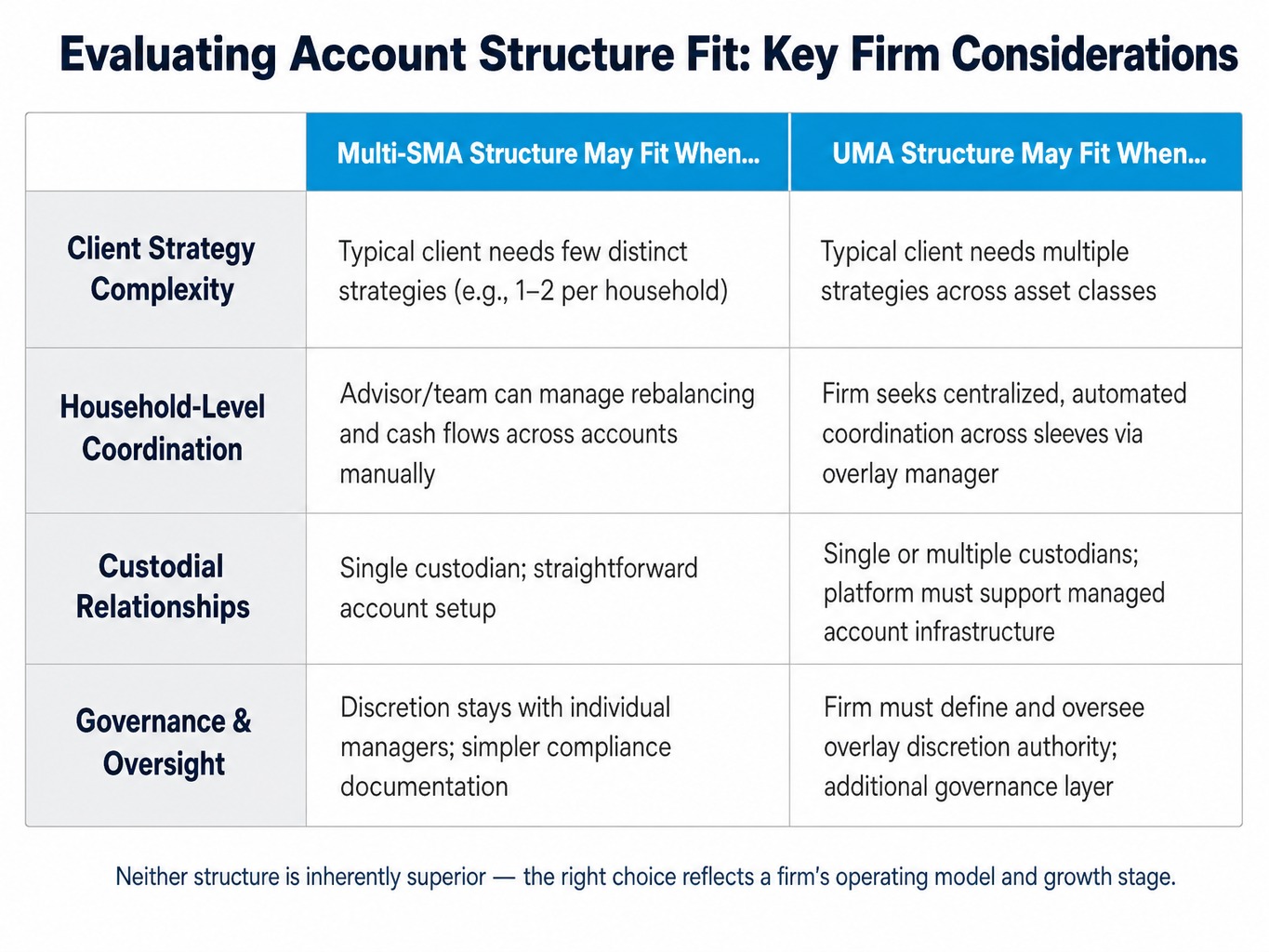
The SMA vs UMA decision is not a question of which structure is inherently superior. It is a question of which structure best aligns with a firm's operating model, client complexity, implementation preferences, and governance approach. The right choice often says more about a firm's priorities than it does about the products themselves.
Firm size alone does not determine the answer. Smaller RIAs may benefit from outsourced UMA programs that simplify coordination inside a single account, while enterprise firms may intentionally maintain separate SMAs to preserve investment flexibility, manager choice, tax considerations, or client-preference alignment. In practice, the decision is less about operational maturity and more about how the firm wants to balance coordination, customization, oversight, and portability.
As firms grow, adding advisors, expanding to multiple custodians, or serving more clients with complex multi-asset-class needs, the operational implications of account structure can become more visible. UMA infrastructure may reduce coordination inside a single account, but it also introduces additional considerations around provider capabilities, delegated discretion, fee presentation, and portability. Likewise, a multi-SMA structure may preserve flexibility, but firms still need a workable process for account-level coordination, reporting, and transition analysis. A compliance review at a growing RIA, for example, might reveal that its Form ADV still describes advisory services in language consistent with a traditional SMA model even after adopting UMA infrastructure. In that case, the issue is not that UMAs create a universal governance gap. It is that disclosures, fees, and descriptions of discretionary arrangements may need to align with the services the firm is actually providing.
Firms can frame the decision by asking a few key questions:
- How many distinct investment strategies does our typical client require within a single account, and how much investment customization do we want to preserve?
- What are the total investment costs under each structure, including advisory fees, platform or manager fees, and any underlying fund expenses where relevant?
- What are the transition-related tax implications of moving existing holdings into a proposed UMA or SMA structure?
- Who is responsible for account-level and multi-account coordination today, and is that workflow sustainable?
- How many custodians and managed account providers does our firm use, and how portable is the structure if provider relationships change?
- What level of discretionary authority is our firm comfortable delegating, and how will that authority be described and supervised?
For deeper insights into industry adoption patterns, firms can consult Cerulli Associates research on the managed accounts landscape.
Read more: RIA Practice Management That Scales: A Workflow-First Approach for Growing Firms
How Comparative Portfolio Analysis Supports the Account Structure Conversation
Whether a firm uses UMAs, SMAs, or a mix of both, one workflow challenge remains constant: analyzing a prospect's or client's existing portfolio and clearly communicating the rationale for a proposed strategy. The account structure is the implementation vehicle, but the conversation that justifies the transition requires objective, data-driven analysis.
That is where the VRGL Growth Platform can support the acquisition workflow. Discovery and fact-finding remain with the advisor. Once a prospect's or client's statements have been gathered, VRGL's Statement Extraction, Comparative Portfolio Analysis, and Tax Transition Analysis capabilities can help advisory firms turn raw portfolio data into structured evaluation. Advisors can assess an existing portfolio across performance, risk, diversification, taxes, and fees, and they can also evaluate the potential tax implications of transitioning current SMA holdings into a proposed UMA or other implementation structure.
Those insights can then be incorporated into client-ready proposals and reports that support the advisor's recommendation. By standardizing the analytical work that precedes implementation, VRGL can support consistency, governance, and documentation across the pre-implementation workflow. VRGL does not perform overlay management, trade execution, or ongoing account administration.
See how VRGL supports your acquisition workflow. Request a demo.
The choice between a UMA and SMAs is not a simple product comparison with a universal winner. It is a strategic operating-model decision shaped by a firm's complexity, client needs, and governance preferences. Evaluating these structures through the lens of their real-world workflow implications is far more productive than comparing high-level feature lists. As managed account platforms continue to evolve, the firms that benefit most will be those that align their account infrastructure with their operational reality, ensuring that technology supports their advisory process rather than inadvertently complicating it.
This content is for informational purposes only and should not be considered investment, legal, tax, or compliance advice. All investment decisions should be made based on your own due diligence and in consultation with qualified professionals.
Frequently Asked Questions
1. Can an advisory firm use both UMAs and SMAs within the same client household?
Yes, and many firms do. A household might hold a core UMA for strategies that benefit from coordination within a single account, while also maintaining a standalone SMA for a specialized allocation, such as a concentrated equity strategy, that benefits from separate management. Coordination across multiple accounts in the same household is a separate design consideration and may depend on the firm's broader household management infrastructure.
2. How do account minimums typically compare between UMAs and SMAs?
Account minimums vary significantly by platform, manager, and sponsor. Some SMA programs still carry higher strategy-level minimums, while many contemporary SMA and UMA programs offer lower entry points than older industry assumptions might suggest. Firms can check current minimums with their platform providers, as these vary by sponsor, strategy availability, and custodial relationship.
3. Does migrating from SMAs to a UMA structure require liquidating existing positions?
Not necessarily, but it depends on the UMA platform, custodian, and proposed sleeve design. Some platforms support in-kind transfers of existing securities into UMA sleeves, while others may require partial or full liquidation to align holdings with the target structure. Firms evaluating a migration may want to assess the tax and operational implications before committing.
4. How does the UMA vs SMA choice affect GIPS composite assignment?
Firms claiming compliance with the Global Investment Performance Standards (GIPS®) may need to evaluate more than whether sleeve-level returns can be calculated. Composite eligibility can also depend on whether a sleeve qualifies as a discretionary portfolio or segregated portion under the applicable GIPS requirements. In UMA structures, overlay activity and cross-sleeve coordination can make that assessment more nuanced than in a standalone SMA, so firms often review the GIPS standards and their own policies carefully.
5. Are there compliance or governance differences between offering UMAs and SMAs to clients?
The primary governance difference centers on discretionary authority and how responsibilities are allocated and disclosed. In many SMA arrangements, a third-party manager holds discretion over that account. In a UMA, overlay discretion introduces an additional governance layer across sleeves within a single account. Delegating operational authority, however, does not by itself remove an advisory firm's fiduciary obligations, which depend on the firm's role, agreements, and regulatory status.