
Key Insights
- RIA consolidation is accelerating, driven by a founder succession gap, sustained private equity investment, and pressure on advisory fees that increases the economic importance of scale.
- Headline EBITDA multiples (e.g., 15-20x) may not fully reflect the economics of a deal or the cash a seller receives at closing, particularly after accounting for EBITDA normalization, contingent earnout structures, and required equity rollovers.
- Operational integration can be an important contributor to post-merger outcomes. When two firms with incompatible advisory workflows combine, the result can be client experience fragmentation and advisor dissatisfaction.
- Operational integration and readiness are important considerations in RIA M &A, particularly when firms are working to standardize the work behind advice without stripping advisors of their workflow autonomy.
- For sellers, demonstrating a repeatable, governed advisory process can help show operational maturity during due diligence.
RIA consolidation is the ongoing trend of registered investment advisor firms combining through mergers, acquisitions, and private-equity-backed roll-ups to achieve greater scale, operational efficiency, and succession continuity. Deal volume has set records in recent years, with data from firms like DeVoe &Company showing continued acceleration into 2026. This reshaping of the wealth management landscape shows no signs of slowing.
Most industry coverage treats this trend as a scale-and-multiples story, focusing on pro forma assets under management (AUM) and headline valuation figures. But this perspective can understate an important consideration in how firms experience a transaction over time. A separate operational question is how advice is prepared, governed, and delivered consistently across a combined entity.
This analysis covers the data, drivers, and deal structures defining RIA M &A today. More importantly, it goes deeper into the operational readiness gap that most deal coverage ignores, exploring why operational integration can be an important consideration alongside valuation.
What Is RIA Consolidation?
RIA consolidation refers to the process by which registered investment advisor (RIA) firms merge, acquire, or are acquired by other firms including private-equity-backed aggregators, strategic acquirers, and peer firms pursuing mergers of equals. It is better understood not as a series of one-time events, but as a structural shift in how the wealth management industry organizes itself, driven by powerful economic, demographic, and capital-flow dynamics.
A crucial distinction often missed is that consolidation is not always synonymous with a complete loss of independence. While many deals involve a full sale, some firms consolidate resources through network affiliations or minority investments. This allows them to gain access to shared technology, compliance oversight, and back-office support without ceding majority ownership or their brand identity.
This distinction matters because the term is often used loosely to describe a wide spectrum of transactions. In reality, the trend encompasses everything from a multi-billion-dollar platform acquiring a smaller practice as a "tuck-in acquisition" to two mid-sized firms combining in a merger of equals to create a regional powerhouse.
RIA Consolidation by the Numbers: 2024–2026
RIA M &A deal volume has set records in consecutive years, with activity in 2025 surpassing all prior periods. The pace shows little sign of abating as the market moves through 2026.
- Record Transaction Volume: According to DeVoe &Company, the industry saw 322 transactions in 2025 , a significant increase from 272 in 2024. First-half data for 2026 suggests a similar trajectory.
- Shifting Buyer-Seller Dynamics: The same DeVoe report identified a notable market shift: the number of sellers entering the market grew by 18%, while the number of active buyers contracted by 19%. This suggests a more competitive environment for sellers and a more selective approach from acquirers.
- Growing Deal Size: The average AUM of selling firms continues to climb, now standing well north of $1 billion, per DeVoe. This indicates a market focus on larger, more established practices over smaller tuck-ins.
- Private Equity Dominance: PE-backed platforms remain the engine of consolidation. Research from Goldman Sachs and Cerulli noted that 295 RIAs were PE-backed as of mid-2025, a figure that continues to grow as new platforms are formed and existing ones recapitalize for further acquisitions.
- Demographic Tailwinds: This activity is underpinned by a powerful demographic wave. Cerulli estimates that roughly one-third of all financial advisors plan to retire within the next decade, creating a predictable and sustained pipeline of firms seeking succession solutions.
What Is Driving RIA Consolidation?
Three forces are converging to accelerate RIA consolidation: a generational succession gap, sustained private equity capital deployment, and fee compression that increases the economic importance of scale as a strategic option. These drivers are not independent; they can reinforce each other, contributing to sustained consolidation activity. Understanding their interplay is key to understanding the market's momentum.
The Succession-Capital Feedback Loop
Succession pressure and private equity capital are not separate drivers; they form a powerful feedback loop. As more founding advisors approach retirement without a clear internal successor, they create a predictable supply of firms seeking an exit. This reliable deal flow, in turn, attracts more private equity capital into the space, as investors can confidently deploy funds into a market with a clear acquisition pipeline.
Consider a hypothetical example: a founding advisor at a $300M AUM firm who, after 25 years, has no junior partner ready to take over, faces rising technology and compliance costs, and sees a market of PE-backed aggregators offering a clean exit with a potential earnout. The availability of this capital-rich buyer pool makes selling a rational, and often necessary, decision. The demographic wave is not just creating supply; it is actively shaping the buyer landscape by making RIA roll-ups an attractive PE strategy.
Fee Compression and the Scale Imperative
Simultaneously, basis-point compression driven by the rise of passive investing, the accessibility of robo-advisors, and heightened client fee awareness is making it harder for many firms to maintain healthy margins. Consolidation is one way firms pursue scale in response. A larger, combined AUM base can allow a firm to spread its fixed costs (compliance, technology, office space) across a wider revenue stream, which can help support margins.
Furthermore, larger platforms can often negotiate better terms with custodians and technology vendors, reducing per-advisor operational costs. This isn't to say consolidation is the only path. Some firms respond to fee pressure by moving upmarket, expanding the range or complexity of services they offer to justify premium fees. However, for many, merging with a larger entity is one of several ways they may respond to the economic puzzle of shrinking revenue per dollar of AUM.
How RIA Deals Are Structured: Five Models Compared
Not all RIA consolidation deals look the same, and deal structure shapes everything from day-one economics to long-term autonomy. Understanding the tradeoffs between these models is a useful starting point for firm owners evaluating how different transactions are commonly framed.
| Deal Structure | Ownership Transfer | Typical Seller Profile | Advisor Autonomy Post-Deal | Earnout Likelihood | Key Risk for Seller |
|---|---|---|---|---|---|
| Full Acquisition | 100% | Founder seeking a clean exit or succession plan. | Low to moderate. Often integrated into buyer's platform. | High | Earnout targets may not be met; cultural clash post-deal. |
| Majority Recapitalization | 51-80% | Growth-focused firm seeking capital and a strategic partner. | Moderate. Founder often retains leadership role. | High | Loss of ultimate control; pressure from new majority owner. |
| Minority Investment | 10-49% | Independent firm wanting capital for tech/talent without ceding control. | High. Firm remains operationally independent. | Low | Dilution of equity; potential for future conflicts with investor. |
| Merger of Equals | ~50/50 (stock swap) | Two peer firms seeking combined scale and shared governance. | High (shared). Requires deep cultural and operational alignment. | Moderate | Integration failure; governance deadlocks between partners. |
| Network Affiliation | 0% (service agreement) | Small firm wanting access to a platform's resources (tech, compliance). | Very High. Firm keeps its own brand and ownership. | None | Platform fees can be high; risk of becoming a commodity provider. |
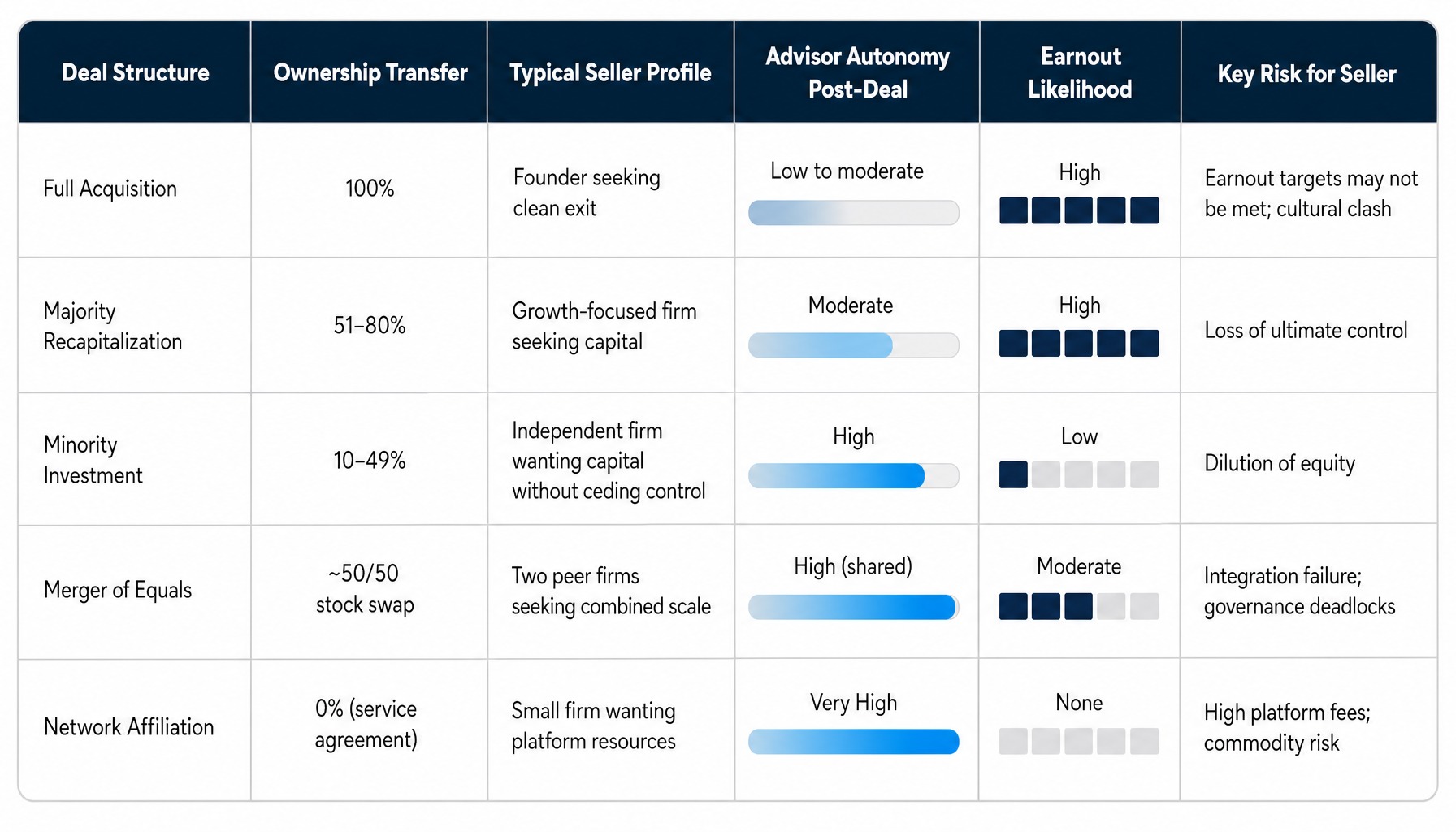
Five RIA M &A deal structures compared – autonomy and risk vary dramatically by model.
Each model reflects a different balance of liquidity, control, growth capital, and integration complexity. For example, a full acquisition typically involves the greatest transfer of ownership and often the most significant post-close integration. A majority recapitalization usually allows a founder or leadership team to retain a meaningful stake while bringing in outside capital. A minority investment preserves more control, but still introduces a new investor relationship and a different set of governance considerations.
Mergers of equals can offer shared scale and governance, but as one AdvisorHub analysis noted, they can also become a "1+1=0" outcome if the cultures clash. These deals require careful cultural and operational evaluation to determine whether two leadership teams can function cohesively. Network affiliations, by contrast, generally preserve ownership while giving firms access to shared resources, with a different tradeoff between independence and platform dependence.
Why EBITDA Multiples Alone Are a Limited Measure of Deal Economics
Headlines about 15x or 20x EBITDA multiples in RIA deals make for compelling conference slides, but they do not always reflect the full economics of a transaction or the amount a seller receives at closing. Focusing too heavily on a single metric can obscure the mechanics of deal structuring and create unrealistic expectations for firm owners. The headline multiple is often a starting point for negotiation, not the final number.
There are three primary reasons the stated multiple may not tell the whole story:
- EBITDA Normalization: Most independent RIAs have owner compensation, discretionary spending (like travel and entertainment), and various one-time costs running through their financial statements. A buyer will perform a "normalization" process to restate the firm's earnings as if it were run as a corporate subsidiary, not a founder-led practice. This normalized EBITDA may differ from the owner's reported figure, and the multiple is applied to the buyer's number, not the seller's.
- Earnout Structures: A significant portion of the purchase price is often contingent on post-close performance. An "earnout" ties payments to hitting specific targets like client retention, revenue growth, or AUM stability over a three-to-five-year period. If these hurdle rates aren't met, that portion of the deal value is not paid. The economics at closing can therefore look different from a headline figure that includes the full potential earnout.
- Equity Rollover: Many deals, particularly those involving PE-backed platforms, require the seller to 'roll over' a meaningful portion of their proceeds into the equity of the acquiring entity. This aligns incentives, but it also means the seller's day-one liquidity event may be smaller than the headline purchase price suggests. Their exposure continues, now tied to the future performance of the combined platform.
Consider a purely hypothetical example for illustration only: a firm with $2M in owner-reported EBITDA receives a '12x multiple' offer, implying a $24M headline value. If a buyer calculates normalized EBITDA at $1.5M, ties part of the consideration to an earnout, and requires an equity rollover, the cash paid at closing could be materially lower than the headline figure. The exact outcome would vary substantially based on the terms of the transaction.
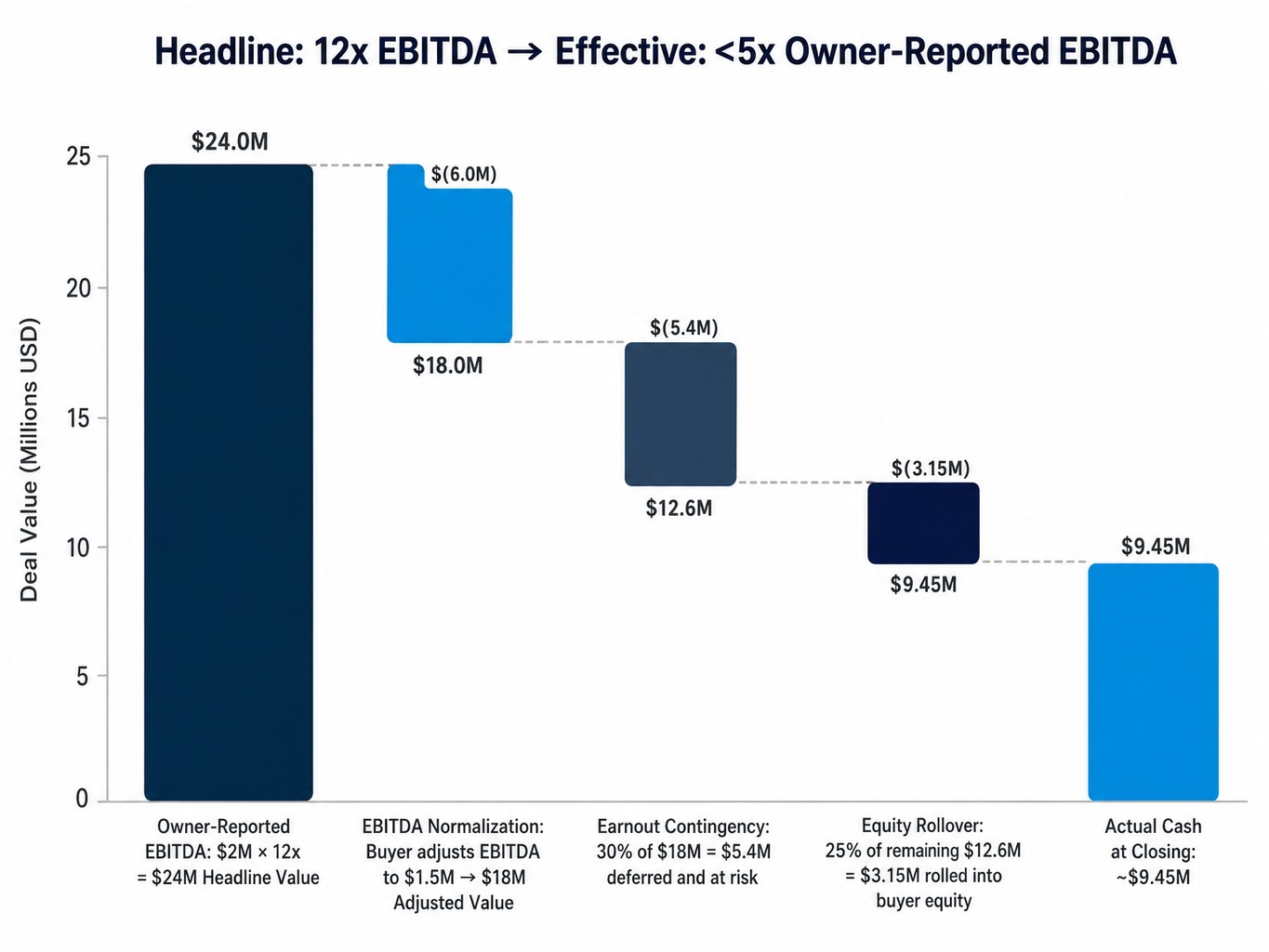
Headline multiples may not reflect the full economics of a deal or the cash a seller receives at closing.
The Operational Readiness Gap: Why Post-Merger Integration Struggles Often Show Up in Workflows
Valuation gets the attention, but integration can play a major role in how a transaction unfolds after close. A common source of post-merger friction is not financial but operational. Two firms that looked complementary on a pro forma AUM slide may discover, after the deal closes, that their advisory workflows are fundamentally incompatible.
Most RIA firms build their advice-preparation and client-delivery processes organically over years. They have different methods for statement intake, different analytics tools, different proposal formats, different compliance review steps, and different client reporting cadences. When two such firms merge, these workflow differences can create immediate friction. Advisors may not prepare client materials consistently. Compliance teams may have limited visibility into outputs from systems they did not build. This is the operational readiness gap, and it often appears in two important ways.
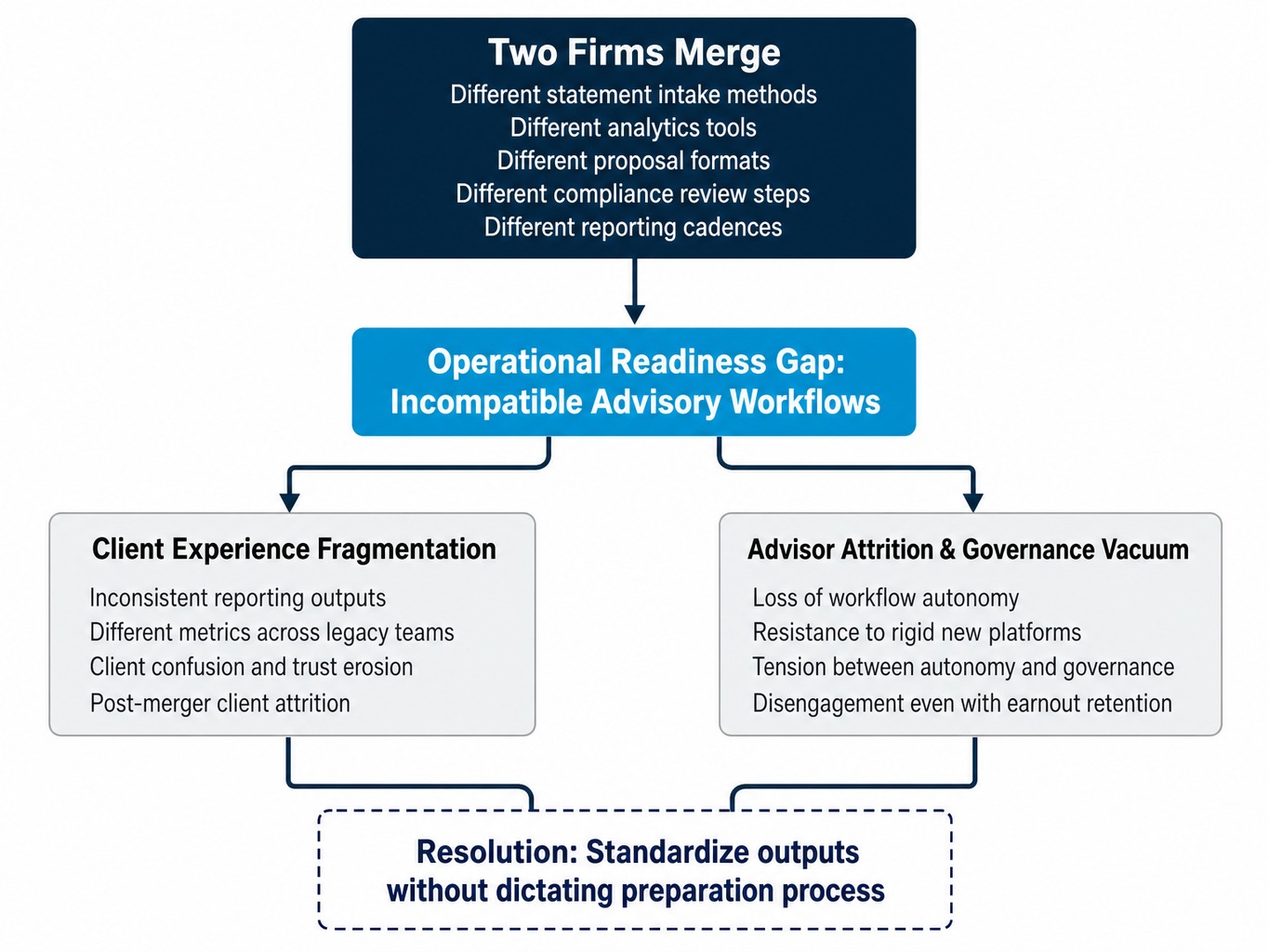
Workflow differences can be an important source of post-merger integration friction.
Read more: Operational Visibility for Wealth Management Growth | VRGL
Client Experience Fragmentation
One of the most visible symptoms of the operational readiness gap is an inconsistent client experience. When two firms merge but continue running separate preparation and reporting workflows, clients served by different legacy teams receive different outputs. One client might get a detailed, analytics-rich quarterly report, while another gets a simple performance summary. For the acquiring firm, this can complicate the goal of presenting a more unified client experience across the combined business.
For the client, it can create confusion and erode confidence, especially if their primary advisor changes or their reporting format shifts without proactive communication . Imagine being a client of an acquired firm and suddenly receiving a new quarterly report that looks nothing like what you're accustomed to, with different metrics and no explanation for the change. This kind of friction can contribute to transition challenges, including retention risk in some situations.
Balancing Advisor Autonomy and Firmwide Governance
Advisor attrition after a merger is not driven by any single factor, but workflow changes and loss of autonomy can contribute to advisor dissatisfaction or attrition. Advisors who have spent years refining their own preparation and presentation processes may be resistant to moving onto an unfamiliar or rigid platform without adequate transition support or a clear rationale.
At the same time, the acquiring firm has a legitimate need for governance. It needs standardized disclosures, compliant proposal templates, and an auditable trail of how advice is being generated and presented. This tension between advisor autonomy and firmwide governance is a central operational challenge of post-merger integration. In practice, firms often need to balance governance and consistency with enough flexibility for advisors to preserve how they work with clients. Both rigid top-down standardization and total fragmentation can create additional integration challenges. Even advisors bound by an earnout may disengage operationally if they feel their professional process has been constrained without support.
What Happens to Clients and Advisors After an RIA Acquisition
After an RIA acquisition closes, clients and advisors experience a series of practical changes that move the deal from a financial transaction to a tangible reality. For clients, three shifts are most common: their advisory agreements are reassigned (a process known as "repapering"), their fee structure may be adjusted, and their relationship with their primary advisor may change.
First, clients must typically consent to the assignment of their advisory contract to the new, combined entity. This is generally a regulatory requirement, and it creates a natural window where a client can choose to leave the firm. Second, acquiring firms often look to standardize fee schedules across their client base, which can result in fee increases for clients who were on a legacy pricing model. Finally, while advisor continuity is often a goal, particularly in tuck-in acquisitions where the original advisor stays on, team restructurings can lead to clients being reassigned.
From a compliance and operational standpoint, firms generally need to manage the consolidation of their Form ADV filings, coordinate the transfer of custodial relationships, and work to keep client communications clear and compliant during the transition. The success of this transition period can be one indicator of the long-term health of the merged entity.
How Firms Use VRGL to Standardize the Work Behind Advice: Before, During, and After a Deal
Operational consistency is relevant in consolidation, but it is also a broader growth challenge for wealth management firms. This is where VRGL fits, not as an M &A integration platform, but as a configurable Growth Platform that helps firms standardize the work behind advice across the client lifecycle.
VRGL supports more consistent analysis, configurable workflows, governance, and client-ready outputs across advisors and offices. Firms can standardize statement extraction, portfolio analytics, proposal templates , and presentation standards while preserving advisor flexibility in how advice is delivered. In a consolidation context, those capabilities can be relevant because they give firms a more repeatable way to prepare, govern, and present advice across teams.
For a firm preparing to sell, having a structured, repeatable advisory process in place can help demonstrate operational maturity during due diligence. More broadly, VRGL provides a common framework for turning portfolio data into consistent, client-ready materials. That can support continuity in analysis and presentation through periods of change, separate from the legal, tax, and custodial steps involved in a transaction.
See how VRGL helps firms standardize the work behind advice .
Conclusion
RIA consolidation is accelerating, and the deal data confirms it. But the industry's focus on transaction volume and headline multiples can obscure another important consideration, the operational infrastructure that shapes how advice is prepared and delivered across a combined firm.
Firms that treat workflow standardization as a post-close afterthought may encounter client fragmentation and advisor frustration during integration. By contrast, firms that build repeatable, governed advisory processes, whether they are buying, selling, or choosing to remain independent, may be better positioned to support consistency as they scale. As the buyer pool contracts and sellers become more sophisticated, operational readiness may become an increasingly important consideration in how firms evaluate transactions.
Frequently Asked Questions
How do earnout structures work in RIA acquisitions?
An earnout ties a portion of the purchase price to post-close performance metrics, typically client retention, revenue maintenance, or AUM growth over a 3-5 year period. The seller receives the earnout payments only if the agreed thresholds are met, which means the seller retains meaningful risk exposure after the deal.
What compliance steps should firms consider when two RIAs merge?
Firms may need to evaluate Form ADV amendments, reassignment of client advisory contracts (which typically requires client consent), custodial relationship transfers, updated disclosure documents, and harmonization of compliance policies. Regulatory requirements vary, so firms generally engage compliance counsel early in the process.
How do I choose between a strategic buyer and a financial buyer for my RIA?
Strategic and financial buyers can differ in how they approach ownership, integration, capital, and governance, but there is significant variation from one transaction to another. Some strategic buyers may emphasize operational alignment, while some financial buyers may offer access to capital and shared infrastructure. The right fit depends on the specific terms, operating model, and long-term priorities involved in a given transaction.
What size RIA is most attractive to acquirers right now?
Buyer interest often varies by market conditions, geography, growth profile, client mix, profitability, and how easily a firm can be integrated. In practice, acquirers pursue a wide range of firm sizes, from smaller tuck-ins to larger platform-building transactions, so attractiveness is not determined by AUM alone.
What are the tax implications of selling an RIA practice?
Tax treatment can vary meaningfully based on deal structure and individual circumstances. At a high level, sellers often evaluate how the transaction is structured, how different components of consideration are treated, and when payments are received. Because these issues are highly fact-specific, firms typically review them with qualified tax and legal professionals.
Is de-consolidation or advisor re-independence a real counter-trend?
Some advisors who joined larger platforms later choose to re-establish independent practices, often citing autonomy, culture, or operating-model fit. While this does not outweigh the broader consolidation trend, it does suggest that post-transaction experience can matter alongside deal terms.