
Key Insights
- Treat onboarding as a revenue system, not an administrative task. Every day of delay between signing and billing can defer revenue, with timing effects that compound across your new client volume.
- Standardize the work behind onboarding data intake, document templates, presentation formats to create a consistent client experience, even if you preserve advisor flexibility in how they deliver advice.
- The most common onboarding failures are silent: ACAT transfers with no client updates, cost-basis reconciliation problems that surface at tax time, and inconsistent experiences across a multi-advisor firm.
- Measure onboarding effectiveness with KPIs that track growth, not just task completion. Focus on time-to-first-value, NIGO rate, billing inception lag, and 90-day retention.
- A repeatable onboarding workflow moves through six phases: data intake, discovery, account opening, asset transfer, portfolio construction, and welcome communication.
Consider a hypothetical scenario where an RIA with $500M in AUM loses a new $3 million household within 90 days. It wasn't because of poor investment performance or a market downturn. It was because the onboarding experience was disorganized. The client received duplicate document requests, waited three weeks for ACAT completion with no status updates, and never saw a consolidated view of their portfolio before the first review meeting.
The cost of that failure can be significant, even when looking at illustrative estimates. That household represented an illustrative estimate of roughly $22,500 in annual revenue and an estimated $225,000 in 10-year client lifetime value, based on standard industry assumptions, gone before the advisor ever delivered a piece of advice.
This scenario is the quiet reality at too many firms. The financial advisor onboarding process is not an administrative step between closing and advising; it is a critical driver of growth and retention for many firms.
This guide details the six sequential phases of a repeatable onboarding workflow, the compliance layer that runs parallel to every step, where the process most commonly breaks, and the KPIs that connect onboarding quality directly to firm growth.
Why the Onboarding Window Has a Meaningful Impact on Revenue Timing
The financial advisor onboarding process is the structured workflow a firm uses to move a new client from a signed agreement to fully funded, actively managed accounts. It is also a critical factor in whether that client stays beyond year one.
A helpful way to view onboarding is as something that can function either as a cost center or as a profit-driving part of the business, depending on how intentionally the process is designed.
The economics are straightforward: delays between agreement signing and the billing inception date can affect revenue timing. For a firm charging 1% on a new $2 million household, a 30-day onboarding delay produces an illustrative estimate of roughly $1,644 in deferred fees, based on the specific billing assumptions used. If that firm onboards 40 new households of similar size per year, that same example translates to an illustrative estimate of over $65,000 in deferred annual revenue, again depending on those assumptions. That can represent meaningful revenue timing impact, which may in some cases reflect operational friction.
The retention impact can also be substantial. Clients who experience a disorganized or slow first 90 days may be more likely to disengage early, regardless of portfolio performance. The initial experience sets the client's baseline expectation for competence and communication for the entire relationship.
Firms that design onboarding as a growth system, not a back-office task, may be better positioned to support long-term client value. They can accelerate time-to-value, start billing sooner, and build trust that helps support long-term retention and future client referrals.
Read more: Operational Visibility for Wealth Management Growth | VRGL
The Six-Phase Financial Advisor Onboarding Workflow
A repeatable wealth management client onboarding workflow moves through six phases in sequence each with a defined action, a measurable output, and a handoff trigger to the next phase. This system transforms a series of disconnected tasks into a governed, predictable process.
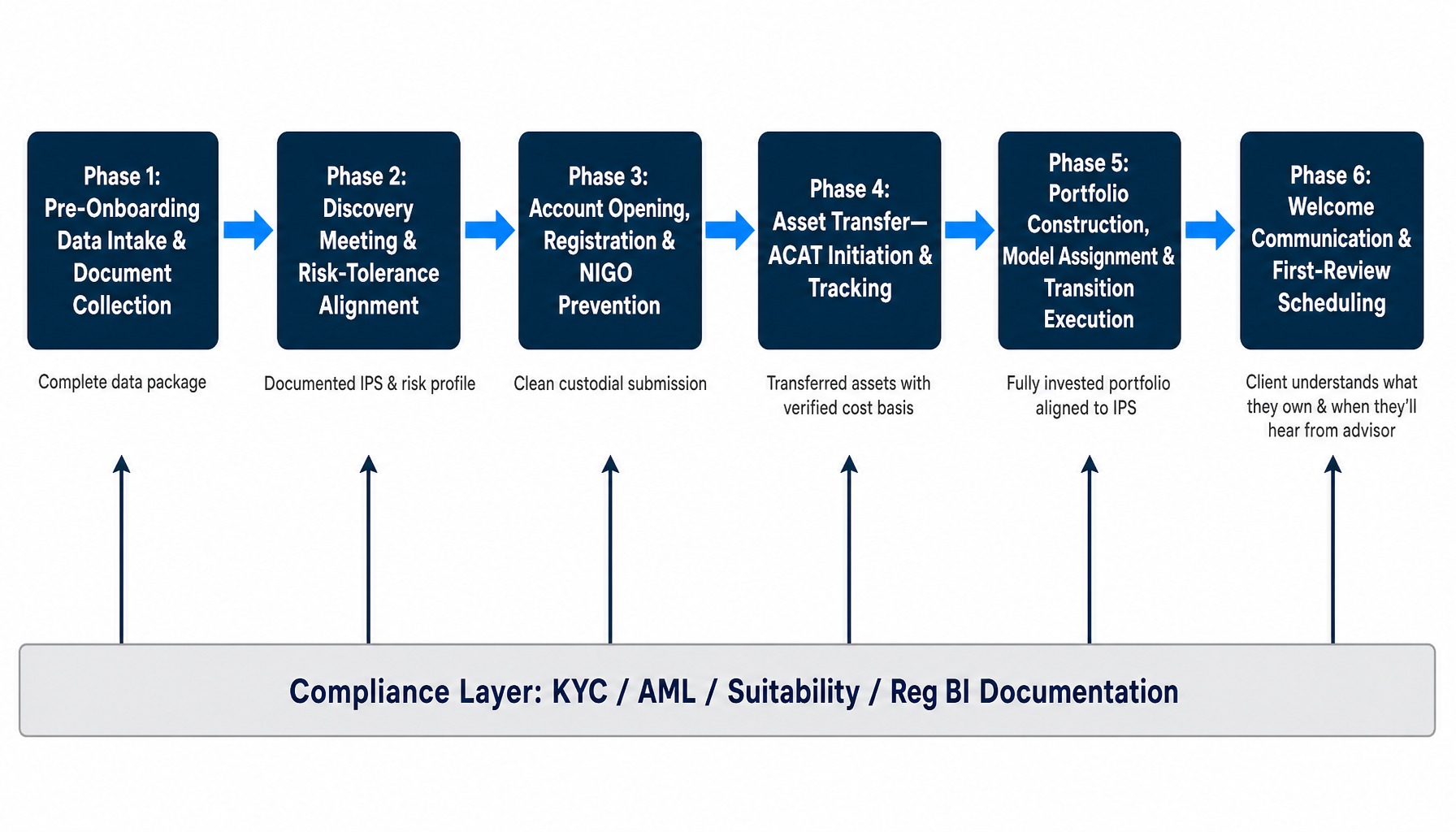
A repeatable six-phase workflow turns wealth management client onboarding into a governed system.
1. Phase 1: Pre-Onboarding Data Intake and Document Collection
Before the first formal meeting, collect the client's existing statements, tax returns, estate documents, and beneficiary designations through a secure digital intake form. Tools like PreciseFP can automate this, while an engagement letter can be sent and returned via DocuSign. Key documents include prior custodian statements for all accounts, the most recent tax return, any trust documents, an existing IPS or financial plan, and current beneficiary and trusted contact designations.
The outcome is a complete data package that eliminates back-and-forth requests and allows the discovery meeting to focus on goals, not paperwork. Firms that skip this pre-intake step and collect documents ad hoc often face significant delays and create a disorganized first impression.
2. Phase 2: Discovery Meeting and Risk-Tolerance Alignment
Conduct a structured discovery meeting that covers goals, time horizon, liquidity needs, and risk tolerance and document the results in a format that can support later portfolio analysis. A risk tolerance questionnaire, whether from a tool like Nitrogen (formerly Riskalyze) or a firm-proprietary system, may produce a scored risk profile that some firms align to a model library, rather than relying only on a subjective conversation summary.
This phase is often where firms produce the investment policy statement (IPS) or its equivalent. The outcome is documented alignment between client expectations and the firm's investment approach, which can support suitability and recommendation documentation over time.
3. Phase 3: Account Opening, Registration, and NIGO Prevention
This is one of the points where the process commonly breaks down. Not-in-good-order (NIGO) rejects from custodians can be a significant source of onboarding delay, often tied to mismatched registration details or missing signatures.
Consider a household opening a joint brokerage account and two IRAs at Schwab Advisor Services. The registration types should be accurate for the account setup (e.g., JTWROS for the joint account, individual for the IRAs). The required forms, new account application, Letter of Authorization (LOA) for discretionary authority, and standing letter of authorization for money movement, also need careful review. Common NIGO triggers in situations like this can include a Social Security number mismatch between Schwab's records and the application, or a missing spousal signature on the joint account forms.
The outcome is a clean submission that clears custodial review with minimal back-and-forth. Using form-filling tools like Quik Forms that pre-populate and validate fields can significantly reduce NIGO-related issues.
4. Phase 4: Asset Transfer ACAT Initiation and Tracking
Initiate Automated Customer Account Transfer Service (ACAT) transfers from prior custodians and establish a tracking cadence so the client is not left wondering where their money is. This involves a key decision: an in-kind transfer may help preserve embedded tax information and avoid immediate liquidation, but it can also bring over positions the advisor may later evaluate for change, creating additional transition-planning considerations.
Custodians like Fidelity Institutional, Pershing, and Schwab can have different ACAT processing timelines, and timing may vary further for alternative holdings or annuities. The outcome is fully transferred assets with verified cost basis where available. One important consideration at this stage is how cost-basis availability will be handled, since gaps in transferred basis data can create reconciliation issues that surface later.
5. Phase 5: Portfolio Construction, Model Assignment, and Transition Execution
Once assets arrive, the advisor can evaluate how the client's current accounts compare with the firm's models, sleeve-level allocations, or broader investment approach, and determine whether any transition steps are appropriate. This phase often benefits from a clear current-vs-proposed analysis covering performance expectations, risk alignment, diversification, the potential tax implications of liquidations, and a fee comparison.
A tax transition optimizer can help illustrate the potential tax implications of moving from current holdings to a proposed approach before any trades are executed. The outcome is a documented transition plan and investment rationale that can support client communication and decision-making. This is often where the advisor's value becomes tangible.
Read more: VRGL Launches Client Transition and Proposal Offering | VRGL
6. Phase 6: Welcome Communication and First-Review Scheduling
Send a structured welcome package and schedule the first portfolio review within a reasonable period after account funding. The welcome package may include a summary of the IPS, fee disclosure confirmation, the advisor's communication cadence, service team contact information, and client portal access instructions.
The first review meeting can present the client's portfolio in the advisor's framework, often covering five dimensions of analysis, performance, risk, diversification, taxes, and fees, to help demonstrate ongoing value. The outcome is a client who better understands what they own, why they own it, and when they will hear from their advisor next, helping support trust early in the relationship.
The Compliance Layer That Runs Parallel to Every Phase
Compliance is not a phase in the onboarding process, it is a parallel consideration that can touch every step, from document collection through portfolio analysis and transition planning. Firms that treat compliance as a single checkbox at account opening may overlook the ongoing documentation considerations that shape both the client experience and internal oversight.
KYC, AML Verification, and Suitability Documentation
Depending on a firm's registration model, account types, and workflows, new client relationships often involve identity verification, anti-money-laundering screening, and suitability or investor-profile documentation before assets are actively managed. KYC may be handled largely through account-opening and custodial processes, while many firms also document how a client's objectives, risk tolerance, time horizon, and other factors connect to the investment approach being discussed.
Items such as trusted contact designations, beneficiary information, and related client records can also become important parts of a well-documented onboarding process. One practical approach is to maintain a documentation checklist alongside the operational workflow in the firm's CRM, whether that's Redtail, Wealthbox, or Salesforce Financial Services Cloud.
Regulation Best Interest and Fiduciary Documentation for Dual-Registered Firms
The documentation approach can vary by registration structure. RIAs, broker-dealers, and dual-registered firms may each face different review, disclosure, and documentation considerations depending on the relationship and account type. In practice, that often means firms need a clear internal process for capturing the rationale, disclosures, and comparative context behind recommendations where applicable.
For example, if a dual-registered advisor recommends a proprietary fund during onboarding without documenting how that recommendation was evaluated against other options, the firm may face more difficult review or supervisory questions later. For firms operating in multiple regulatory frameworks, it can be helpful to build relevant documentation steps directly into proposal and transition workflows rather than treating them as a separate, after-the-fact exercise.
Where Onboarding Breaks: Three Failure Patterns That Cost Firms Clients and Revenue
Many onboarding failures are not dramatic. They are quiet, cumulative, and often invisible to the advisor until the client disengages or leaves. These systemic problems are recognizable to many experienced operators.
The Silent ACAT Delay That Erodes Trust Before Advice Begins
A client signs their agreement and hears nothing for 18 days while their ACAT transfer sits in processing. The advisor assumes the custodian is handling it, the client assumes the advisor has forgotten them. The root cause is a lack of a tracking cadence and proactive client communication during the transfer window.
One approach firms may consider is setting an internal service standard for periodic status updates after ACAT initiation, even when the update is simply that the transfer appears to be progressing normally. Alternative holdings like annuities or limited partnerships can also extend ACAT timelines and may require separate handling. The client's emotional experience during this transfer window can shape their early trust in the relationship.
The Cost-Basis Reconciliation Problem That Surfaces at Tax Time
An advisor executes a tax-aware transition, selling legacy positions and reinvesting. Six months later, the client's CPA flags that cost basis on several transferred positions is missing or incorrect. The delivering custodian didn't transfer the basis data with the ACAT, and the advisor's team never reconciled it.
The root cause is treating cost basis reconciliation as a back-office afterthought rather than a Phase 4 checkpoint. One way firms may address this is by considering cost-basis availability early in the transfer process and gathering supporting records when needed. Tax-aware onboarding depends heavily on the quality of the underlying data.
The Multi-Advisor Consistency Gap That Undermines Firm Growth
A 15-advisor RIA acquires a $5M household through a referral. The referring client had a structured, high-touch onboarding experience. The new client is assigned to a different advisor who uses their own intake process, document templates, and communication cadence. The new client's experience feels disjointed and unprofessional compared to what they were told to expect.
The root cause is that the firm has no centrally governed onboarding workflow. A practical response is to standardize the work behind onboarding data intake forms, document templates, communication sequences, and presentation formats while preserving each advisor's flexibility in how they conduct discovery and deliver advice. Inconsistency across advisors is often less a training issue than a workflow-design issue, and it can become a real barrier to scaling growth.
Designing Onboarding Tracks for Different Client Types
A single onboarding workflow may not serve a $500K rollover IRA and a $10M multi-entity household with equal effectiveness. Many growing firms use configurable onboarding tracks for different client segments.
- High-Net-Worth Households: Clients with trusts, LLCs, or family entities may involve multi-custodian account opening, more extensive entity documentation, and sometimes multiple discovery meetings before portfolio recommendations are finalized. Workflows often need to accommodate complex household linking and sleeve-level analysis. The timeline can also stretch materially depending on complexity.
- Clients Transitioning from Another Advisor: Whether a breakaway transition or a competitive switch, these clients often involve careful handling of in-kind transfers, cost basis preservation, and sensitivity to their prior experience. The process can also include extensive repapering across multiple accounts.
- Next-Generation Inheritors: These clients may benefit from a different discovery conversation focused on their own goals, not the original client's. They also may prefer a different communication style and meeting cadence.
The core onboarding phases remain the same, but the depth, documentation, and communication cadence within each phase may be configurable by client segment. This allows a firm to scale its process without losing personalization.
Five KPIs That Measure Onboarding as a Growth Function
Many firms track whether onboarding is "done," but not always whether it is working. To manage onboarding as a growth function, track these five KPIs:
- Time-to-First-Value: The number of days from a signed agreement to the moment the client sees their first portfolio analysis in your firm's framework. This isn't just account funding, it's the moment they experience your differentiated insight.
- NIGO Rate: The percentage of account applications rejected by custodians on first submission. A well-governed process may use this metric to monitor how often applications need rework before approval.
- Billing Inception Lag: The average number of days between agreement signing and the first fee billing. Every day of lag can affect revenue timing.
- 90-Day Retention Rate: The percentage of new clients still active after 90 days. This can serve as one useful early indicator of longer-term relationship health and onboarding effectiveness.
- Referral Velocity from New Clients: The number of qualified referrals generated by clients within their first year. Strong referral activity can be one signal that the early client experience is landing well, although many factors can influence referrals.
These metrics help turn onboarding from a back-office process into a measurable growth function.
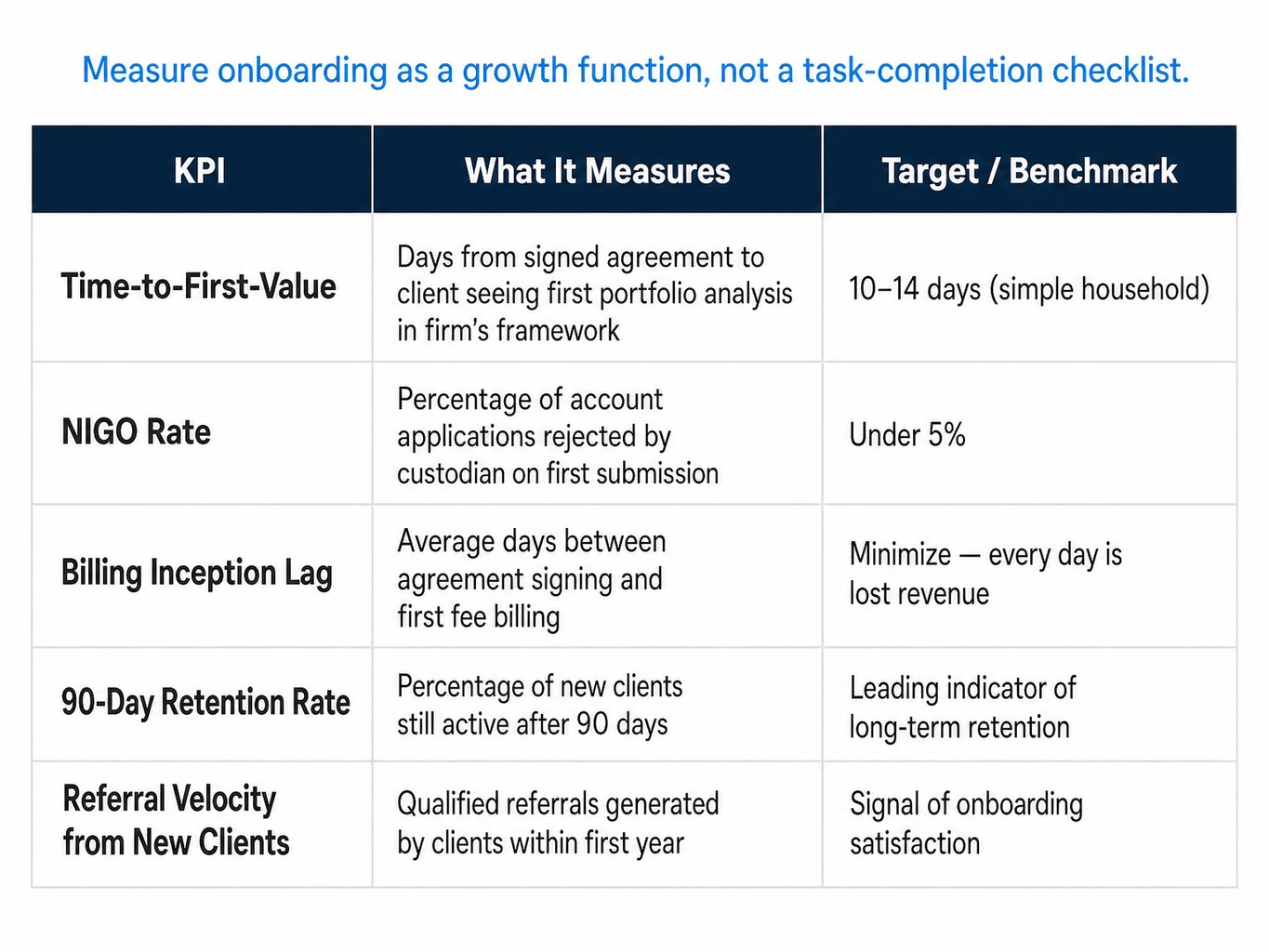
Five KPIs that help connect the financial advisor onboarding process to broader firm growth.
How VRGL Connects the Onboarding Workflow Into a Single System of Work
The core tension in many wealth management onboarding processes is coordinating data intake, portfolio analysis, risk profiling, tax-aware transition planning, and client-ready presentations. Many firms bridge this gap with disconnected tools, spreadsheets, and manual work, creating the consistency gaps and failure modes described above.
VRGL helps connect the analytical and presentation parts of onboarding into a configurable system of work. It does not replace your CRM, custodian, or account-opening process. Instead, it supports the workflows between data intake and client-ready output.
Automated statement extraction from paper or PDF statements can significantly reduce manual data entry in Phase 1. Institutional-grade VRGL Analytics across performance, risk, diversification, taxes, and fees support the current-vs-proposed analysis in transition planning. Integrated risk tolerance questionnaires support advisor workflows around client profiling and portfolio analysis. Finally, white-labeled proposals and presentations can help firms deliver more consistent, centrally governed output across advisors. For enterprise firms, centrally managed presentation standards and disclosure templates can help address the multi-advisor consistency gap, making growth more repeatable.
Onboarding Is the First, Best Demonstration of Your Value
The financial advisor onboarding process is not just a checklist to complete. It is one of the earliest and most visible demonstrations of how your firm delivers advice.
Firms that design onboarding as a revenue and retention support system with governed workflows, parallel documentation, and measurable KPIs may be better positioned to support growth, strengthen consistency, and improve the early client experience. They can build trust from day one, accelerate revenue timing, and create a stronger foundation for long-term relationships.
In our view, the firms growing most consistently are often the ones that pair strong marketing with a clear and repeatable client experience. When the relationship starts with clarity, confidence, and a visible system of work behind the advice, firms are better positioned to support retention over time.
Frequently Asked Questions
How long does the typical wealth management onboarding process take from signed agreement to fully funded accounts?
For a straightforward household with one or two accounts at a single custodian, onboarding can sometimes move relatively quickly. More complex households with alternative holdings, multiple entities, or multiple custodians often take longer. Transfer timing is one major variable, and the full timeline can vary meaningfully depending on the assets, account types, and firms involved.
What CRM and workflow tools do financial advisors use for client onboarding in 2026?
Common CRM choices include Salesforce Financial Services Cloud, Redtail CRM, and Wealthbox CRM. These are often paired with tools like PreciseFP for digital data intake, DocuSign for e-signatures, and a portfolio analytics platform for statement extraction and proposal generation. The key is integrating these layers to avoid the consistency and tracking gaps that create friction.
What is the difference between onboarding at an RIA versus a wirehouse or broker-dealer?
RIAs often have more flexibility to design their own onboarding workflows, while wirehouses and broker-dealers may provide more centralized infrastructure. Dual-registered firms can face added complexity because documentation, disclosure, and supervisory considerations may differ by account type and regulatory framework.
How do you reduce NIGO rejection rates during new account opening?
One effective approach is using tools that help pre-populate and validate fields before submission. Common NIGO triggers can include SSN mismatches between the custodian's records and the new application, as well as missing signatures on joint or trust accounts. Many firms also use a pre-submission review checklist to catch issues before forms are sent.
What should a financial advisor include in a new client welcome kit?
A welcome kit can contain a summary of the client's investment policy statement, fee disclosure confirmation, the advisor's communication cadence, service team contacts, and client portal access instructions. Avoid generic brochures, the kit should reflect the specific decisions made during discovery, reinforcing that the advisor listened and acted on the client's priorities.
How do you handle onboarding for clients with cryptocurrency or digital asset holdings?
Digital assets can introduce additional considerations around custody, valuation, and tax documentation, and practices may vary across firms and custodians. Because this remains an evolving area, many firms take a careful approach to documenting how digital asset holdings are reviewed and addressed within the broader client relationship.