
Key Insights
- Client experience is not client service. Service is about responsiveness; experience is the consistency and rigor of the analysis you deliver at every touchpoint.
- A consistent client experience does not come from branded templates or a polished portal. It comes from a standardized analytical foundation: shared data, shared analytics, and shared presentation logic.
- For independent advisors, analytical consistency is a competitive differentiator that makes competence visible to prospects. For enterprise firms, it is a core governance function.
- The advisor's internal preparation workflow is a significant bottleneck to a better client experience. Reducing manual prep time frees advisors to focus on interpretation and advice.
- Measuring client experience requires looking beyond satisfaction scores (NPS) to upstream metrics like proposal creation time, analytical coverage, and workflow adoption across the firm.
A wealth management firm invests heavily in its client-facing technology. It launches a polished client portal, rolls out uniform branded report templates, and integrates a modern CRM. The firm's marketing materials promise a consistent, high-caliber experience.
Yet, two advisors in the same office deliver materially different outcomes to clients with similar portfolios. One presents a detailed risk and fee analysis derived from institutional-grade tools. The other provides a summary printout from a custodial platform. The client portal looks identical for both clients. The underlying wealth management client experience does not.
This gap exposes a fundamental misunderstanding in the industry. Client experience is not the interface layer. It is whether every touchpoint the initial proposal, the review meeting, the transition analysis, the ongoing reporting runs on the same underlying data, the same analytical rigor, and the same presentation standard.
For independent advisors , this consistency is a competitive differentiator. For enterprise leaders, it is a governance question: can every advisor across the firm deliver the same caliber of experience, not just the same logo? This article reframes what client experience actually depends on and identifies where most firms' efforts misfire.
Client Experience Is Not Client Service and the Difference Matters
Most wealth management firms conflate client service with client experience. Service is about responsiveness, availability, and courtesy. Experience is the consistency, depth, and clarity of every analytical and presentational touchpoint across the relationship lifecycle. The two are not the same, and they fail in different ways. Poor service generates complaints that firms can track and resolve, but poor experience consistency is almost never reported by clients because they have no visibility into what another client received. The problem compounds without a feedback signal.
Consider an advisor who responds to every email within an hour and remembers a client's personal milestones. The service is excellent. But if that same advisor presents a portfolio review built from a spreadsheet with no risk attribution, no fee transparency, and no comparison to the client's stated objectives, the experience is thin.
Client service is about the advisor's behavior; client experience is heavily shaped by the firm's infrastructure. That infrastructure is the data, analysis, and presentation foundation that influences what the client actually sees, reads, and evaluates.
This distinction becomes critical when mapped across the client lifecycle:
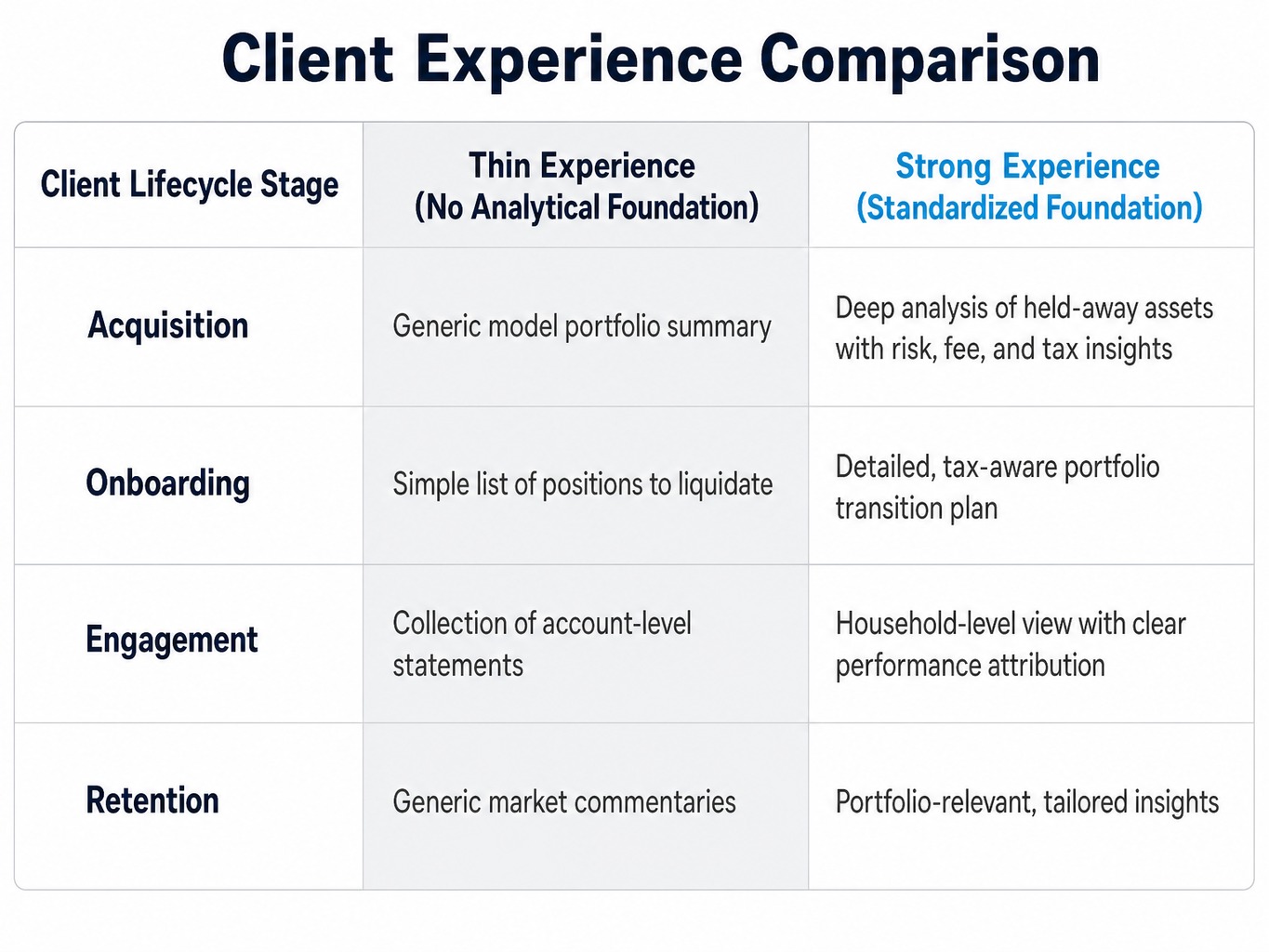
Client experience in wealth management varies by analytical depth at every lifecycle stage.
- Acquisition: Does the initial proposal reflect deep analysis of the prospect's held-away assets , or is it a generic model portfolio summary?
- Onboarding: Is the portfolio transition analysis a detailed, tax-aware plan, or is it a simple list of positions to be liquidated?
- Engagement: Does the quarterly review book provide a household-level view with clear performance attribution, or is it a collection of account-level statements?
- Retention: Are ongoing communications tailored with portfolio-relevant insights, or are they generic market commentaries?
At each stage, the quality of the client experience in wealth management is heavily influenced by whether the advisor has access to a repeatable workflow that produces outputs of consistent depth and clarity. Investing in service improvements is valuable, but it cannot fix a gap in the analytical and presentational infrastructure that underpins the advice itself.
The Real Foundation of Client Experience: Shared Data, Shared Rigor
Client experience consistency does not come from standardizing the interface or the branding. It comes from standardizing the analytical foundation ensuring that every proposal, every review, and every transition analysis draws from the same data extraction process, the same risk and fee analytics, and the same presentation framework.
When the underlying data and analysis are consistent, the client-facing output is consistent regardless of which advisor prepares it. When they are not, no amount of portal design or template polish can close the gap. Standardizing the client-facing template without standardizing the analytical inputs underneath it can actually make inconsistency harder to detect, because the uniform visual layer masks divergent assumptions. The implications of this challenge differ significantly by firm type.
For Independent Advisors: Consistency as Differentiation
For an independent RIA, the client experience gap is most visible during prospect conversion. When a firm's analytical foundation varies by advisor, the cost shows up directly in the sales cycle. A prospective client who receives a rigorous, data-dense proposal from one advisor and a surface-level summary from another is effectively evaluating two different firms, and that inconsistency erodes the brand promise marketing spent years building.
Imagine a prospect brings in statements from two prior advisors. One advisor has their team manually enter holdings into a spreadsheet and produces a generic allocation pie chart. Another uses a platform with structured data extraction and institutional-grade analytics to present a consolidated, household-level view with risk attribution, fee analysis, tax implications, and a side-by-side comparison to a proposed model.
Both advisors may be equally competent fiduciaries. But the second advisor's client experience communicates that competence in a way the prospect can see, evaluate, and trust. For independent firms, the quality and consistency of the analytical output is the differentiator. It is what makes the firm's advice feel institutional-grade, helping to justify fees and win business from larger, more established competitors.
Read more: How to Create Winning Proposals: 3 Tips for Advisors
For Enterprise Firms: Consistency as Governance
For enterprise wealth management firms, the client experience problem is a governance problem. Can leadership ensure that every advisor across offices, teams, and regions delivers the same caliber of analysis and presentation not just the same branding?
In a hypothetical workflow audit for one multi-office firm, a review revealed that advisory teams were pulling portfolio data from different sources, running analysis in separate spreadsheets, and formatting proposals in their own templates. Two clients with nearly identical portfolios received proposals that differed in fee presentation, risk framing, and asset classification labels. The inconsistency was invisible to leadership because the client-facing portal looked uniform, but the analytical layer underneath was entirely fragmented.
This is where brand consistency without workflow consistency becomes cosmetic. Enterprise governance over the wealth management client engagement model requires governance over the preparation workflow itself the data extraction, analytics, proposal templates, and disclosure standards that produce the client-ready output. Without that, leadership has no visibility into whether their firmwide standards are operational or merely aspirational.
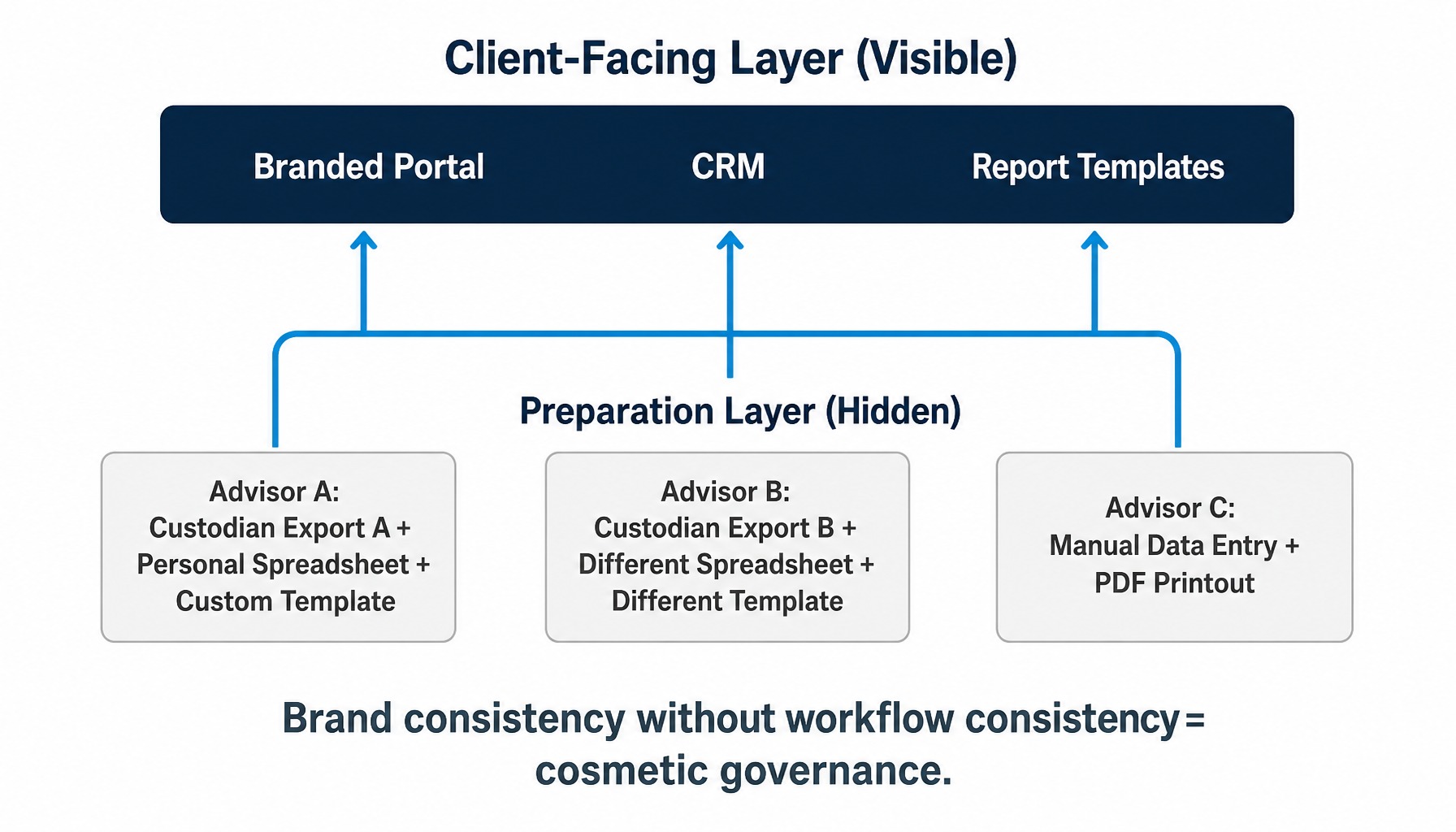
Wealth management client engagement governance requires workflow consistency, not just brand consistency.
Read more: Operational Visibility for Wealth Management Growth | VRGL
The Advisor's Preparation Workflow Is the Hidden Bottleneck
Firms invest heavily in the client-facing layer portals, apps, branded reports but often underinvest in the advisor-facing layer that feeds it. The experience the client sees is the direct output of a preparation process the client never sees. When that preparation process is manual, fragmented, or inconsistent, the output reflects it.
Picture an advisor preparing for a quarterly review. They spend two hours manually consolidating holdings from three different custodians, re-keying data into a spreadsheet, and formatting a presentation. By the time the meeting starts, the advisor has spent more time on data assembly than on thinking about the client's actual situation and goals. The review meeting feels rushed, the analysis is shallow, and the client leaves feeling processed, not advised.
Now contrast this with an advisor whose preparation workflow is built on a system that automatically extracts and consolidates statement data, runs risk and fee analytics, and produces a branded presentation. That advisor is freed to spend their preparation time on interpretation, strategy, and anticipating the client's specific questions. The client experience is better not because the portal is better, but because the advisor had more time and better data to work with.
Improving client experience often requires improving the advisor's internal workflow. It is a question of advisor capacity; the number of clients an advisor can serve well is constrained by how much time each client's preparation requires. Reducing that manual burden is one of the most direct ways to scale a financial advice practice and elevate the quality of advice delivered.
What to Measure When You Measure Client Experience
Most firms default to client satisfaction surveys or Net Promoter Score (NPS) as their primary client experience metric. These are useful but are fundamentally lagging indicators. They tell you how clients felt after the experience, not whether the experience itself was consistent or analytically sound. In fact, NPS and client satisfaction scores are structurally unable to capture experience consistency because they measure individual sentiment at a point in time, not variance across clients or advisors.
To get a true read on client experience, firms should also measure upstream indicators of consistency and efficiency:
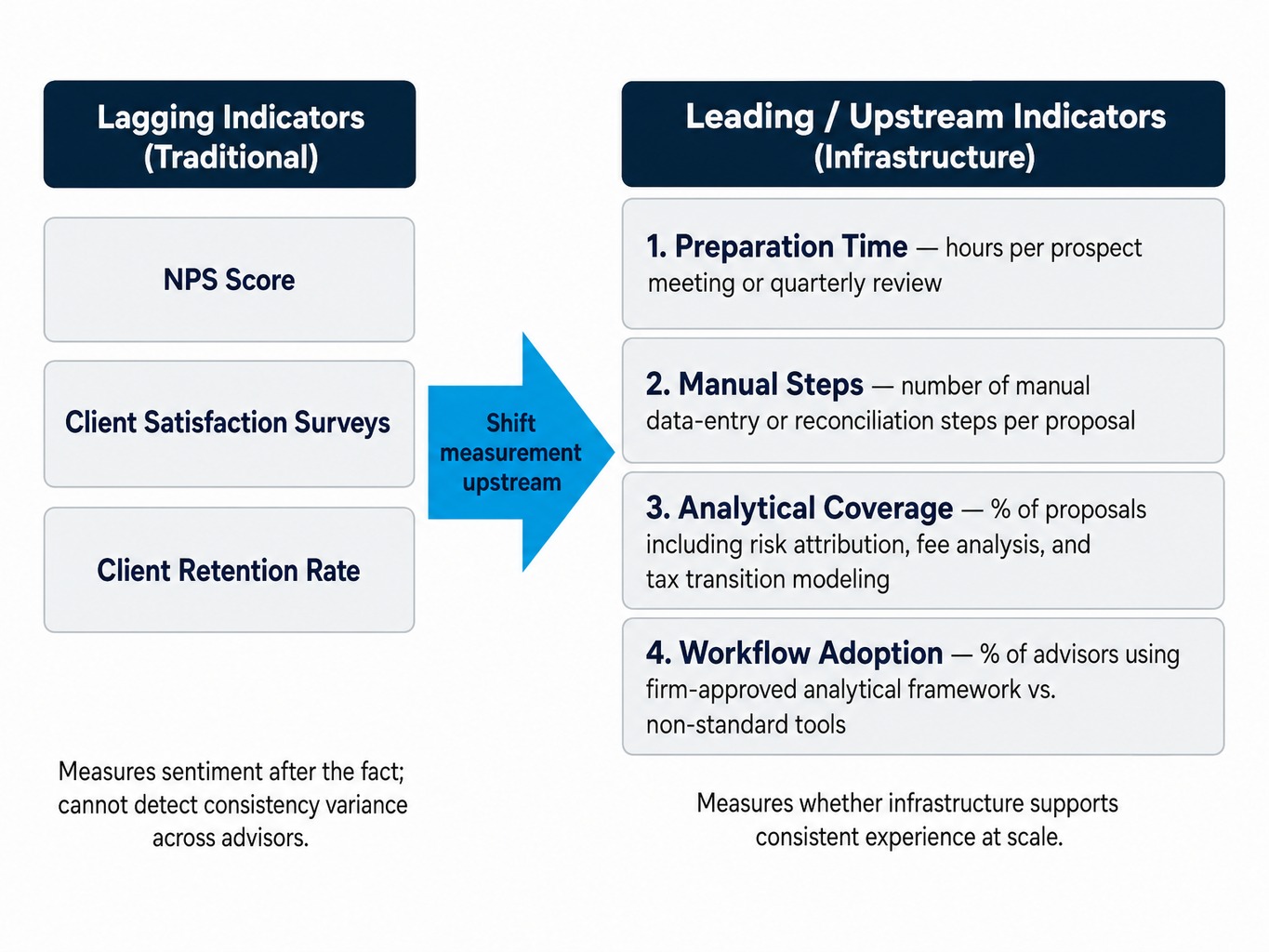
Measuring wealth management client experience requires upstream infrastructure metrics, not just NPS.
- Preparation Time: How long does it take an advisor to prepare for a standard prospect meeting or quarterly review?
- Manual Steps: How many manual data-entry or reconciliation steps are involved in building a proposal?
- Analytical Coverage: What percentage of proposals include risk attribution, fee analysis, and tax transition modeling? Is this consistent across the book of business?
- Workflow Adoption: Are all advisors using the same firm-approved analytical framework, or are some using spreadsheets and other non-standard tools?
For enterprise firms, a critical governance dimension must be added: can leadership see which advisors are using the firm's standard workflow and which are not? Without that visibility, client experience consistency remains an unmanaged risk. These upstream metrics reveal whether a firm's infrastructure can support a consistent client experience at scale or whether quality depends on individual advisor effort, which does not scale.
Building the Analytical Foundation for Consistent Client Experience
The central tension for advisory firms is clear: client experience consistency depends on a shared analytical foundation, yet most firms' preparation workflows are fragmented across spreadsheets, custodial exports, and disconnected tools. This is the operational gap that a configurable system of work behind advice is designed to close.
VRGL provides the infrastructure that enables firms to standardize the work that happens before the client sees anything. The platform creates a repeatable path from raw data to client-ready output:
- Automated Statement Extraction creates a consistent data starting point, converting PDF statements from any custodian into structured, analyzable data in minutes. This eliminates the manual entry that consumes advisor time and introduces errors.
- Institutional-Grade Analytics ensures every proposal and review draws from the same analytical depth, covering risk, fees, diversification, and tax transition modeling. This allows firms to set a firmwide standard for rigor.
- White-Labeled Proposals and Reports standardize the presentation layer, supporting compliance workflows through firm-approved disclosures and consistent branding, but without dictating how advisors advise.
For independent advisors, this means every prospect sees the same caliber of analysis that communicates competence and differentiates the firm. For enterprise firms, this means firmwide governance over the preparation workflow, with controlled templates, permissions, and audit trails that give leadership visibility into whether consistency is operational or just aspirational.
See how VRGL helps firms build consistency into the work behind advice .
Client experience in wealth management is not determined by the portal, the app, or the birthday card. It is determined by whether every advisor at the firm can deliver the same depth of analysis, the same quality of presentation, and the same rigor at every client touchpoint from the first proposal to the tenth annual review. That consistency is an infrastructure decision, not a branding decision.
Firms that continue to treat client experience as a design problem will keep redesigning interfaces, chasing a feeling of modernity without addressing the underlying fragmentation. The firms that treat it as a workflow and data problem will build the kind of consistency that compounds over time across advisors, across offices, and across generations of clients. They understand that the work behind the advice is the client experience.
Frequently Asked Questions
How does compliance affect the client experience in wealth management?
Compliance requirements like disclosures and suitability documentation can either erode client experience by creating friction or reinforce it. When these obligations are embedded into the proposal and reporting workflow, the process feels smooth to the client. When they are bolted on as a separate, manual step, they can introduce delays and make the engagement feel disjointed.
Can firms personalize client experience at scale without adding headcount?
Yes. Personalization at scale depends less on individual advisor effort and more on whether the firm's infrastructure can produce client-specific outputs from a repeatable workflow. When statement extraction, analytics, and report generation are systematized, each client's deliverable is personalized by their actual data, not by an advisor manually customizing a template.
How can firms support next-generation engagement before a wealth transfer?
Next-generation engagement is often stronger when firms have workflows and infrastructure that make relevant communication easier to deliver consistently. That can include household-level visibility, flexible presentation outputs, and branded communication workflows that help teams prepare materials suited to different stakeholders without relying on ad hoc manual effort. In that sense, the supporting system matters because it makes engagement more repeatable across households and advisor teams.
What is the difference between a client portal and a strong client experience?
A client portal is a delivery channel it shows clients information. A strong client experience depends on what information is delivered, how consistently it is produced, and whether it reflects genuine analytical depth. A polished portal displaying shallow or inconsistent analysis is still a weak experience. The preparation and analytics behind the portal matter more than the portal itself.
How do high-net-worth clients evaluate their wealth management experience differently from mass-affluent clients?
High-net-worth and UHNW clients often evaluate experience with a high bar for clarity, sophistication, and relevance, particularly when their financial lives involve greater complexity. In many cases, that can place more weight on capabilities such as tax-aware transition analysis, multi-custodian consolidation, and detailed risk reporting, rather than on digital convenience alone.