
Key Takeaways
- A unified managed account (UMA) is a single custodial account holding multiple investment strategies in distinct "sleeves," coordinated through an overlay function or comparable account-level coordination framework.
- A UMA generally coordinates activity at the account level. Household-level coordination across multiple related accounts is a separate concept, often described as a unified managed household (UMH).
- The primary advantages of a UMA structure are consolidated oversight and trade coordination, but the operational experience for the firm can vary significantly by program design, provider capabilities, and outsourcing model.
- Adopting a UMA program is an operational and governance decision, not just an investment one. Evaluating client base fit, reporting readiness, transition complexity, advisor adoption, and overlay provider capabilities can help firms assess whether the structure aligns with their operational capacity.
- The quality of a UMA program depends heavily on the overlay platform's capabilities, particularly how it handles constraints, data, trading workflows, and coordination across sleeves.
Unified managed accounts have become one of the faster-growing segments of the managed account industry, with assets in UMA programs showing growth over time. The appeal is intuitive: consolidate multiple investment strategies into a single account with coordinated oversight, simplifying the client's financial picture.
But the structural and operational implications of adopting a UMA account program extend well beyond selecting strategies. The reality for advisory firms is that sleeve-level management, overlay coordination, fee transparency, reporting complexity, and governance requirements can become more sophisticated when moving from simpler account structures to a UMA framework. At the same time, an effectively designed and outsourced UMA program can reduce the firm's internal operational workload despite that added structural complexity.
This is not a sales case for or against UMAs. It is a practical examination of how they work, where they add value, and what advisory firms should evaluate before recommending them. Understanding the operational machinery is the first step toward determining if the benefits of a UMA program align with your firm's capabilities and your clients' needs.
What a Unified Managed Account Actually Is
A unified managed account (UMA) is a single custodial account that holds multiple investment strategies, each allocated to a distinct sleeve, managed under a coordinated overlay structure. Unlike a traditional brokerage account where all holdings sit in one undifferentiated pool, a UMA assigns each strategy its own sleeve with defined allocation targets, drift tolerances, and potentially different sub-advisors or model portfolios.
In this structure, the account can hold a range of investment vehicles, including individual securities, ETFs, mutual funds, and other eligible holdings, depending on the program. The defining distinction is not the exclusion of pooled vehicles. It is the ability to accommodate multiple strategies within one coordinated account structure. That design affects tax management considerations, reporting transparency, and how portfolio transitions are handled, creating a different set of responsibilities for the advisory firm compared to simpler single-strategy arrangements. The UMA is less a product and more an operating framework for delivering multi-strategy advice.
How Sleeves Organize Multiple Strategies in One Account
Each sleeve within a UMA functions like a virtual sub-account. It can hold ETFs, individual equities, fixed income, mutual funds, or other securities according to a specific model or strategy. For an illustrative example, one sleeve might follow a large-cap equity model from a third-party manager, another a municipal bond ladder managed by the firm's CIO, and a third a tactical allocation strategy using ETFs.
The key point is that sleeves allow for strategy-level tracking and rebalancing within a single account number. This is an organizational construct, not a custodial one. From the custodian's perspective, there is one account holding all the securities. But from the perspective of the overlay and reporting systems, there are distinct strategy allocations that can be monitored and managed independently.
Coordinated Account Structure vs. Investment Vehicle Type
A UMA is best understood as a coordinated account structure rather than as a statement about which security types it can or cannot hold. Some UMA programs emphasize direct ownership of individual securities in certain sleeves, while others may incorporate ETFs, mutual funds, or blended approaches alongside separately managed sleeves.
This flexibility is what makes the structure distinct. The advisory firm can combine multiple strategies within one account and apply account-level coordination across them, even when the underlying sleeves use different implementation approaches. That can create advantages in oversight, allocation management, and client communication, but it also increases the importance of understanding how the specific UMA program handles reporting, tax considerations, and sleeve interactions.
How a UMA Differs from an SMA and a Model Portfolio
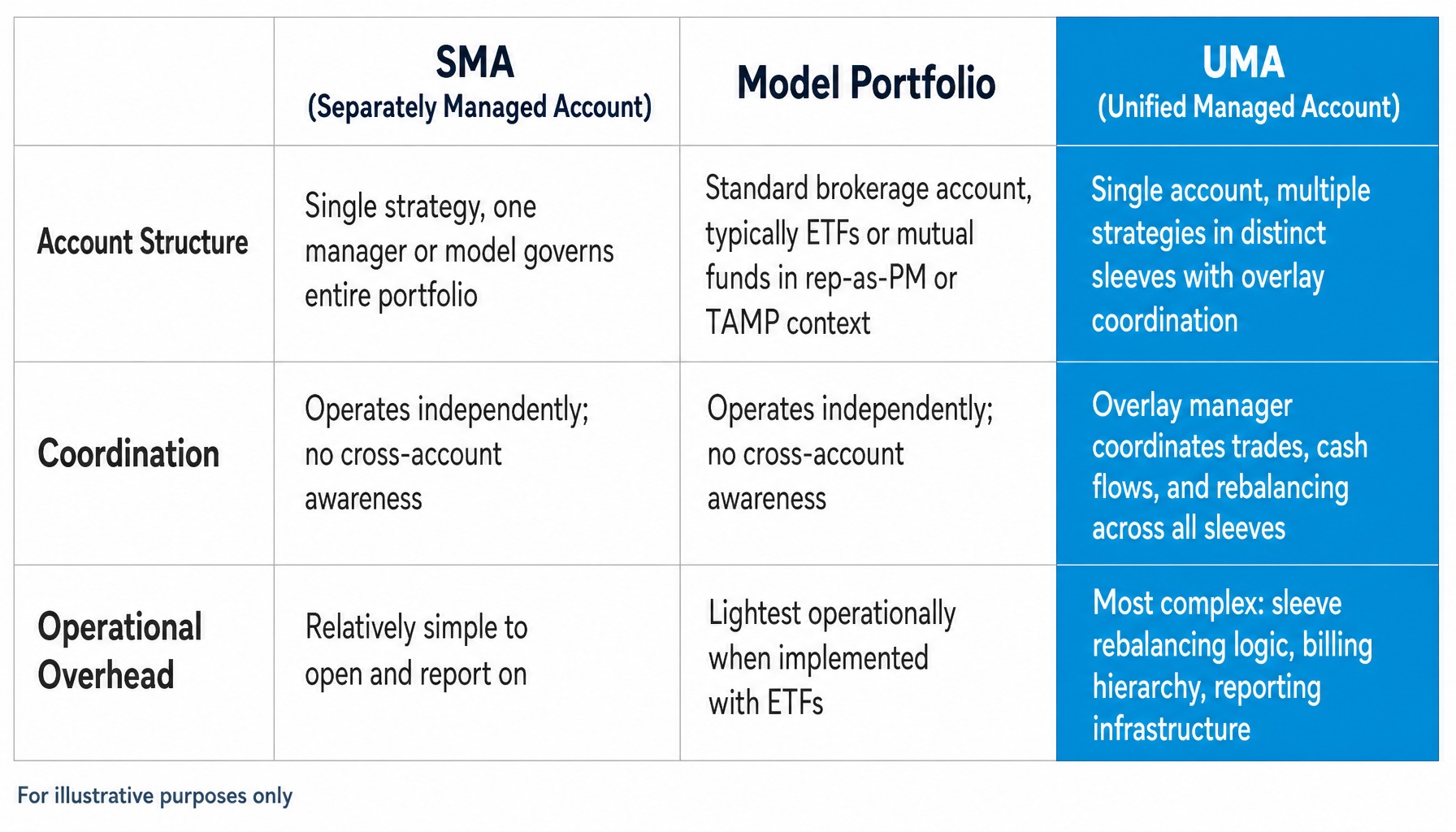
The terms UMA, separately managed account (SMA), and model portfolio are often used loosely, but the distinctions are operationally significant for an advisory firm. The choice between these structures is not just about investment preference. It is about how much operational infrastructure the firm is prepared to support.
- Account Structure: An SMA is typically a single-strategy account where one manager or model governs the entire portfolio. A model portfolio is often implemented in a standard brokerage account, using ETFs or mutual funds in a rep-as-PM or TAMP context. A UMA consolidates multiple strategies into one account with sleeve-level separation. In practice, UMA programs vary in how the coordination function is structured, how much discretion sits with the overlay, and how responsibilities are divided across the provider, advisor, and underlying managers.
- Coordination: SMAs and model portfolios often operate more independently than a UMA structure. If a client holds three different SMAs, the underlying managers may not have direct visibility into one another's activity, although coordination can still occur through the advisor, centralized trading infrastructure, or a household-level management platform. A UMA introduces an overlay manager or comparable coordination function that can coordinate trades, cash flows, and rebalancing across sleeves, potentially reducing redundant transactions.
- Operational Overhead: SMAs are relatively simple to open and report on. Model portfolios implemented with ETFs can be the lightest operationally. A UMA account often involves more sophisticated sleeve rebalancing logic, billing hierarchy configuration, and reporting infrastructure than simpler account types, although the operational burden experienced by the advisory firm can vary significantly depending on the provider and service model.
When firms adopt UMA programs without evaluating the operational dependencies between overlay management, sleeve-level governance, and advisor workflow, the resulting inefficiencies can quietly erode the capacity gains the structure was supposed to deliver. This kind of multi-strategy complexity can also increase the importance of clear comparative analysis and client communication, which is where platforms like VRGL can support the advisory workflow without serving as the ongoing UMA management or overlay layer.
Read more: Operational Visibility for Wealth Management Growth | VRGL
How Overlay Management Coordinates Trades Across UMA Sleeves
The overlay function is what makes a UMA more than just multiple strategies sharing an account number. It is the coordination layer that manages interactions between sleeves. The overlay manager, which may be a person, a team, or a systematic process on a dedicated overlay platform, is responsible for monitoring allocations, managing cash flows, and coordinating rebalancing.
The overlay manager does not simply net trades across sleeves. It must reconcile potentially conflicting instructions from sub-advisors who may have limited visibility into each other's activity. Its value depends heavily on the quality and granularity of its constraint rules, but also on execution quality, data integrity, custodial connectivity, tax lot information, and the program's ability to implement investment strategies consistently.
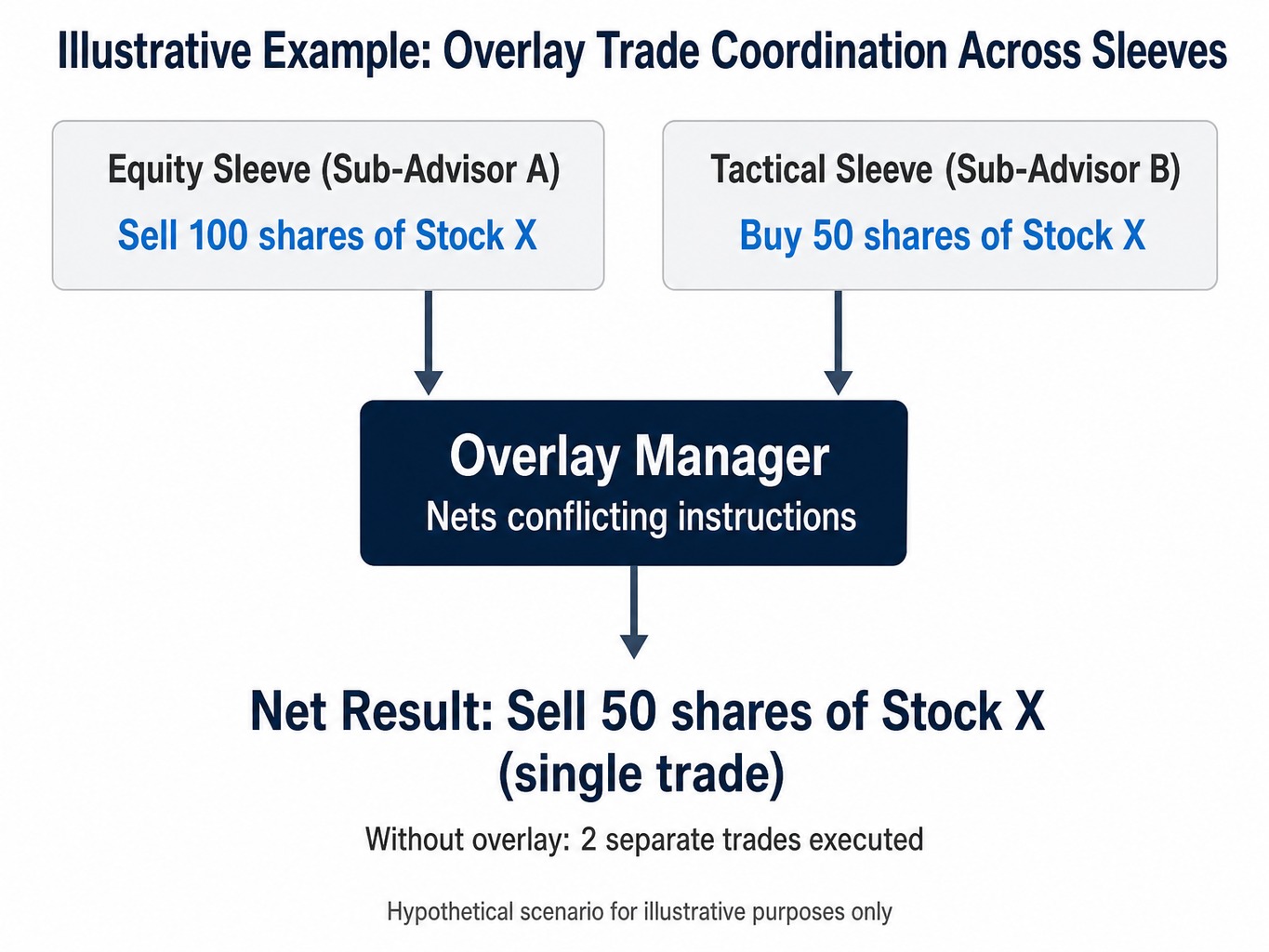
Consider this hypothetical scenario: a UMA has an equity sleeve managed by Sub-Advisor A and a tactical sleeve managed by Sub-Advisor B.
- Sub-Advisor A's model signals a rebalance to sell 100 shares of a specific stock.
- Simultaneously, Sub-Advisor B's model signals a need to buy 50 shares of the same stock.
Without an overlay, these might execute as two separate trades, generating unnecessary transaction costs and commissions. With an overlay, the system may be able to net the instructions, resulting in a single trade to sell only 50 shares, if the overlay has the authority, tax lot visibility, restriction handling, and sleeve-accounting framework needed to do so. This coordination can also support wash sale awareness across sleeves, but the effectiveness of that monitoring depends on the scope and quality of the information available to the overlay system, including whether relevant activity outside the UMA is visible. The firm's compliance and tax processes remain responsible for final determinations.
Advantages and Limitations of Unified Managed Accounts for Advisory Firms
Most marketing for unified managed accounts emphasizes investor benefits like consolidated statements and simplified tax coordination. However, the decision to adopt a UMA program is made at the firm level and involves operational trade-offs that directly affect advisor workflows, compliance, and reporting.
Where UMA Structure Can Add Value
From a firm's perspective, the structural advantages of a UMA are primarily operational.
- Consolidated Oversight: A single account with sleeve-level visibility can simplify an advisor's ability to review a client's total allocation and communicate it more clearly during reviews. It provides a more integrated view than reconciling statements from three separate SMAs.
- Trade Coordination: As discussed, effective overlay management can reduce redundant or conflicting trades across strategies. This may lower transaction costs and support more tax-aware management at the account level, especially when raising cash or rebalancing the entire portfolio.
- Scalability for Multi-Strategy Clients: For clients who need exposure to multiple distinct investment approaches, a UMA can reduce the number of accounts the firm needs to open, maintain, and report on. Depending on the provider and service model, this can improve operational efficiency for both the advisor and back-office teams. A common misconception is that a UMA automatically provides better tax coordination. In practice, the tax benefit depends on whether the overlay has been configured with client-specific constraints and whether the firm's operations team maintains those constraints as the client's situation changes.
Operational and Structural Limitations to Evaluate
The advantages of a UMA come with significant operational considerations that may not be suitable for every firm.
- Operational Complexity: UMA programs may require more sophisticated rebalancing logic, billing hierarchy configuration, and reporting infrastructure than simpler account types. Mid-size firms may find the underlying infrastructure demands are disproportionate to the client base that genuinely needs this level of multi-strategy coordination, although outsourced programs can reduce the internal burden on the advisory firm.
- Platform Dependency: The quality of the UMA experience depends heavily on the overlay platform, its custodial integrations, and the reporting tools the firm uses. Switching platforms or custodians can be significantly more complex with a book of UMA accounts than with SMAs.
- Investment Minimums and Fee Layering: Investment minimums vary significantly by provider, strategy, and program. Some UMA programs carry higher minimums than individual SMAs or model portfolios, while others may be more accessible. Furthermore, fee transparency in UMAs can be more complex because the advisory fee, sub-advisory fees, and any overlay management fee may each be calculated on different bases, making it important for firms to map the full fee structure before presenting it to clients.
- Reporting Complexity vs. Reporting Simplicity: Producing UMA reports can require more sophisticated underlying infrastructure because firms may need both consolidated account-level views and sleeve-level detail. At the same time, consuming those reports can be simpler for clients when the end result is a more consolidated presentation of the relationship.
What Firms Should Evaluate Before Adopting a UMA Program
The decision to offer a UMA account is often framed as an investment menu question, which strategies to include, which sub-advisors to select. The more consequential evaluation, however, is operational.
Consider an illustrative scenario: a mid-size RIA migrates several model strategies into a UMA structure, expecting consolidated reporting and simplified rebalancing. After implementation, the firm discovers that its overlay provider cannot accommodate the firm’s preferred approach to cross-sleeve coordination. The operations team spends months manually tracking activity in a spreadsheet before acknowledging the overlay’s rule engine needs reconfiguration. In cases like this, the gap is often less about the technology itself and more about the operational questions that were not evaluated alongside the investment decision.
Firms can strengthen this evaluation by focusing on five key criteria:
- Client Base Fit: Does the firm have a critical mass of clients with multi-strategy needs and sufficient account sizes to justify the infrastructure investment? If the UMA structure is only suitable for a handful of the firm's largest clients, the operational cost may outweigh the benefit.
- Reporting and Governance Readiness: UMA accounts can require more sophisticated reporting infrastructure. Firms can assess whether their current systems can present sleeve-level performance, allocation, and fee information clearly, while also delivering a consolidated client-facing experience and supporting consistent presentation across advisors.
- Transition Complexity: Moving existing clients from SMAs or model portfolios into a UMA structure may involve account registration changes, transfer planning, cost basis record transfer or reconciliation, and potentially taxable events if securities are sold. In some cases, holdings may move in kind and historical cost basis records may carry over. This is not a uniform conversion process, so firms benefit from understanding the operational and tax implications of the specific transition path under consideration.
- Advisor Adoption: A UMA program only works if advisors understand the structure well enough to explain it to clients and use the overlay tools effectively. Firms may want to consider how they will support advisor education and workflow integration to ensure the platform is used as intended.
- Overlay Provider Evaluation: Because so much of the UMA experience depends on the coordination layer, firms can also evaluate the overlay provider directly. Areas to assess may include trading authority, customization options, tax management approach, custodial compatibility, data availability, and how the platform handles client-specific constraints across sleeves.

How VRGL Supports the Analytical Work Behind Multi-Strategy Portfolio Decisions
Unified managed accounts introduce structural complexity that affects how firms analyze, present, and communicate portfolio information. Evaluating whether a UMA structure is appropriate for a prospect or comparing their current multi-account arrangement against a proposed UMA can involve comparative analysis across performance, risk, diversification, fees, and tax considerations, alongside operational, investment, tax, and client-specific factors that extend beyond comparative analysis alone.
This analytical work is what VRGL is designed to support within the advisory workflow. Discovery and fact-finding remain with the advisor. Once a prospect’s or client’s statements have been gathered, VRGL’s Statement Extraction and Comparative Portfolio Analysis capabilities can help organize existing holdings, compare current allocations against proposed strategies, and support clearer client-ready materials. When firms are evaluating transitions from multiple SMAs into a single UMA structure, the acquisition workflow can include extracting data from existing statements, comparing current allocations against proposed models, and evaluating transition considerations in a more structured way.
This configurable system of work helps advisory firms move from raw statement data to structured comparative analysis across five pillars - performance, risk, diversification, taxes, and fees. Tax Transition Analysis is particularly relevant when evaluating whether existing holdings can move into a proposed UMA structure efficiently, because it can help advisors assess the potential tax implications of selling, retaining, or transitioning positions. The platform connects that analysis to branded, governed proposal outputs, supporting clearer, more consistent conversations about complex portfolio structures. VRGL does not function as an overlay manager or UMA platform.
See how VRGL supports the acquisition workflow behind multi-strategy portfolio conversations
The UMA Is an Operational Commitment, Not Just a Product
A key takeaway is that a UMA account is an operational commitment, not just an investment product. Firms that evaluate UMA programs through both an investment and an operational lens are better positioned to implement them effectively and deliver on their promise of coordinated, multi-strategy management.
While UMAs offer real advantages in oversight and trade coordination, they also introduce complexity in reporting, governance, transitions, and advisor adoption that firms need to evaluate before committing. At the same time, the operational burden experienced by the firm can vary widely depending on provider capabilities, service model, and internal workflow design. As more firms consider sophisticated multi-strategy approaches for clients with complex portfolios, the quality of the analytical and presentation infrastructure behind those conversations becomes as important as the investment architecture itself. A successful UMA program depends not just on the strategies it holds, but on the operational discipline and provider support that surround it.
Frequently Asked Questions
1. Can a UMA account hold both ETFs and individual securities in separate sleeves?
Yes. A UMA's sleeve structure is designed to accommodate different security types. For example, one sleeve might hold individual equities following a direct indexing model, while another holds a ladder of individual bonds, and a third uses ETFs for tactical exposure. The overlay function coordinates across these different sleeve types. The specific securities and vehicle types available depend on the UMA platform and custodial relationship the firm uses.
2. What investment minimums are typical for UMA accounts?
Minimums vary significantly by provider and program. Some UMA programs may set account-level minimums in the low six figures or higher, and individual sleeve minimums may apply on top of that, but ranges differ materially across platforms, strategies, and service models. Firms should evaluate whether their client base has sufficient account sizes to make the UMA structure practical, as higher minimums can limit adoption to a narrower segment of clients.
3. How does billing typically work in a UMA structure?
UMA billing can involve multiple layers: the advisory firm's fee, an overlay or platform fee, and sub-advisor fees for individual sleeves. These are not always simply additive; some platforms bundle overlay and sub-advisor fees into a single wrap fee, while others itemize them. Fund expense ratios apply only to pooled products held within sleeves and are typically already reflected in the fund's net asset value rather than billed separately to the account.
4. What happens to a UMA account if the firm changes overlay platforms or custodians?
Changing the overlay platform or custodian for a UMA program can be significantly more complex than transitioning simpler account types. Sleeve-level allocations, model assignments, billing configurations, and account records may need to be transferred, reconciled, or re-established on the new platform. Historical cost basis records may also need to be transferred and validated, but changing platforms does not inherently create a new tax cost basis. Firms considering a UMA program may want to evaluate platform portability and custodial flexibility as part of their initial due diligence to understand potential downstream friction.
5. How do UMAs affect client reporting compared to holding multiple separate accounts?
UMAs can simplify the client's view by consolidating multiple strategies into a single account statement, but they increase the complexity of what the firm needs to report. Sleeve-level performance, allocation drift, fee breakdowns, and tax lot information all require more granular reporting infrastructure than a single-strategy account. The quality of the client reporting experience depends heavily on the firm's reporting tools and their integration with the UMA platform.
This content is for informational purposes only and should not be considered investment, legal, tax, or compliance advice. All investment decisions should be made based on your own due diligence and in accordance with your firm's policies and procedures.