
Key Insights
- For many financial advisors, unstructured preparation work is a meaningful productivity drain, often more than meetings themselves or clearly defined administrative tasks.
- Standardizing how your firm moves from raw data to client-ready insight to final presentation can help compound advisor capacity over time.
- Five specific decisions around data intake, analysis, presentation, segmentation, and measurement can shape whether a practice scales efficiently or simply stays busy.
- This article proposes measuring productivity by outcomes delivered, such as recommendations presented or reviews completed consistently, rather than relying only on revenue-per-advisor metrics.
- Separating analytical thinking from presentation formatting is a practical way to preserve more of an advisor's cognitive energy for higher-value work.
Many financial advisors feel they have an efficiency problem. They block their calendars with precision, delegate administrative tasks, use a modern CRM, and still end every week feeling behind. In many firms, a common source of that pressure is the preparation work that happens before meaningful client conversations, including analysis, statement review, and proposal assembly. Advisors often describe this work as taking hours when there is no clearly defined process behind it. Across dozens of meetings each month, that repeated workflow can consume a meaningful share of the week and shape whether advisor capacity is compounded or consumed.
From that perspective, financial advisor productivity is less a pure time-management problem and more a workflow standardization problem. The advisors who expand capacity without burning out are often not the ones who simply find more hours in the day. They are the ones who build a repeatable system for the preparation and presentation work that happens between meetings. This article outlines five specific decisions that target this less visible work, helping firms turn ad hoc effort into a source of operational leverage and sustainable growth.
Financial Advisor Productivity Starts with Diagnosing Where Time Actually Disappears
For the purposes of this article, financial advisor productivity can be viewed as the amount of client value and firm output generated per hour of advisor effort. From that perspective, it is often constrained not by meetings or administrative tasks alone, but by the unstructured preparation work connecting data intake to client-facing conversations.
Industry surveys, like the Natixis 2024 Global Survey of Financial Professionals or data from Kitces Research , provide a useful but incomplete picture. They often categorize "client-related work" as a single block, obscuring the wide range of activities within it. Pulling statements, reconciling holdings, running analytics, building proposals, and formatting presentations are all "client work," but they have very different leverage. When an advisor spends multiple hours preparing for a one-hour meeting, the issue is not simply that time was spent on clients. It may also indicate that a recurring process is being handled without a consistent workflow.
Consider a hypothetical example: an advisor with 80 households who runs quarterly reviews. That would create 320 review cycles a year. If each cycle required 90 minutes of manual preparation, including downloading statements from multiple custodians, entering holdings into a planning tool, and assembling a basic presentation, that would add up to 480 hours annually. In this illustrative scenario, that is roughly twelve full workweeks, or about 25% of a standard working year, spent on repetitive preparation. The point is not that these figures represent an industry benchmark. It is that even modest assumptions can reveal how quickly recurring prep work adds up when the process is largely manual. The real cost is not just time, but also the inconsistency and cognitive drain that come with rebuilding the workflow for each meeting.
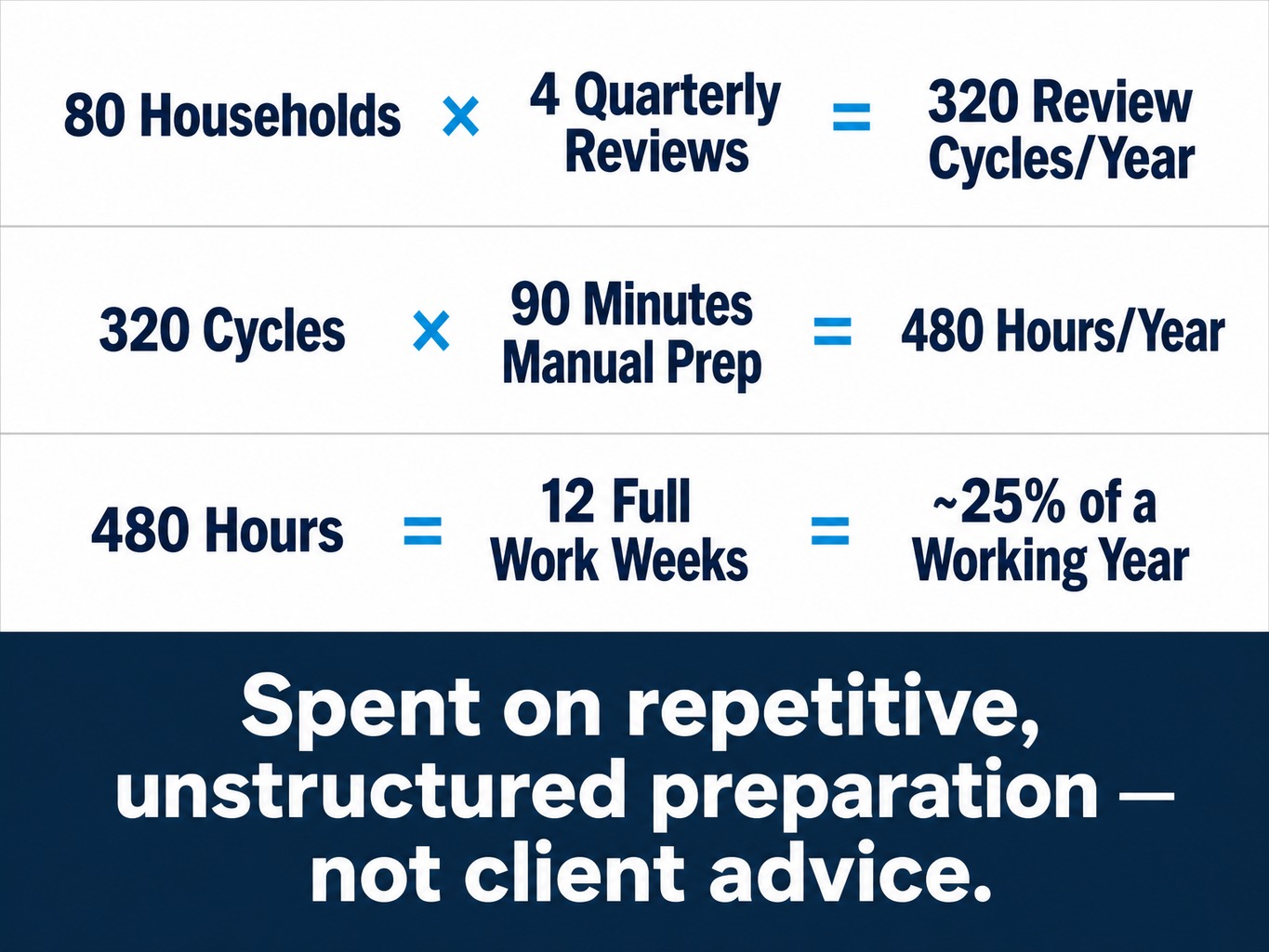
The hidden math behind financial advisor time management bottlenecks.
Read more: Operational Visibility for Wealth Management Growth | VRGL
5 Decisions That Compound Financial Advisor Capacity
The following five decisions are not a menu of individual tactics. They are sequential choices that build on each other, creating a system of work. Each one targets a different layer of the preparation-to-presentation workflow, and their compounding effect comes from implementing them together.
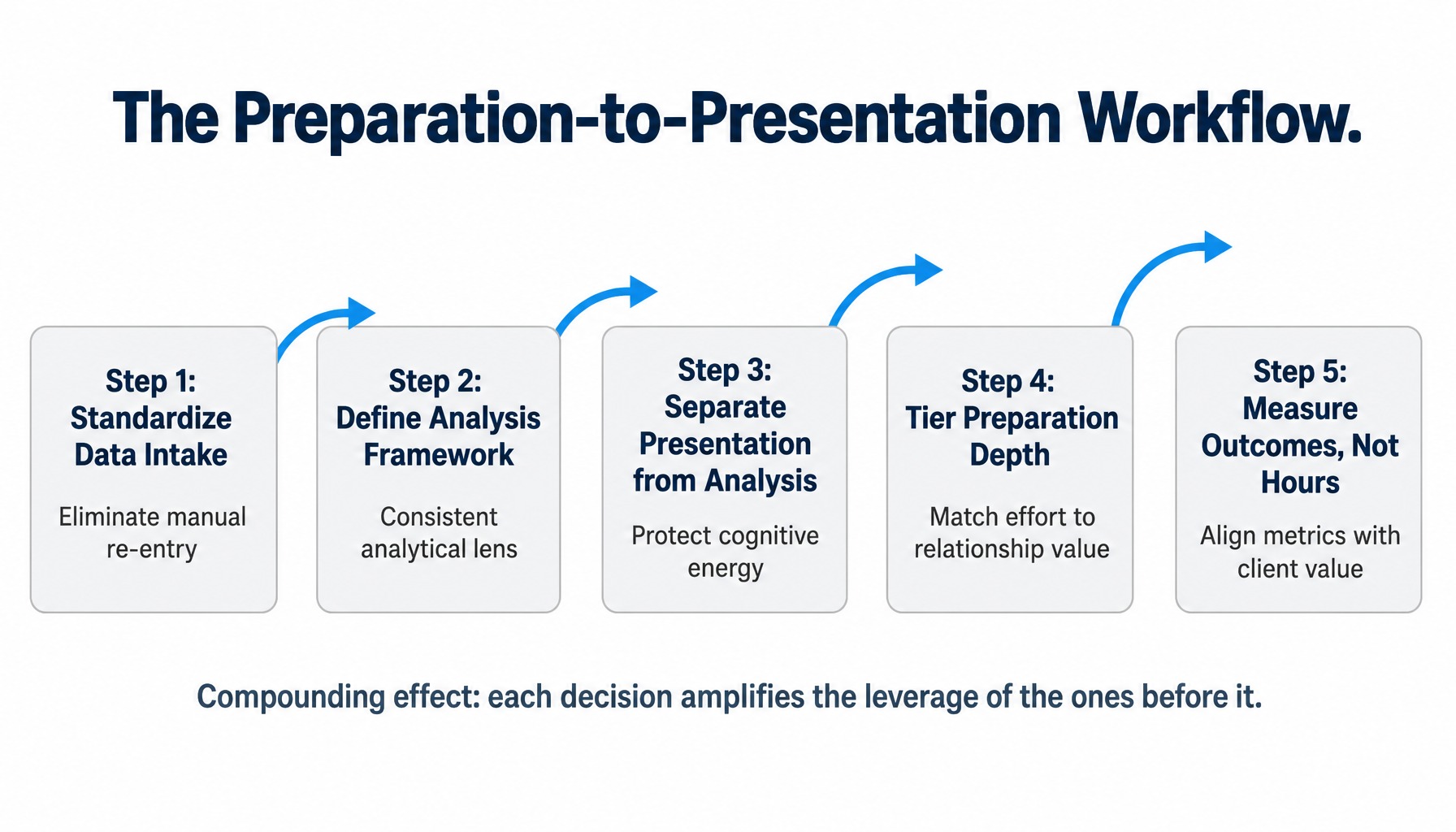
Five sequential decisions that turn preparation into a scalable system.
Decision 1: Standardize Your Data Intake Instead of Reinventing It Every Time
A common time-consuming, error-prone step in advisors' preparation workflow is getting client and prospect data into a usable format. For most firms, this process is entirely ad hoc.
Imagine a prospect brings in statements from two different custodians and a 401(k) provider. The typical workflow involves an advisor or paraplanner manually entering holdings into a spreadsheet or a tool like MoneyGuidePro or RightCapital. They cross-reference tickers, hunt for missing cost basis information, and reconcile totals against statement summaries. This can easily take 30 to 90 minutes per case. The failure mode is not just the time drain; it's the inconsistency. When data intake is manual, the quality of all downstream analysis depends entirely on who did the data entry and how carefully they worked that day.
Contrast this with a standardized intake process. This means having a defined, repeatable method for converting investment statements into structured data that can feed directly into analytics and proposal systems without manual re-entry. By designating a specific case prep block on the calendar and using technology for automated statement extraction, firms can batch this work and reduce a major source of friction in the preparation workflow. Platforms with this capability, like VRGL , are designed to turn a traditionally manual task into a much faster, more structured, and reconciled process, creating a cleaner foundation for everything that follows.
Decision 2: Define Your Analysis Framework So Every Review Tells the Same Story
Most advisors analyze portfolios competently, but they often do so inconsistently. The dimensions they choose to examine can shift depending on the client, the advisor's focus that day, or what they happened to notice first. This inconsistency is invisible to the advisor but tangible to the client, who may receive a different depth or format of analysis from one meeting to the next. The productivity cost is that every analysis starts from scratch conceptually, even when the tools are the same. Two clients with similar portfolios might receive very different review experiences simply because the process was not standardized.
Why Inconsistent Analysis Costs More Time Than It Saves
Ad hoc analysis feels faster in the moment but creates hidden drags on an advisor's time and energy. The advisor spends cognitive bandwidth deciding how to approach the review, second-guesses whether they have covered enough ground, and often over-prepares for some meetings while under-preparing for others. This is a classic case of decision fatigue applied to analytical choices. A solo advisor running 15 reviews in a week is making dozens of micro-decisions about analytical scope that could be reduced by a standard internal framework. This reactive approach consumes mental energy that would be better spent interpreting the results and preparing for the client conversation.
What a Repeatable Analytical Lens Looks Like in Practice
Defining a repeatable analytical lens means establishing a consistent internal framework for how the firm approaches portfolio reviews. The goal is not to prescribe what every advisor must analyze or recommend. It is to create a standard starting point so reviews are prepared through a common process, with room for advisor judgment and client-specific nuance. Firms may choose to standardize the categories they review, the sequence in which insights are surfaced, or the format used to present findings. Deeper or more customized analysis can still be layered on where appropriate. Applying consistency to the workflow behind the review, rather than dictating the substance of advice, is what creates operational leverage. This is where institutional-grade analytics platforms can support a more repeatable review process.
Decision 3: Separate Presentation Assembly from Analytical Thinking
One of the most significant and least-discussed productivity drains in advisory work is the context-switching between deep analytical thinking and shallow presentation formatting. An advisor finishes analyzing a portfolio, then immediately spends the next 30 to 45 minutes arranging charts in a slide deck, adjusting fonts, and hunting for the firm's latest disclosure language. This is not analytical work; it's production work. But because most advisors lack a system that separates them, they perform both jobs in the same sitting.
Consider an advisor who has just identified a meaningful diversification gap or fee issue in a prospect's portfolio. That's a moment of high-value insight. But instead of spending the next 20 minutes thinking through how to present that observation clearly and persuasively, they spend it resizing a pie chart and copying and pasting disclosures. The analytical momentum is broken. This is often where strategic clarity gives way to administrative drag. The prospect receives a document that looks adequate but may not communicate the insight as clearly as it could.
The fix is not "better design skills." It's separating the two workflows entirely. When analysis flows directly into a pre-built, branded proposal template with standardized formatting and firm-approved disclosure language, the advisor's job shifts from document assembly to narrative curation. This is the logic behind a paraplanner handoff protocol and the value of white-labeled proposal and reporting tools. They allow the advisor to stay in a state of focused work, concentrating on the story the data tells rather than the container it's delivered in.
Read more: How to Create Winning Proposals: 3 Tips for Advisors | VRGL
Decision 4: Build a Client Segmentation Model That Governs Preparation Depth, Not Just Meeting Frequency
A robust client segmentation model can govern not just how often a firm meets with each client segment, but how preparation is operationalized for different types of relationships. Most segmentation models in wealth management stop at meeting frequency.
A-B-C-D client tiering is common practice, but its operational value often comes from defining how preparation workflows, presentation formats, and review depth are organized across client segments. An advisor with 120 households who prepares the same 12-page review for every relationship may be applying the same workflow regardless of complexity, service model, or meeting objective. This can create a capacity ceiling because preparation workflows do not scale well when every case is handled the same way.
Why Meeting Cadence Alone Is an Incomplete Segmentation Model
A calendar-based segmentation model addresses only one dimension of advisor capacity: scheduled meeting time. The preparation work behind each meeting often remains unchanged across client types because the firm has not differentiated the workflow itself. An advisor who meets with one segment less frequently but still uses the same preparation process each time has reduced calendar volume, but not necessarily operational effort.
How to Tier Preparation Depth Without Reducing Quality
A more effective approach is to tier the operational workflow behind the review. For example:
- One segment may receive a more customized presentation format for complex planning or transition conversations.
- Another may receive the firm's standard review package with a consistent set of visuals and talking points.
- A third may be served through a more streamlined report format that still aligns with the firm's chosen review process.
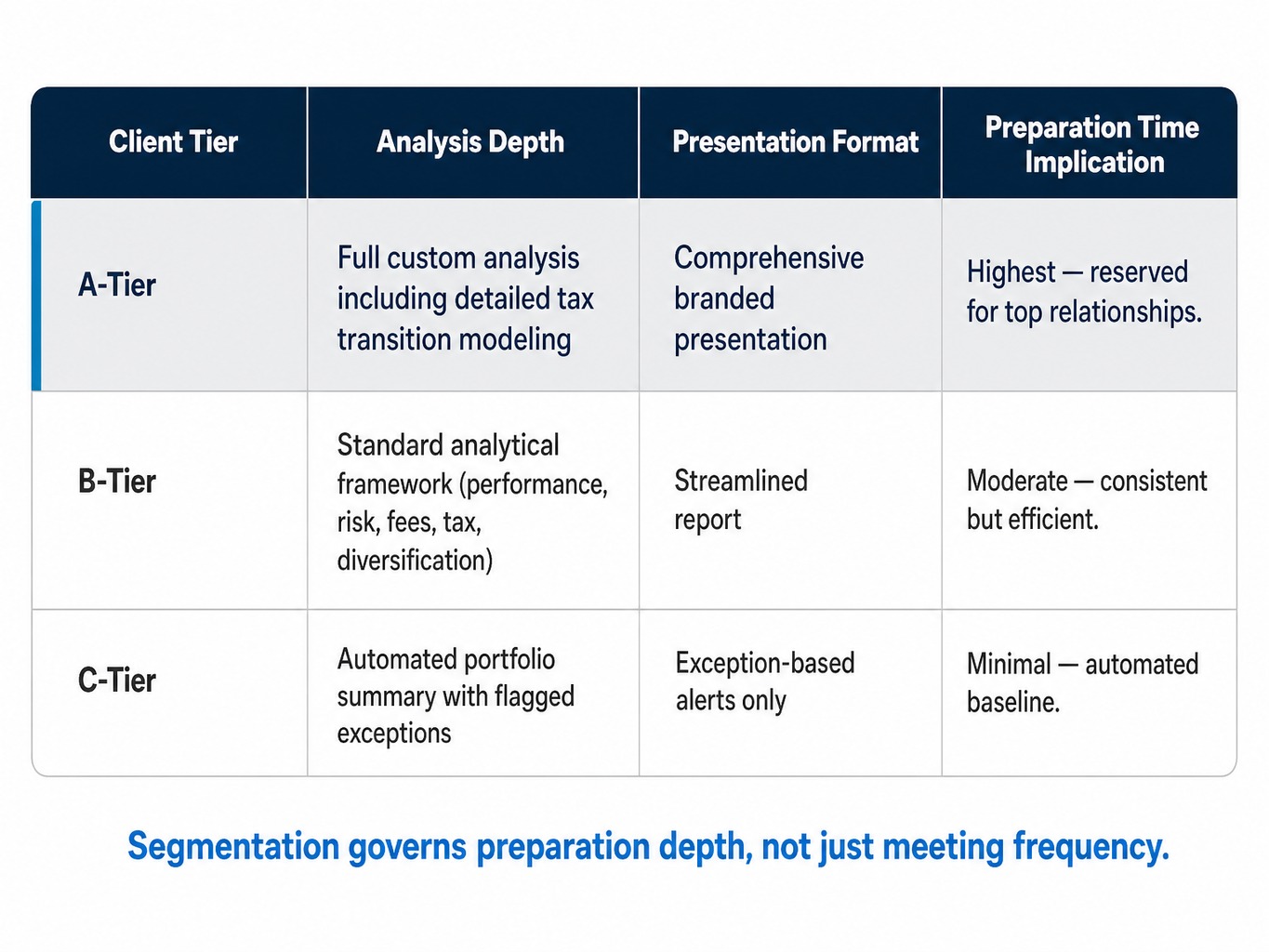
Tiered preparation is the key to scaling financial advisor productivity.
This is not about setting different standards of care. It is about aligning preparation effort, report format, and internal workflow to the needs and complexity of different client relationships while maintaining consistency within the firm's service model. Supported by model libraries and configurable report templates, this kind of segmentation can create operational leverage without prescribing how advice should be delivered.
Decision 5: Measure Productivity by Outcomes Delivered, Not Hours Worked
The default productivity metrics in many advisory firms, such as revenue per advisor or clients per staff member, can incentivize volume more than workflow quality. An advisor who serves 150 households with generic annual reviews may look more "productive" by these measures than one who serves 80 households with deeper, more differentiated preparation. Yet the second advisor may be contributing to a stronger client experience and a more durable operating model. The point is not that one approach always leads to better business results, but that traditional metrics can miss important differences in how value is delivered.
This disconnect becomes clear when a firm owner reviews their T-12 revenue and realizes their highest-grossing advisor also has the lowest client satisfaction scores. The metrics rewarded activity, and the advisor delivered it, but quality and client experience diverged.
A better approach is to measure productivity by outcomes delivered. This means shifting the practice management dashboard to track metrics like:
- Number of recommendations or review insights presented per meeting cycle.
- Percentage of clients who have received a formal proposal or review package in the last 12 months.
- Average time from a prospect meeting to a delivered proposal.
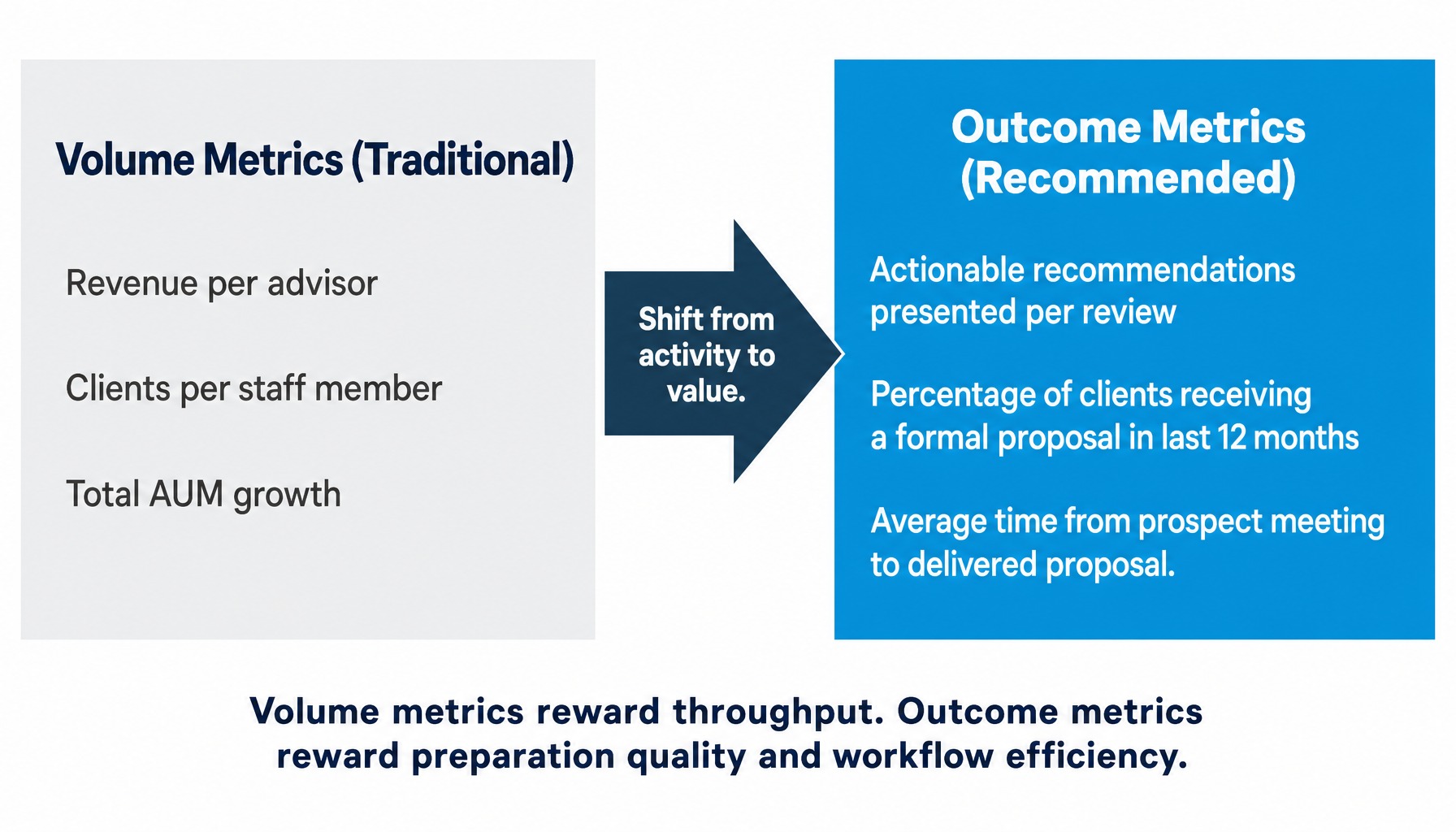
Measuring outcomes, not hours, aligns financial advisor time management with value.
These metrics can help firms evaluate preparation quality and workflow efficiency rather than raw throughput alone. A revenue-per-hour analysis may still be useful, but it becomes more informative when paired with measures that reflect the consistency and timeliness of client-facing deliverables. Measuring the right things can support better alignment between advisor activity, client experience, and long-term firm growth.
How VRGL Supports the Work Between Meetings
The five decisions outlined above require a system of work that connects data intake to analysis to presentation without forcing advisors into a rigid, one-size-fits-all workflow. This is precisely what VRGL's platform is designed to support. It provides the configurable infrastructure to make these decisions operational rather than just aspirational.
- Standardized Intake: VRGL's automated Statement Extraction addresses Decision 1 by converting multi-custodian investment statements into structured, reconciled data in minutes, reducing a common manual bottleneck in preparation.
- Repeatable Analysis: The platform's institutional-grade analytics support Decision 2, enabling firms to apply a consistent analytical lens across portfolio reviews without dictating the advisor's recommendations.
- Separated Presentation: VRGL's white-labeled proposals and reports directly address Decision 3. With standardized templates, version control, and firm-governed presentation workflows, advisors can focus on curating the client story, not assembling the document.
- Tiered Preparation: With configurable report outputs and access to a firm's model library, VRGL helps firms execute Decision 4, matching preparation workflows and presentation formats to different client segments.
- Outcome Visibility: By creating a consistent path from data to presentation, VRGL provides the firmwide visibility needed for Decision 5, helping leaders understand where preparation is efficient and where it is not.
VRGL is the technology layer that helps firms execute the work behind advice with more consistency and less friction.
See how VRGL turns preparation into a repeatable system request a demo.
Compounding Capacity, Not Hours
Improving financial advisor productivity is not about managing time better; it's about standardizing the preparation and presentation work that can consume a significant portion of non-meeting hours. Conventional advice, block your calendar, delegate admin, segment clients by meeting frequency, addresses the visible, scheduled portion of an advisor's work. The five decisions in this article target the less visible portion: the analysis, proposal assembly, and presentation work that determines whether a meeting creates value or just fills a time slot.
The advisors and firms that compound their capacity over the coming years are often the ones who do not simply find a way to work more hours. They are the ones who build a repeatable, scalable, and advisor-friendly system for the work that nobody sees but every client feels. Repeatable is productive.
Frequently Asked Questions
What is the surge meeting model and how does it affect advisor productivity?
The surge meeting model concentrates client reviews into defined multi-week cycles, followed by blocks for planning, prospecting, and operational work. In firms that use it, this approach can support productivity by batching preparation and reducing daily context-switching. Its effectiveness often depends on whether the underlying preparation workflow is consistent enough to handle compressed review periods efficiently.
How should a solo financial advisor structure their weekly calendar differently from a team-based advisor?
The main difference is usually operational capacity. Solo advisors often have fewer opportunities to offload preparation work, which can make repeatable workflows especially valuable. Team-based advisors may have more flexibility to distribute tasks across roles, but both models benefit when preparation, analysis, and presentation follow a more consistent process.
What tasks should a financial advisor always keep versus delegate to a paraplanner?
The answer varies by firm structure, service model, and supervisory framework. In general, many firms distinguish between tasks that rely heavily on advisor judgment and relationship context, and tasks that are more operational or process-driven. The broader productivity question is less about prescribing who must do what, and more about ensuring that repeatable work is handled through a clear and consistent workflow.
How do you conduct a time audit as a financial advisor?
One common approach is to review how time is currently divided across client-facing work, preparation, administrative activity, and business development. The goal is not to prescribe a single method, but to create visibility into where effort is being consumed, especially across fragmented preparation tasks that are easy to underestimate.
Can financial advisors improve productivity without hiring additional staff?
In many cases, yes. Workflow standardization is one of several ways firms can improve productivity without immediately adding headcount, especially when repetitive preparation work is creating avoidable friction. Hiring may expand capacity, but more consistent preparation and presentation workflows can also help firms make better use of the resources they already have.